Intro
A fault is pickleball’s full stop: one broken rule, rally over, no replays, no arguments that change it. Beginners commit dozens per game without realizing it — and most could be avoided by knowing exactly what counts. This guide lists every fault that matters, explains the edge cases that trip up even experienced players, and shows how faults actually played out in real pro matches.
Learn the list once, and you will stop donating points.
What a Fault Is — and What Happens Next
A fault is any rule violation that ends the rally immediately. The ball is dead the instant the fault occurs. What happens to the score depends on who faulted and the scoring format:
- Serving team faults → the serve passes. In doubles, the partner (second server) takes over; after both servers fault, the serve goes to the other team (side-out). In singles, the serve goes straight to the opponent.
- Receiving team faults → the serving team scores a point (in traditional side-out scoring — see [pickleball scoring]).
That asymmetry is why faults hurt the serving team more: a receiving team’s fault just gives away a point, but a serving team’s fault can end their entire scoring turn.
The Complete Fault List
Serve faults
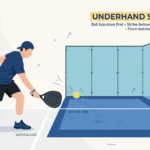
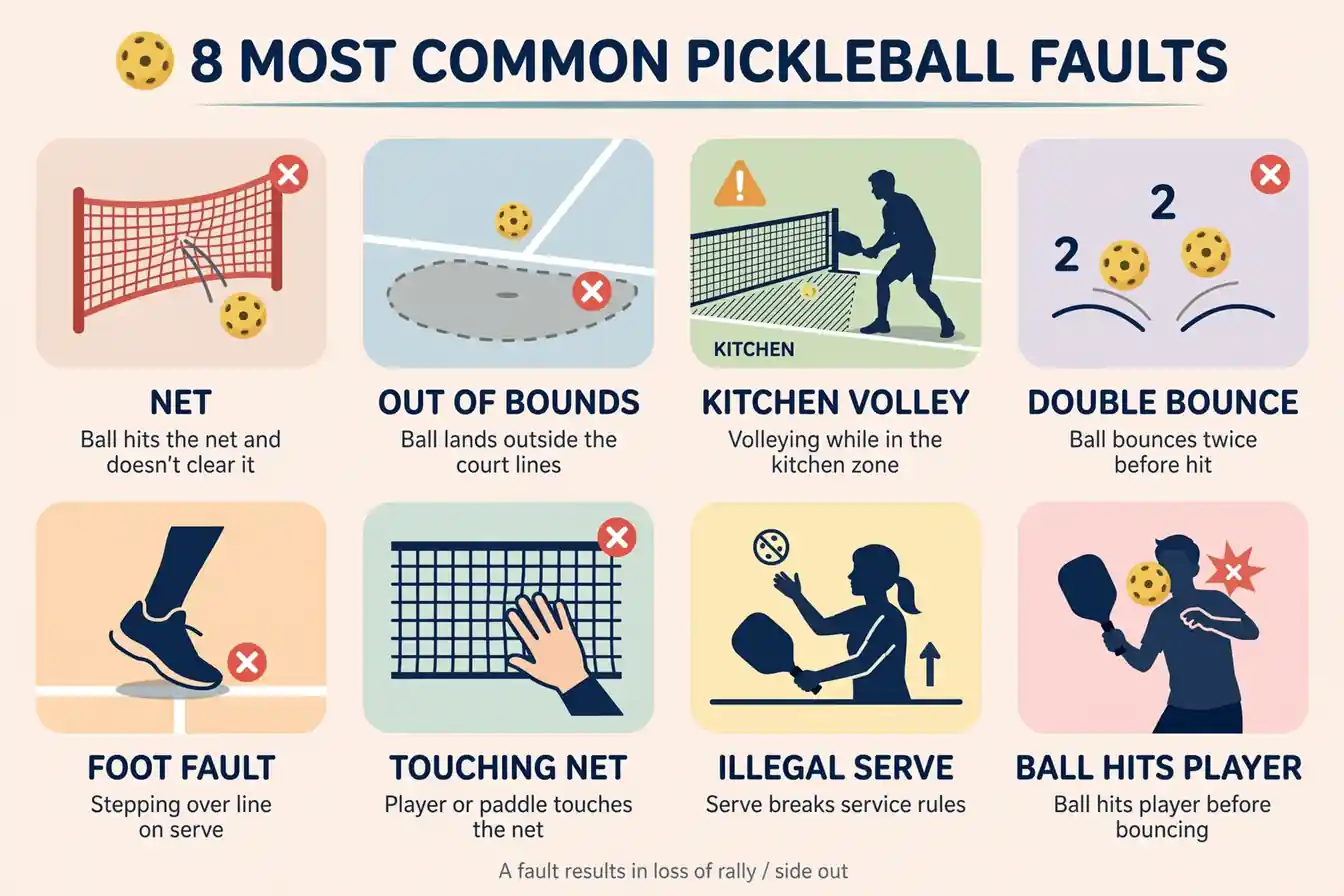
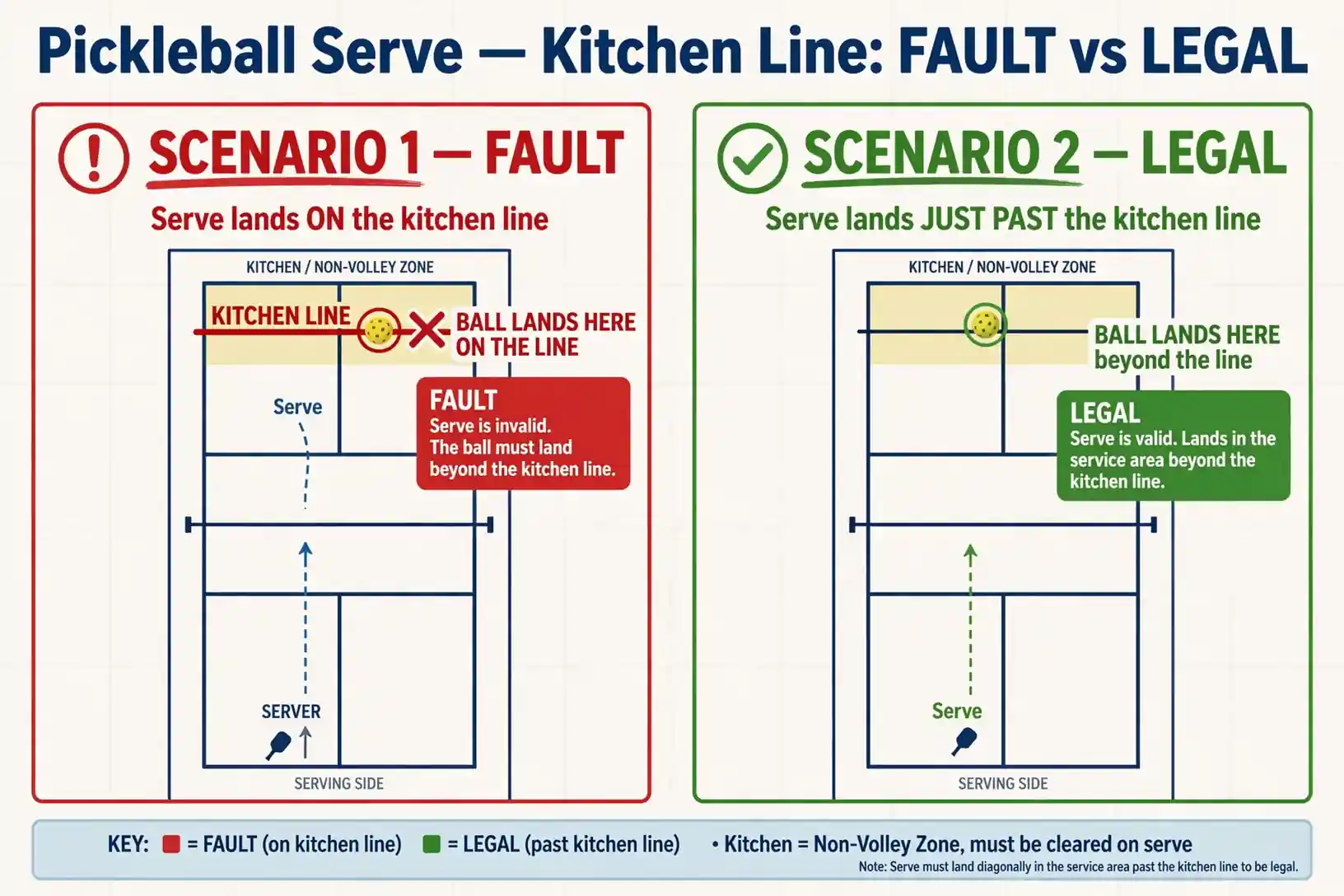
- Serve lands in the kitchen or on the kitchen line (the line counts as “out” on serves).
- Serve lands outside the correct diagonal service box.
- Serve fails to clear the net.
- Serve hits a permanent object (net post, fence, ceiling) before landing.
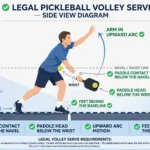
- Illegal serve motion: contact above the waist, paddle head above the wrist, no upward arc (see [pickleball serve rules]).
- Foot fault: touching the baseline/court or crossing line extensions at contact.
- Pre-spin on the ball release.
- More than one serve attempt (lets excepted).
Bounce faults

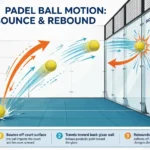
- Two-bounce rule violation (Rule 7.A): volleying the serve or the return before the required bounces — see [pickleball double bounce rule].
- Double bounce (Rule 7.E): letting the ball bounce twice on your side before returning it. (Wheelchair players are allowed three bounces.)
Kitchen (non-volley zone) faults
- Volleying while any part of you touches the kitchen or its line.
- Your momentum carrying you into the kitchen after a volley — even after the ball is dead.
- Anything you are wearing or carrying (hat, paddle sticker, sweatband) touching the kitchen during a volley.
- Touching your partner during their volley while you contact the kitchen (you are treated as one player).
- See the full breakdown: [pickleball kitchen rule].
Net and ball faults
- Hitting the ball into the net without it crossing over.
- Hitting the ball under the net or between the net and the net post.
- You, your clothing, or your paddle touching the net, net posts, or net system while the ball is live (Rule 7.G).
- A live ball striking you or anything you wear or carry — except your paddle hand below the wrist while that hand is holding the paddle (Rule 7.H). A ball off your forearm is a fault; a ball off your paddle hand below the wrist is play on.
- Catching or stopping a live ball before it lands (Rule 7.I) — never grab a ball you think is going out; let it bounce and be out instead.
- A live ball hitting a permanent object (ceiling, wall, fence) before bouncing on the court (Rule 7.J). Indoors, know your venue’s ceiling rule before playing.
Conduct faults
- Deliberately distracting an opponent (shouting mid-swing, waving arms) can be faulted.
- Technical warnings for profanity or abuse; a second technical warning costs a point, and accumulating them can forfeit a match (see the case studies).
Edge Cases Most Guides Miss
The paddle-hand rule. Your paddle hand, below the wrist, is legally part of the paddle while gripping it. Ball hits your knuckles on a volley? Play on. Ball hits your wrist or forearm? Fault. Switching hands mid-point with both hands on the paddle? Still covered — either hand below the wrist is legal.
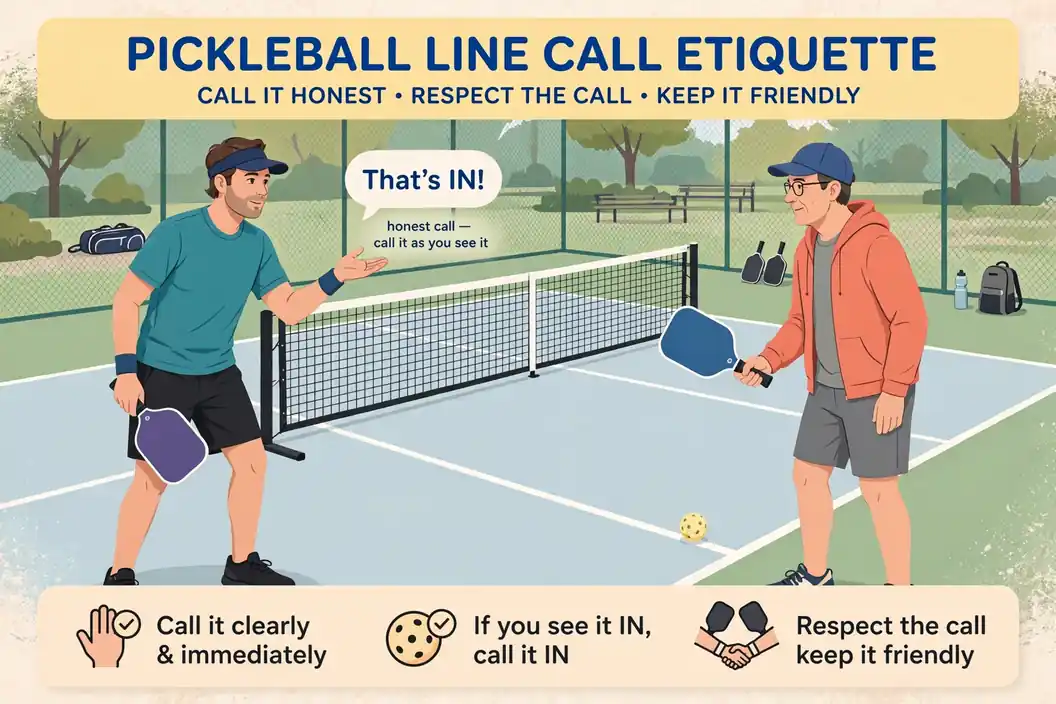
Conflicting line calls. In doubles without a referee, if you call a ball “out” and your partner calls it “in,” the ruling is in — doubt always favors the opponent. You cannot overrule your partner’s “in” call.

The ball is “in” unless you are sure. If you cannot clearly see space between the ball and the line, it is in. Benefit of the doubt goes to your opponent — that is not just etiquette, it is the standard.
Catching a ball that was flying out. Do not do it. The moment you catch a live ball, you have committed a fault (Rule 7.I) — even if it would have landed out. Let it land.
The net cord is your friend (usually). A shot that clips the net cord and drops over is legal and play continues. Only the serve has special handling (a legally-landing netted serve is replayed as a let).
Distraction vs. communication. Calling “mine!” or “bounce!” to your partner is legal communication. Shouting as your opponent swings is a distraction fault. Intent and timing decide.
Line Calls: Who Calls What
In rec play there is no referee — players call lines on their own side of the court:
- A ball touching any line is IN — lines are part of the court.
- The one exception: on a serve, a ball landing on the kitchen (NVZ) line is a fault.
- Make “out” calls promptly and clearly. Late calls breed arguments.
- Never ask spectators to make calls for you.
- If you did not clearly see it out, it was in.
Why Does This Rule Exist?
Faults are not punishments — they are the boundaries that make the game a game. Every fault rule answers the question “what would players exploit without it?” No kitchen-volley fault, and tall players camp the net smashing everything. No double-bounce fault, and rallies never develop. No distraction rule, and gamesmanship replaces skill.
The conduct rules deserve special attention. Pickleball’s culture was built on self-officiated rec play — players calling faults on themselves. Technical warnings and point penalties exist because the sport is now professional, televised, and heated. The fault system scales from a friendly park game (honor system) to a pro final (referees, replay, penalties) without changing a word. That is rare in sports, and it is why learning faults properly matters at every level.
What-If Scenarios
My hat falls off mid-volley and lands in the kitchen? Fault. Anything you wear or carry counts as part of you during a volley.
I volley, regain my balance, and THEN my paddle drops into the kitchen? This exact situation was clarified in a widely discussed pro ruling (involving Dekel Bar): once the “act of volleying” — swing, follow-through, momentum — has fully ended and balance is regained, entering the kitchen is legal. The key word is momentum: if you are still falling forward, it is a fault.
The ball hits the net post and drops in? On any shot except the serve, if a live ball hits the net post and lands in bounds, play continues — it is legal. (On a serve, hitting the post is a fault.)
My opponent’s shot hits me while I am standing out of bounds? Fault on you. A live ball that strikes a player is a fault regardless of where the player stands — which is why you never catch a ball you think is sailing out.
We both call it differently — I say out, partner says in? The ball was in. Conflicting calls resolve in the opponent’s favor, always.
Someone swears after missing — fault? A single outburst usually earns a technical warning from a referee, not a fault. A second technical warning costs a point. In rec play without a referee, it costs you friends, not points.
Case Studies: Real Matches, Real Rules
“It’s a dumb rule.” At Pickleball Slam 3 in Las Vegas, tennis legend Andy Roddick — playing Andre Agassi for a $1 million prize — returned a shot while standing inside the kitchen. The volley violation was called, the point lost, and Roddick vented: “No no buddy, it’s a dumb rule.” The event’s own broadcast mocked him: not one but two feet in the kitchen. It is the most-watched kitchen fault in the sport’s history, and the perfect lesson: even elite athletes from other racket sports forget that in pickleball, where you stand when you volley matters as much as the shot itself.
The line call with no replay. At the PPA Vietnam event in April 2026, Hoang Nam Ly faced Christian Alshon in singles. On match point at 11–10, Alshon hit a serve return that Nam Ly called out. The problem: the match was on Grandstand Court, where video replay was not available. Alshon believed the ball was inside the line; the call stood, and Nam Ly won. It is the nightmare scenario every rec player fears — and the reason the etiquette rule exists: if you are not sure it was out, it was in. On match point, “not sure” should never end a match.
Net cord, tempers, and technicals. In a recent PPA singles final, Chris Bellamy’s backhand clipped the net on its way over against Hunter Johnson. No initial ruling was made; Bellamy was awarded the point to go up 9–3. Johnson challenged, believing the ball hit the net post (which would make it out). Review showed net cord, not post — legal shot, call upheld. Already carrying a technical warning, Johnson’s unsuccessful appeal without timeouts available drew a second technical warning — an automatic point penalty, giving Bellamy match point at 10–3, which he converted for his first PPA title. Two lessons in one match: know the difference between the net cord (play on) and the net post (fault/out), and know that in pro play, arguing calls has a formal price.
FAQ
What is the most common fault in pickleball? For beginners, the two-bounce violation (volleying the serve or return too early) and kitchen volleys. For all levels, balls hit out of bounds and into the net.
Does a fault always give the other team a point? No — only if the receiving team faults (in side-out scoring). If the serving team faults, they lose the serve, not a point.
Can you get a fault for something your partner does? Yes — if you are touching your partner during their volley and contact the kitchen, you are treated as one player.
Is there a fault for a bad line call? Not a formal fault in rec play — but deliberately dishonest calling violates the sport’s code of conduct and will get you uninvited from games fast.
What happens if the ball breaks mid-rally? Play is stopped and the rally is replayed — a broken ball is not a fault on either side.
Do faults work the same in rally scoring? The definitions of faults are identical; only the consequences differ, since every rally scores a point in rally formats (see [pickleball rally scoring]).
Key Takeaways
- A fault ends the rally instantly — no replays, no do-overs.
- Serving team faults lose the serve; receiving team faults give away a point.
- Know the edge cases: paddle hand below the wrist is legal, conflicting calls go to “in,” never catch a live ball.
- Lines are in — except the kitchen line on a serve.
- Momentum has no time limit: if your volley carries you into the kitchen, it is a fault even after the ball is dead.
- In rec play, honest calling is the whole system. When unsure, play on.
Keep Reading
- Pickleball Rules for Beginners
- Pickleball Serve Rules: Complete Guide
- The Kitchen Rule in Pickleball: Non-Volley Zone Explained
- Pickleball Double-Bounce Rule Explained
Keep Reading