Intro
Badminton is one of the fastest racket sports in the world, yet its rules are surprisingly beginner-friendly. This guide answers every new player’s questions: how scoring works, how to serve legally, where the shuttle can land, and what counts as a fault — all based on the official Laws of Badminton from the Badminton World Federation (BWF), the same rules used at the Olympics.
The basics: what you are trying to do
Two players (singles) or two pairs (doubles) face off across a net. You win a rally when the shuttle lands inside your opponent’s court, or when your opponent commits a fault. Every rally won = one point, no matter who served — this is rally scoring, the heart of modern badminton.
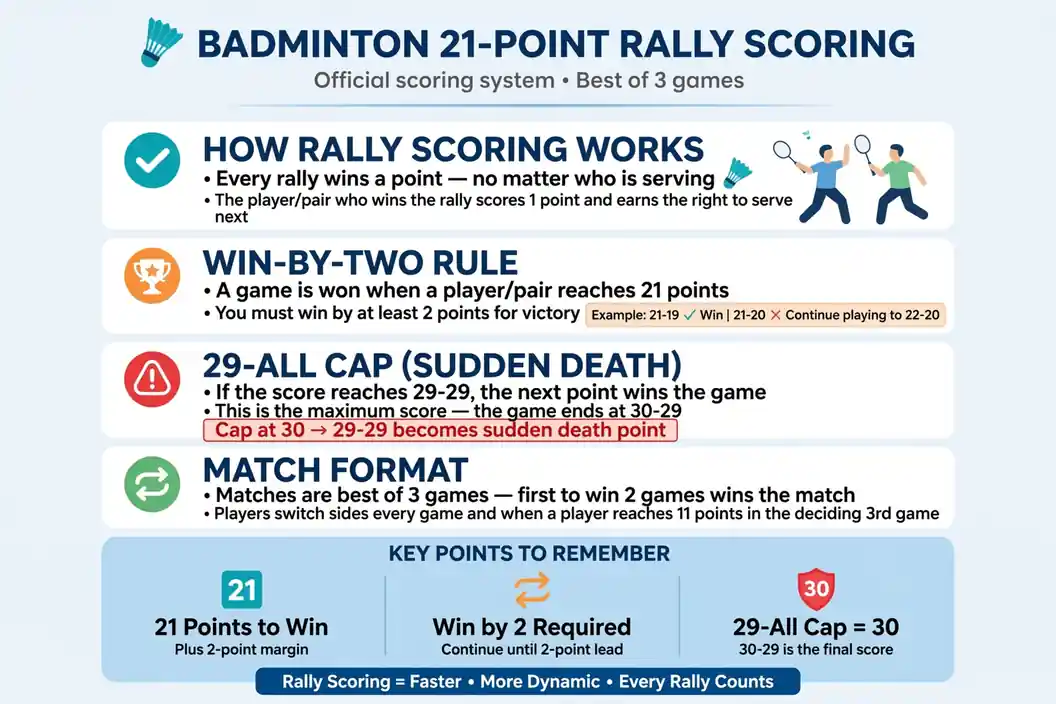
Scoring: the 21-point rally system
How points work
- Each rally is worth exactly one point, awarded to the side that wins the rally.
- It does not matter who served — unlike the old days, the receiver can score too.
- A game is won by the first side to reach 21 points.
Winning by two — and the 30-point cap
You cannot win a game 21–20. You must lead by two clear points:
- At 20–20, play continues until one side leads by two (for example 22–20).
- To stop games going on forever, there is a cap: if the score reaches 29–29, the side that wins the 30th point wins the game. 30–29 is the highest possible score.
So a game can end 21–15, 24–22, or 30–29 — but never 21–20.
Matches: best of three games
A match is the best of three games — the first side to win two games wins the match. The side that wins a game serves first in the next game.
A big change is coming in 2027

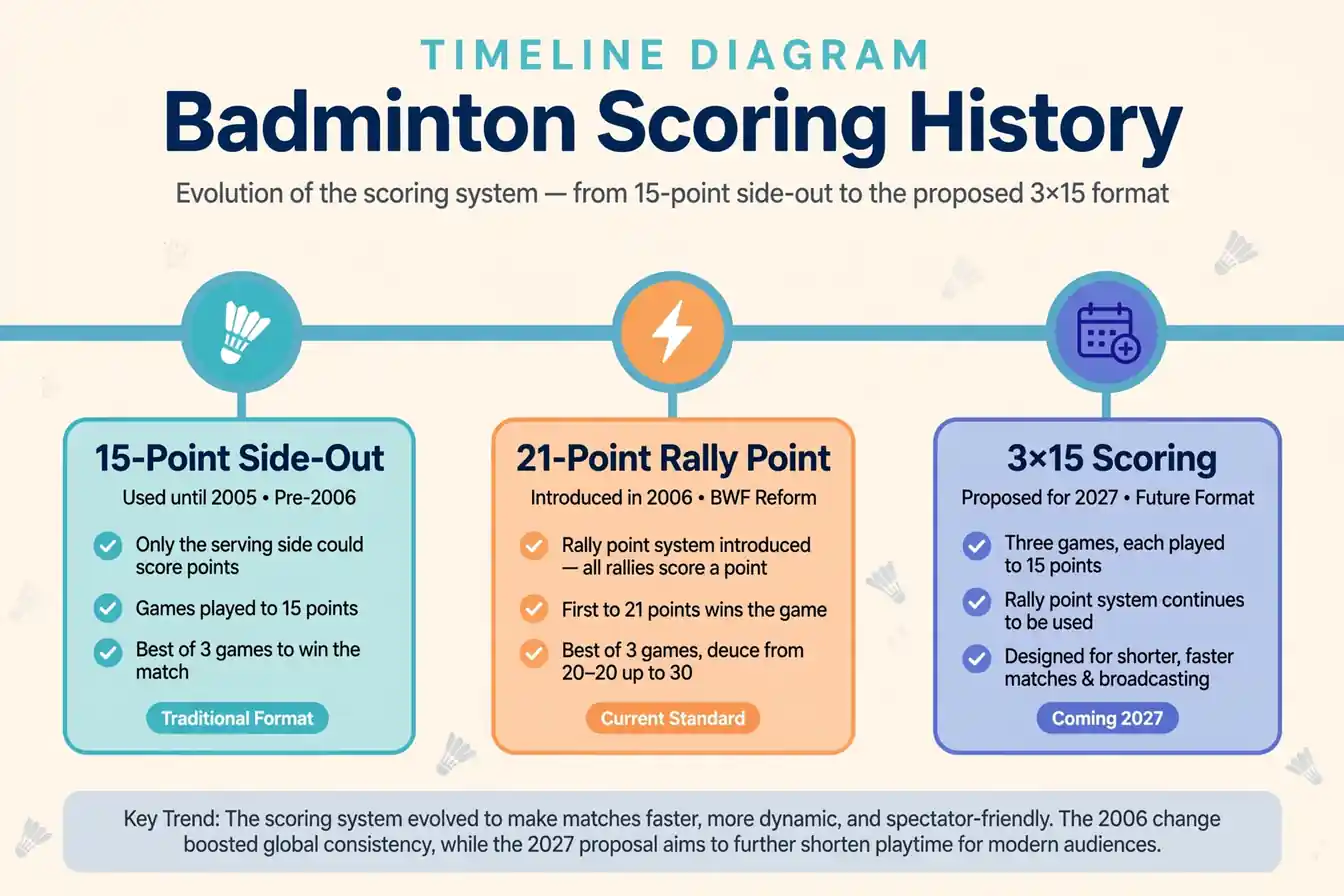
In April 2026, the BWF voted to replace 21-point games with a 3×15 system from 4 January 2027: best of three games, each game to 15 points (still win by two, with a cap at 21 — at 20–20 the next point wins). The mid-game break will move to 8 points. Until that date, 21-point scoring remains the standard everywhere — so learn it now, and you will adapt easily later.
For the full deep-dive, see our badminton scoring system guide.
Serving rules: the strictest part of the game
The serve has more rules than any other shot. Get these right and you will avoid the most common beginner faults.
The serve in six rules
- Diagonal only. Serve from your right service court when your score is even (0, 2, 4…), and from your left service court when it is odd (1, 3, 5…). The shuttle must land in the diagonally opposite service box. Our badminton serving rules guide shows the exact boxes.
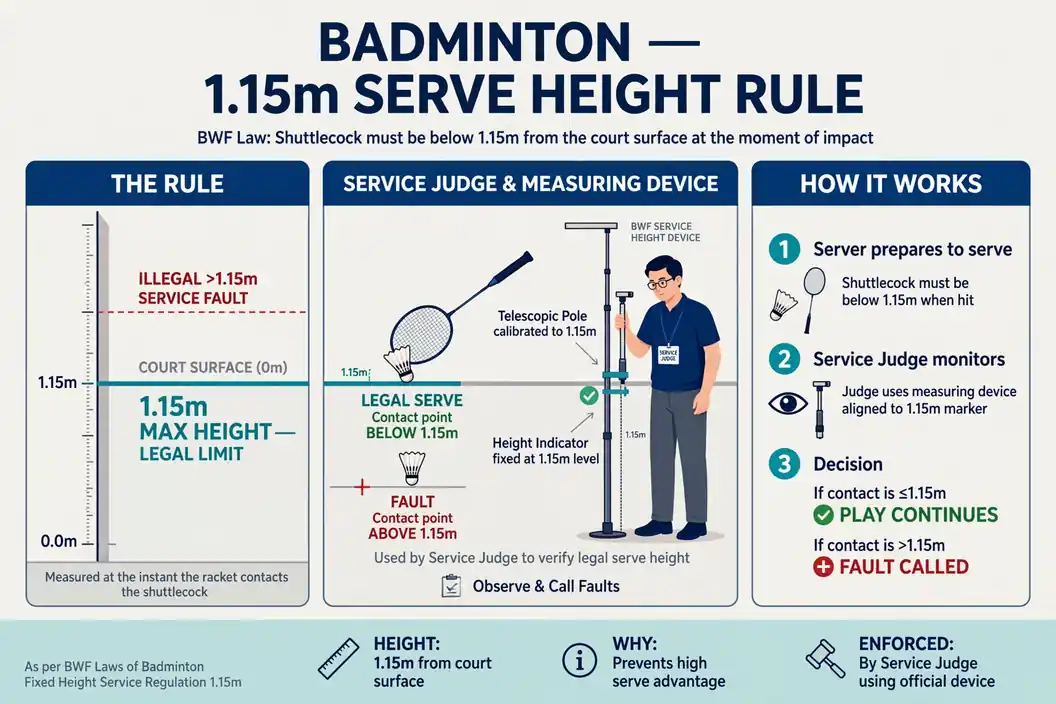
- Below 1.15 metres. The whole shuttle must be below 1.15 m from the court surface at the instant you hit it. In professional events a service judge enforces this with a measuring device. (Older guides say “below the waist” — that was the rule before 2018; the official law now uses the fixed 1.15 m height.)
- Hit the cork first. Your racket must strike the base (cork) of the shuttle first, in one continuous forward motion — no feinting or double-hitting the serve.
- Feet still and on the floor. Some part of both feet of the server and the receiver must stay in contact with the court, in a stationary position, from the start of the serve until the shuttle is hit. Stepping on a line is a foot fault.
- No delays. Once both sides are ready, the serve must be delivered without undue delay.
- A net-cord serve that lands in is GOOD. If your serve clips the net and drops into the correct service box, play continues — it is not replayed.
Singles vs doubles service courts
The service boxes differ (see our singles vs doubles rules comparison): singles serves must land between the short service line and the back boundary on the narrow court; doubles serves must land before the doubles long service line (0.76 m inside the back boundary) on the wide court. A deep serve that is “in” in singles is out in doubles.
The court and equipment: the key numbers
The official numbers (drawn to scale in our badminton court dimensions guide):
- Court: 13.40 m × 6.10 m (doubles); singles uses the 5.18 m width.
- Net: 1.55 m at the posts, 1.524 m at the centre; posts stand on the doubles sidelines even in singles.
- Lines: 40 mm wide; a shuttle touching a line is in. Short service line: 1.98 m from the net.
- Shuttle: 16 feathers, 4.74–5.50 g. Racket: max 680 mm long, 230 mm wide.
Faults and lets
Faults (you lose the rally)
- The shuttle lands outside the boundary lines.
- The shuttle hits the net and does not cross to the other side.
- You hit the shuttle twice in a row, or you and your partner hit it one after the other in doubles.
- You touch the net with your body, clothes, or racket while the shuttle is in play.
- You reach over the net and hit the shuttle on the opponent’s side (you may follow through over the net after hitting it on your side).
- You obstruct an opponent or deliberately distract them.
- A service fault: serve above 1.15 m, foot fault, wrong court, or not hitting the cork first.
Lets (replay the rally)
A let means the rally is replayed — nobody wins or loses the point:
- The shuttle gets caught on top of the net or breaks during play.
- The server serves before the receiver is ready.
- Play is interrupted by something outside the players’ control.
Match flow: intervals, ends, and officials
- Intervals: up to 60 seconds when the leading score reaches 11 in a game; up to 120 seconds between games.
- Change of ends: after every game, and in the decider when a side first reaches 11.
- Officials: at tournaments an umpire runs the match, a service judge watches serves, and line judges call in/out. In casual play, call your own lines honestly.
Why does this rule exist?
From Poona to Badminton House
Modern badminton began as Poona in British India in the 1860s–70s. British officers brought it to England, where it was played at a lawn party at Badminton House, Gloucestershire — the Duke of Beaufort’s estate — in 1873, giving the sport its name. The Bath Badminton Club wrote the first rules (1877), the Badminton Association of England formalised them (1893), and badminton became an Olympic medal sport at Barcelona 1992.
Why 21-point rally scoring? (2006)
For most of the 20th century, badminton used side-out scoring: only the serving side could win a point, with games to 15 (men’s singles and all doubles) or 11 (women’s singles). It had two problems. First, matches were unpredictably long — a game could drag on while the serve changed hands without the score moving. Second, it was hard to follow on television, because long scoreless passages killed the drama.
In 2006 the BWF replaced it with 21-point rally scoring: every rally wins a point, whoever served. Matches became shorter, tighter, and far easier to schedule and broadcast. Comebacks became possible from anywhere — losing 15–10 means nothing when every rally counts — and that is exactly why modern badminton feels so relentless.
Why change again in 2027?
The new 3×15 system (best of three games to 15, cap at 21) is the same logic applied again: shorter, more consistent match durations, high-pressure moments arriving earlier, and benefits for player recovery. The BWF’s membership approved it by the required two-thirds majority at the 2026 AGM in Horsens, Denmark. Scoring rules evolve with the sport’s audience — and beginners starting now will live through the change.
What-if scenarios
What if the score reaches 20–20? Play on until someone leads by two — 22–20, 25–23, whatever it takes (up to the 30-point cap).
What if it reaches 29–29? The next point wins the game. 30–29 is the final possible score.
What if my serve hits the net but lands in the box? Play continues. It is a legal serve, not a replay.
What if I am not sure whether to serve from the left or right? Check your own score: even = right court, odd = left court. At 0–0 you always start from the right.
What if my foot touches the line while serving? That is a foot fault — you lose the rally. Both feet must stay behind (not touching) the service court lines until the shuttle is struck.
What if the shuttle lands exactly on the line? In. Lines are part of the court they enclose.
What if I catch the shuttle on my racket instead of hitting it? That is a fault — the shuttle must be hit cleanly, not caught, carried, or thrown.
What if we disagree on a line call in casual play? Replay the rally as a let. In friendly games, goodwill beats one point.
Case studies: the rules in real matches
1. The 110-minute epic — Okuhara vs Sindhu, World Championships final 2017
The women’s singles final of the 2017 World Championships in Glasgow (27 August 2017) is the longest women’s singles final in the event’s history — a perfect showcase of rally scoring. Japan’s Nozomi Okuhara beat India’s P.V. Sindhu 21–19, 20–22, 22–20 in 110 minutes. The second game ended with a staggering 73-shot rally won by Sindhu, and the decider was tied 14 times before Okuhara took it 22–20 — the win-by-two rule keeping both players alive to the last rally. It was Japan’s first women’s singles world title.
2. Two match points saved — Lin Dan vs Lee Chong Wei, World Championships final 2011
At Wembley Arena, London, on 14 August 2011, China’s Lin Dan beat Malaysia’s Lee Chong Wei 20–22, 21–14, 23–21 in 81 minutes — saving two match points when Lee led 20–19 and 21–20 in the decider. Under rally scoring every rally was a knife-edge, and Lin’s defence at match point down turned the final. It was his fourth world title.
FAQ
How many points do you need to win a game of badminton? 21 points, and you must lead by two. At 20–20 play continues; at 29–29 the next point (the 30th) wins.
Can the receiver score a point in badminton? Yes. Badminton uses rally scoring: every rally awards one point to the winner, regardless of who served.
How high can you serve in badminton? The whole shuttle must be below 1.15 metres from the court surface when struck. The old “below the waist” description is outdated in the official laws.
What is a let in badminton? A rally that is replayed with no point awarded — for example if the shuttle breaks, gets stuck on the net, or the server serves before the receiver is ready.
Is the doubles court bigger than the singles court? The court is the same length (13.40 m). Doubles uses the full 6.10 m width; singles uses the narrower 5.18 m width between the inner sidelines.
How long is the break in a badminton game? Up to 60 seconds when the leading score reaches 11 points in a game, and up to 120 seconds between games.
When do players change ends? After each game, and in the deciding third game when one side first reaches 11 points.
Is badminton changing its scoring system? Yes — from 4 January 2027 the BWF is moving to best-of-three games to 15 points (win by two, capped at 21). Until then, 21-point scoring is the standard.
Key takeaways
- Badminton uses rally scoring: every rally wins one point, whoever served.
- Games go to 21 points — you must win by two, and at 29–29 the 30th point wins.
- Matches are best of three games; the game winner serves first in the next game.
- Serves must be diagonal, with the whole shuttle below 1.15 m, the cork struck first, and both feet still — even score serves from the right, odd from the left.
- A shuttle on the line is in; touching the net or hitting twice is a fault; a broken shuttle or unready receiver means a let.
- From January 2027, the standard becomes 3×15 — but everything you learn about 21-point scoring transfers straight across.
Keep Reading
- Badminton Serving Rules: Complete Guide
- Badminton Court Dimensions and Net Height Explained
- How to Play Badminton: Complete Beginner Guide