Intro
Here is a scoring twist most beginners never hear about: for four years, professional pickleball did not use the scoring system you play at the park. Major League Pickleball awarded a point on every single rally, no matter who served. Then in 2025, the league abandoned it and went back to traditional scoring — with a brutally honest explanation.
This guide explains both systems side by side, tells the story of the biggest scoring experiment in the sport’s history, and answers the only question that matters for you: which one should you play?
Traditional (Side-Out) Scoring: The Standard
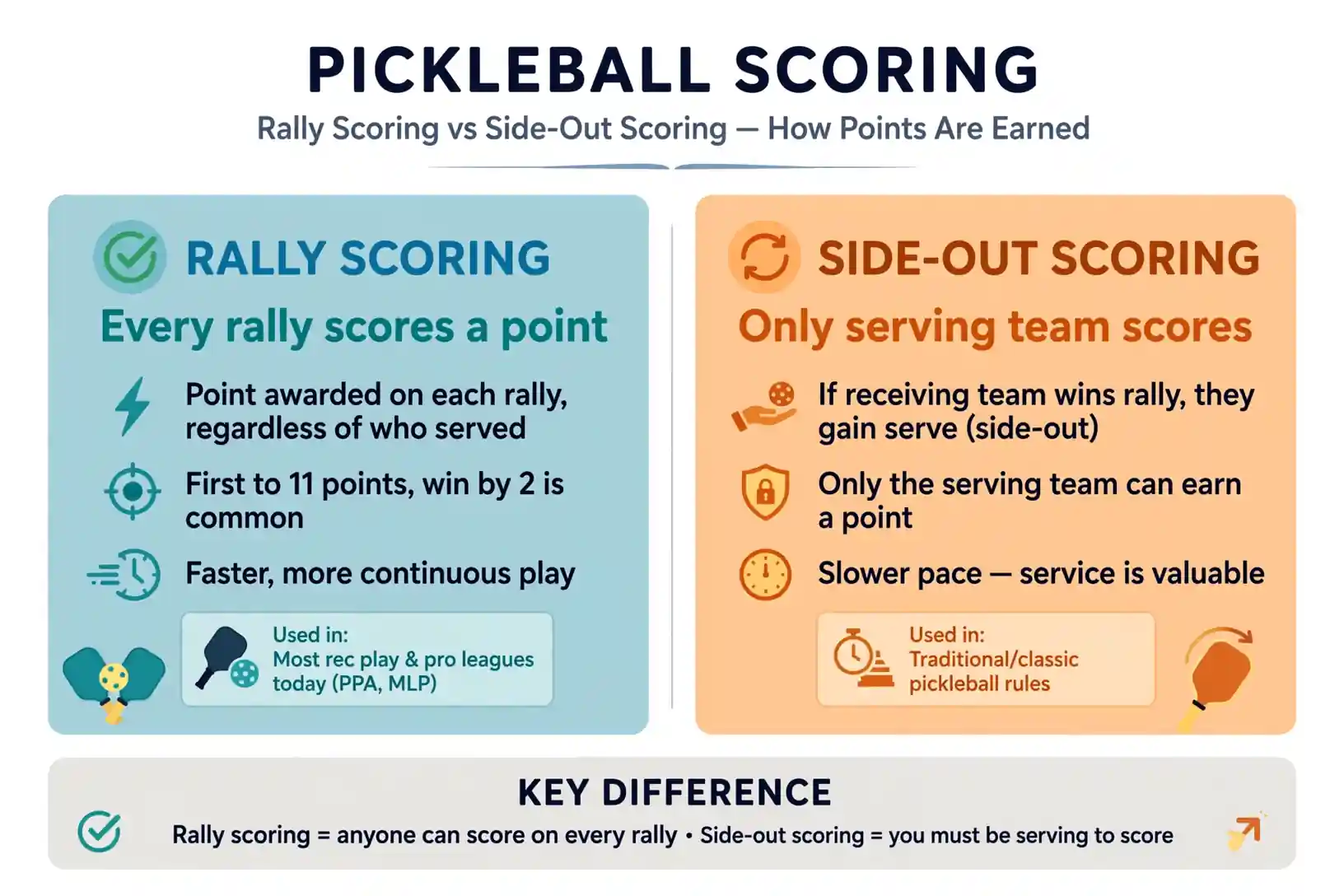
This is the scoring in the USA Pickleball rulebook, used in rec play, PPA Tour events, and almost every tournament on earth:
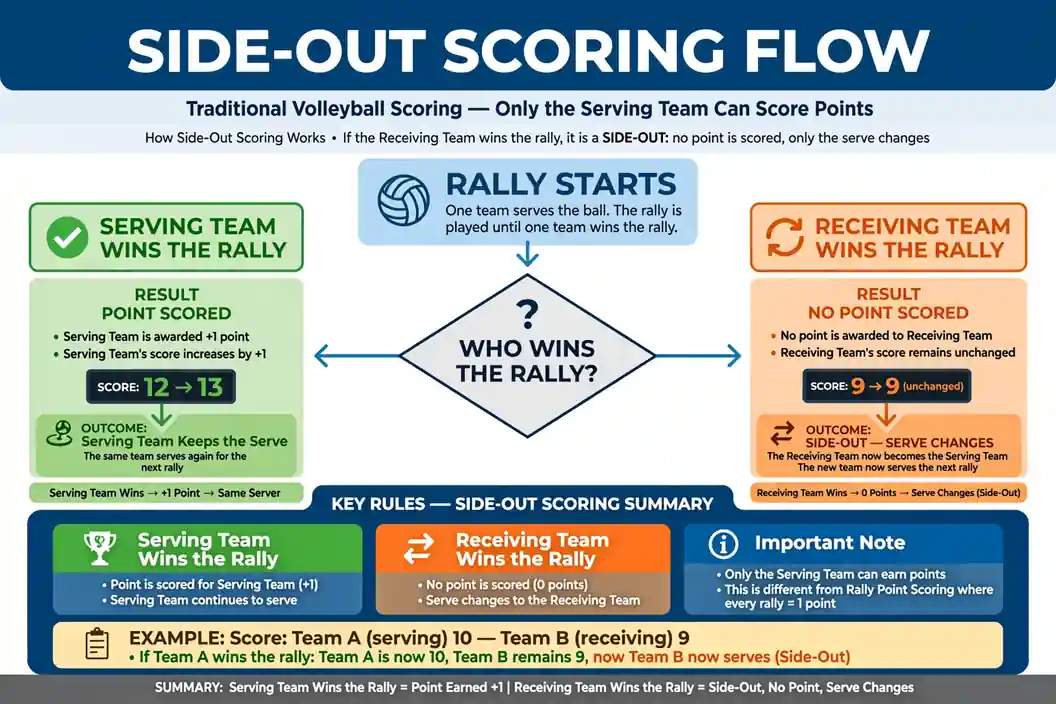
- Only the serving team can score. Win a rally while serving → +1 point. Win a rally while receiving → you earn the serve, but no point.
- Games to 11, win by 2. (Some tournaments use 15 or 21 — always win by 2.)
- The serve is therefore precious. Every point requires two steps: first win the serve, then hold it. A team down 8–3 can absolutely come back, because the scoreboard only moves on their serve.
Full mechanics: [pickleball scoring]. The key strategic consequence: momentum is not the same as points. You can dominate five straight rallies as the receiving team and gain zero points — you have only gained the chance to score.
Rally Scoring: The Challenger
Rally scoring flips the one big rule:
- Every rally scores a point, no matter who served. Win the rally → +1, period.
- Games are typically played to a higher target (MLP used 21, win by 2) to keep match length similar.
- The serve still rotates, but it is just a way to start the rally — it carries no scoring privilege.
The effects are immediate: no more scoreless comebacks-in-waiting. Every rally matters on the scoreboard, leads change constantly, and matches run on a predictable clock — which is exactly why television loves it. Badminton and volleyball both switched to rally scoring for the same broadcast reasons.

The strategic shift is subtle but real: since receiving-team rallies now score, there is no “earn the serve first” phase. Aggression pays off earlier, and the slow build of side-out scoring disappears.
Side by Side
| | Side-out (traditional) | Rally scoring | |—|—|—| | Point on every rally? | No — only serving team scores | Yes — winner of the rally scores | | Typical game target | 11, win by 2 | 21, win by 2 | | Comebacks | Slow-burning; need serve + holds | Instant; every rally counts | | Match length | Variable, can swing wildly | More predictable | | Serve’s value | Huge — it is the only way to score | Neutral — just starts the rally | | Where you’ll meet it | Rec play, PPA, USAP rulebook | MLP DreamBreaker, some exhibitions |
Neither is “more correct.” They produce different sports: side-out rewards patience and the ability to hold serve under pressure; rally scoring rewards winning the rally in front of you, every time.
The Great MLP Experiment (2021–2025)
Major League Pickleball launched with rally scoring as its identity. Every doubles game: rally scoring, fast matches, TV-friendly pacing. For four seasons, the pro team league played a visibly different sport from the PPA Tour and from every park in America.
Then came the 2025 season — and a U-turn. MLP announced that doubles matches would switch to traditional side-out scoring (one game to 11, win by 2), keeping rally scoring only for the DreamBreaker, its singles-rotation tiebreaker (to 21).
The league’s explanation was disarmingly honest. An MLP official said they were “tired of having to explain rally scoring to a pickleball-watching public that, 99% of the time, plays side-out scoring.” Translation: the sport’s own fans found the pro product confusing, because it did not match the game they play. Tradition beat television.
The 2025 overhaul went further: rosters expanded to six players (three men, three women), the schedule grew to 14 weeks with 25 regular-season matches per team, and the league rebranded as MLP presented by DoorDash in the largest sponsorship deal in its history. But the scoring switch was the headline — the moment pro pickleball admitted the park was right.
The DreamBreaker: Rally Scoring’s Last Stand
Rally scoring did not disappear entirely — it survives in the DreamBreaker, MLP’s tiebreaker, and it is worth understanding because it is genuinely thrilling:

- Played when a team match is tied, as a singles rotation: players from each team rotate in every four rallies.
- Rally scoring to 21, win by 2.
- The freeze: at game point, scoring freezes — the leading team must win the final rally on their serve (“win on serve”). No cheap finish on a receiving rally.
The DreamBreaker is rally scoring at its best: every rally matters, the scoreboard never sleeps, and the freeze manufactures maximum drama. It is no accident the league kept it — it is the most TV-friendly ten minutes in the sport.
Why Does This Rule Exist?
Side-out scoring exists for the same reason as the two-bounce rule and the kitchen: to make the serve a beginning, not a weapon. By making points available only on serve, the traditional game forces players to earn the right to score, then defend it. That two-stage pressure — first get the serve, then hold it — is the psychological engine of classic pickleball.
Rally scoring exists for the opposite master: the audience. Predictable match lengths, a constantly moving scoreboard, no dead stretches where nothing scores. Every sport that chased television eventually flirted with it. Pickleball’s flirtation lasted four years and ended with the league choosing its players over its producers — a decision almost no other sport has made.
A Tale of Two Match Points
To feel the difference, imagine match point under each system. Score: 10–9.
Side-out scoring, you are serving at 10–9. You win the rally — game over, you win 11–9. But lose it, and the serve passes with zero damage done: still 10–9, and now they must win a rally just to earn the serve, then hold it to tie. Your match point cost them nothing but the serve. The pressure is entirely on holding.
Rally scoring, you lead 20–19. You win the rally — game over. You lose it — it is 20–20, and the next rally decides everything, no matter who serves. There is no “earn the serve” buffer. Every single rally is match point for someone.
That is the whole debate in one image: side-out scoring makes the serve the drama; rally scoring makes every rally the drama. Traditionalists love the slow squeeze of the first; broadcasters love the constant jeopardy of the second. Now you know exactly what you are choosing when your group picks a format.
What-If Scenarios
Which scoring should my rec group use? Side-out, always. It is the official rulebook standard, it is what every tutorial teaches, and mixing systems causes endless confusion.
Can we try rally scoring for fun? Absolutely — many groups play rally-to-21 for faster games when courts are crowded. Just agree before the first serve, because the strategy changes.
Does the two-bounce rule still apply in rally scoring? Yes. Scoring format changes when points are awarded, not how rallies are played. Serves, faults, and the kitchen are identical.
Why 21 for rally scoring but 11 for side-out? Because every rally scores in rally formats, games would end too fast at 11. The higher target keeps match duration comparable.
What is “the freeze” exactly? In the DreamBreaker, when a team reaches game point (20), they cannot win on a receiving rally — the score “freezes” until they win a rally on their own serve.
Will rally scoring ever come back to pro doubles? Never say never — but the 2025 reversal suggests the sport has settled the debate for now: tradition won.
Case Studies: Real Matches, Real Rules
The tiebreaker that decided a championship. The 2024 MLP finals — Dallas Flash versus New Jersey 5s — could not have scripted a better advertisement for the DreamBreaker. The 5s took the women’s matches; the Flash answered in mixed doubles; the title came down to a rally-scoring DreamBreaker, and Dallas Flash took the championship. Under side-out scoring, that final set might have taken an hour. Under rally scoring, every rally moved the scoreboard, and a champion was crowned in minutes of unbearable tension. Whatever you think of rally scoring for everyday play, nobody who watched denies the DreamBreaker delivers.
The quote that ended an era. When MLP announced the 2025 switch back to side-out scoring, the official explanation — tired of explaining rally scoring to a public that “99% of the time plays side-out scoring” — was remarkable for its candor. Leagues almost never admit a format failed with fans. Within one season, pro team pickleball realigned with the park game, and the four-year rally-scoring experiment became a historical footnote with one survivor: the DreamBreaker. If you ever play rally scoring at your club, you are playing a piece of that history.
FAQ

Is rally scoring in the official USA Pickleball rulebook? No. The rulebook uses side-out scoring exclusively; rally scoring has only appeared in pro exhibitions and MLP formats.
Does the PPA Tour use rally scoring? No — PPA events use traditional side-out scoring.
Which is better for beginners? Side-out. It is the standard, it teaches serve-holding pressure gradually, and every learning resource assumes it.
Why did badminton and volleyball switch to rally scoring permanently? Television and scheduling — the same reasons MLP tried it. Pickleball is the rare sport that tried it at the top level and walked it back.
Can a game end 11–0 under side-out scoring? Yes — if the serving team never loses a rally. Rare, but legal. (In rec play, it is customary to go easy long before that.)
What happens at 10–10 in an 11-point game? Play continues until someone leads by 2 — 12–10, 13–11, and so on. There is no cap.
Could side-out scoring ever disappear from pro pickleball? Unlikely now. The PPA never left it, and MLP’s 2025 return effectively reunified the pro game around the traditional system. The experiment’s legacy is the DreamBreaker, not a revolution.
Key Takeaways
- Side-out scoring (the standard): only the serving team scores; games to 11, win by 2.
- Rally scoring: every rally scores; typically played to 21, win by 2.
- MLP used rally scoring from launch, then switched back to side-out in 2025 — because fans found it confusing.
- The DreamBreaker keeps rally scoring alive: to 21, with the freeze, must win on serve.
- For your games: play side-out. It is the rulebook, the PPA, and 99% of players.
- The scoring debate is really about who the sport serves: players (tradition) or audiences (television). In 2025, the players won.
Keep Reading
- Pickleball Scoring Explained
- Pickleball Rules for Beginners
- Pickleball Singles vs Doubles Rules: What’s Different
- Common Pickleball Faults and How to Avoid Them
Keep Reading