Intro
You have heard the hype — the fastest-growing sport in America, 24.3 million players and counting — and now you are standing at the edge of a court wondering what to actually do. Good news: pickleball is famously the easiest racket sport to start. Most beginners rally within their first hour.
This guide takes you from zero: what to bring, what the court means, your first rally step by step, the five shots that matter, and the mistakes to skip. Read it, grab a paddle, and play today.
What You Need: Equipment
You need less than you think.
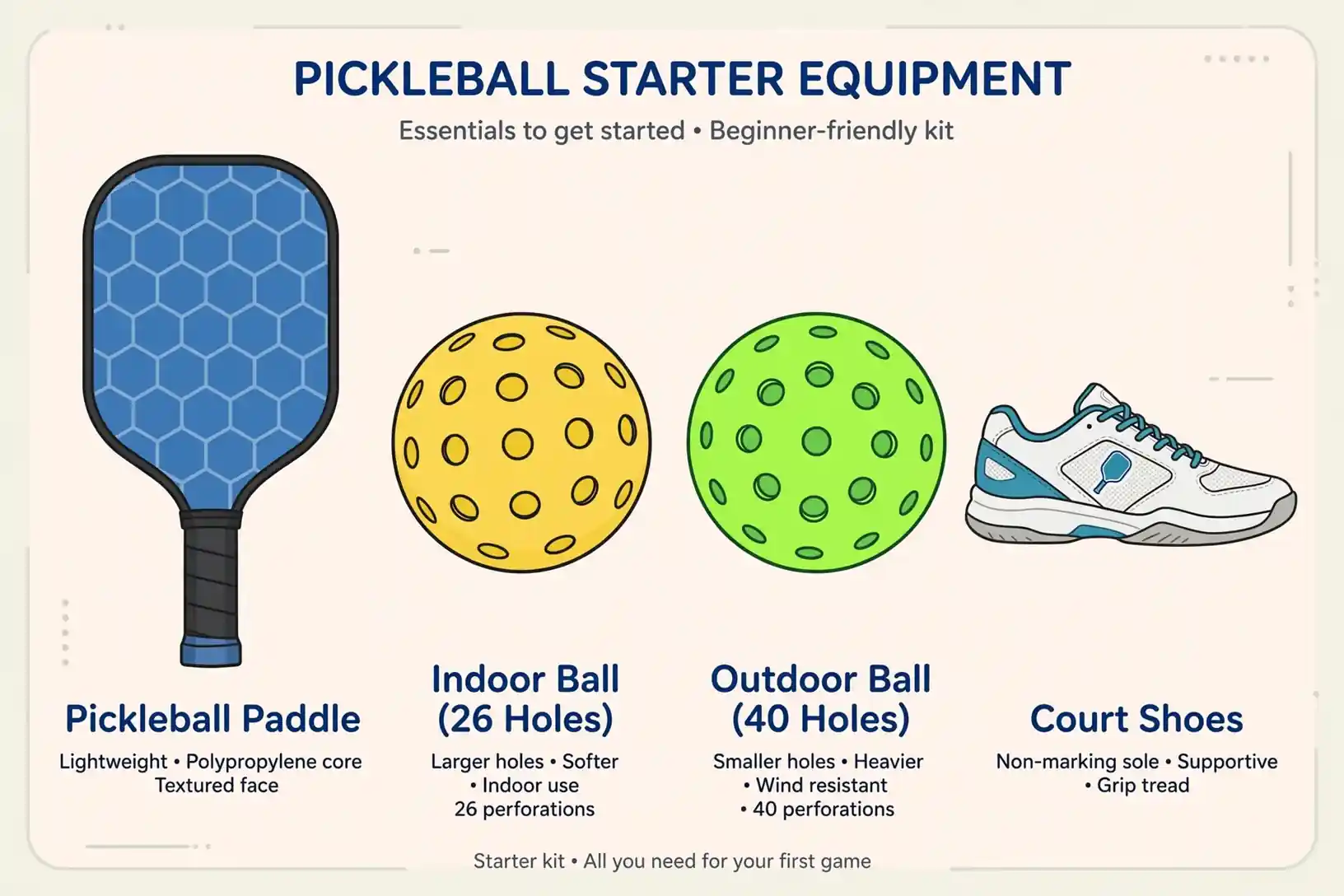
Paddle. Solid-faced (no strings), roughly the size of a table-tennis paddle scaled up. Official limits: no longer than 17 inches, and length plus width no more than 24 inches combined. Beginner paddles run $30–50; anything composite in that range is fine to start. Do not overthink your first paddle — upgrade after a month, when you know what you like.
Ball. A hollow plastic ball with holes — like a wiffle ball. Two types: indoor balls (softer, 26 larger holes, slower and quieter) and outdoor balls (harder, 40 smaller holes, built to resist wind). Use the right one for your court; an outdoor ball indoors flies like a rocket.
Shoes. Court shoes (tennis or pickleball-specific). Running shoes are built for forward motion with a raised heel — on a court, that means rolled ankles. This is the one piece of gear that prevents injuries.
Clothes. Anything athletic. That is genuinely it — paddle, correct ball, court shoes.
The Court in 60 Seconds
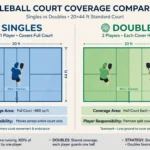
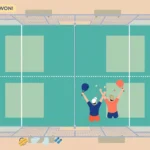
A court is 20 feet wide × 44 feet long — less than a third of a tennis court. The net is 36 inches high at the sidelines, 34 at the center. Three zones to learn:
- Baselines: the back lines. Serves start behind them.
- Service boxes: the rectangles behind the kitchen, split left/right by a centerline.
- The kitchen: the 7-foot zone on each side of the net. You may stand in it — you just cannot volley (hit the ball out of the air) from inside it.

Full rules: [pickleball rules]. For your first game, remember: kitchen = no volleys, everything else = play.
Your First Rally, Step by Step
Here is exactly what happens, in order:
- Call the score. Server announces it (in doubles: three numbers, e.g. “0–0–2”; in singles: two, e.g. “0–0”). Details: [pickleball scoring].
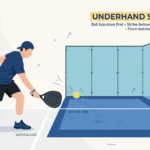
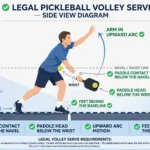
- Serve underhand, diagonally. Arm in an upward arc, contact below your waist, into the opposite service box, clearing the kitchen. One attempt. Full mechanics: [pickleball serve rules].
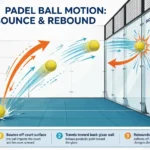
- Let it bounce. The receiver MUST let the serve bounce before returning.
- Return deep. Hit it back — deep toward the baseline is ideal — and the serving team MUST let that bounce too. This is the [pickleball double bounce rule]: serve bounces, return bounces, then anything goes.
- Move to the kitchen line. After returning, get to the kitchen line quickly. Whoever owns the net usually owns the point.
- Rally. Dink, drive, volley (outside the kitchen!), lob — until someone faults or hits a winner.
- Score it. Serving team wins the rally → point. Receiving team wins → they get the serve (no point, in traditional scoring).
That is a complete point. Repeat until someone reaches 11 (win by 2).
The 5 Shots Every Beginner Needs
1. The serve. Your only fully-controlled shot. Aim deep and consistent, not powerful. A reliable deep serve beats a flashy faulted one every time.
2. The return of serve. Deep and safe. Its job is not to win the point — it is to buy you time to reach the kitchen line while the servers are pinned back.
3. The dink. The soul of pickleball: a soft shot that arcs just over the net and lands in the opponent’s kitchen. Use a loose grip (about 3 out of 10 tightness), lock your wrist, and swing from the shoulder. Master the dink and you can hang with anyone.
4. The third-shot drop. The serving team’s answer to the net-rushing returners: a soft arc from the baseline into the opponent’s kitchen, buying time to move forward. The hardest beginner shot — and the most important one to practice.
5. The volley. Hitting the ball out of the air — allowed anywhere except inside the kitchen, and only after the two-bounce rule is satisfied. Keep volleys compact: short punch, paddle in front.

Bonus vocabulary you will hear: the drive (hard flat groundstroke), the lob (high defensive arc to push net players back), and the Erne (an advanced move where you jump around the kitchen post to volley — legal, spectacular, and absolutely not for week one).
Basic Positioning: Where to Stand
- After serving: stay back. You must let the return bounce, so start behind the baseline.
- After returning: move to the kitchen line fast. The returners’ advantage is positional — claim it.
- At the net: stand just behind the kitchen line, knees bent, paddle up and in front, weight on the balls of your feet. This “ready position” is home base for half the sport.
- In doubles: cover your half, communicate constantly (“mine!”, “yours!”), and never both chase the same ball.
Your First Game: A Walkthrough
Arrive, warm up with gentle dinks at the kitchen line — no scoring, just feeling the ball. Then play a real game to 11. Expect this:
- The first ten minutes: constant two-bounce-rule faults. Everyone does this. Laugh, call “bounce!” for each other, carry on.
- Minutes ten to twenty: serves start landing, rallies reach 4–6 shots, someone discovers the dink.
- By game two: you are calling scores (badly), arguing kitchen lines (politely), and already planning when to come back.
A recreational game takes 15–30 minutes. Play two, and you will be genuinely playing pickleball — not just surviving it.
Beginner Mistakes to Skip
- Serving too hard. The serve starts the rally; it does not need to end it. Deep and in beats fast and out.
- Forgetting the two-bounce rule. The #1 beginner fault. When in doubt, let it bounce.
- Camping at the baseline. Points are won at the kitchen line. Get there.
- Volleying from the kitchen. Watch your feet — the line counts as the kitchen.
- Smashing everything. Power gets returned at this level; placement wins.
- Running shoes. Your ankles will file a complaint. Court shoes.
- Not calling the score. In doubles, all three numbers, every serve. Arguments start here.
- Trying the Erne on day one. Admire it on video. Practice your dink.
Why Does This Rule Exist? (Why the Game Is Built This Way)
Pickleball was invented in the summer of 1965 on Bainbridge Island, Washington, when Joel Pritchard, Bill Bell, and Barney McCallum cobbled together a badminton net, ping-pong paddles, and a plastic ball to entertain their bored kids. Every design choice since — the small court, the slow ball, the underhand serve, the kitchen, the two bounces — serves one goal: a racket sport where a 12-year-old and a 70-year-old can rally together on day one.

That is why the rules feel forgiving compared to tennis: the sport was engineered for instant playability, then refined for competition — not the other way around. You are not learning a dumbed-down sport. You are learning one designed, from birth, to be learned fast.
What-If Scenarios
I have never played any racket sport. Can I still start? Yes — most new players have not. Pickleball’s learning curve is famously gentle precisely because it borrows a little from tennis, badminton, and ping-pong without demanding any of them.
Do I need lessons, or can I just show up? You can absolutely just show up — open play at parks and clubs welcomes beginners. One introductory clinic, though, will fix your serve and footwork before bad habits set in.
What if I only have three players? Play “cutthroat” (one vs. two, rotating) with house rules, or drill. Official rules assume 2 or 4 players.
Indoor or outdoor — does it matter? Use the right ball for the surface (26-hole indoors, 40-hole outdoors) and check whether the venue has ceiling or wall rules for faults.
How fit do I need to be? Doubles at a beginner level is moderate exercise — constant short movements, nothing extreme. Singles is a real workout. Start with doubles.
When am I “good enough” for intermediate games? When you can serve and return consistently, dink without popping the ball up, and know the scoring cold. Most players get there within a month of regular play.
Case Studies: Real Matches, Real Rules
The game that started everything. In 1965, three dads on Bainbridge Island lowered a badminton net, handed their kids oversized ping-pong paddles, and invented a game in an afternoon. Within a few years, the first permanent court was built in a neighbor’s backyard; by the 1970s, the first tournaments were running. Sixty years later, that backyard improvisation has 24.3 million American players (SFIA, 2025) and professional leagues. Every rule in this guide descends from one afternoon of parents trying to keep kids busy — a useful reminder that the sport’s DNA is play, not punishment.
The serve that rewrote the rulebook. Pro Zane Navratil treated the serve as a laboratory: first the “chainsaw” spin serve (banned 2022), then the one-handed finger-spin version (banned 2023). Each ban tightened the same principle — the serve starts the rally; it does not win it. For beginners, Navratil’s saga is oddly encouraging: even at the top of the sport, players are still experimenting with the basics you are learning today. Master the legal serve first; the laboratory comes later.

FAQ
How long does it take to learn pickleball? You will rally in your first session and play real games within a week or two. Feeling competent takes about a month of regular play.
Is pickleball easier than tennis? To start, yes — smaller court, slower ball, underhand serve. To master, it has its own deep strategy (just ask anyone who has faced a good dinker).
What should I wear? Athletic clothes and court shoes. That is the whole dress code.
Can kids play? Absolutely — the sport was literally invented for bored kids. Junior paddles and a lowered net help the youngest players.
Do I need a partner to start? For doubles you need four total, but open-play sessions always need extra players — show up alone and you will be adopted within minutes. For solo practice, a wall and a ball work wonders for dinks and volleys.
How much does it cost to start? A $30–50 paddle, a few dollars for balls, and court shoes if you do not own any. Many parks have free courts; that is the entire startup cost.
Where do I find games near me? Park district courts, community centers, and dedicated pickleball clubs all run open-play sessions — most list beginner hours. Showing up to a posted open play is the standard front door.
Key Takeaways
- You need a paddle, the right ball, and court shoes — nothing else to start.
- The rally sequence: serve (bounce) → return (bounce) → kitchen line → play.
- Learn five shots: serve, return, dink, third-shot drop, volley.
- Position wins points: servers stay back, returners rush the net.
- Beginners: play doubles, serve deep and safe, dink more than you smash.
- The sport was designed to be learned in an afternoon — trust the design, and play.
Keep Reading
- Pickleball Rules for Beginners
- Pickleball Serve Rules: Complete Guide
- Pickleball Scoring Explained
- The Kitchen Rule in Pickleball: Non-Volley Zone Explained
- Pickleball Double-Bounce Rule Explained