Intro
Every point in padel starts the same way: a gentle underhand serve. No 200 km/h aces, no unreturnable bombs — the serve is deliberately designed to start a rally, not end one. But “gentle” does not mean “anything goes.” The padel serve has some of the most misunderstood rules in racket sports: the bounce-before-you-hit requirement, the waist-height limit, the invisible lines your feet must respect, and a special rule about the metal fence that surprises almost every beginner.
This guide covers every padel serve rule from the official FIP rulebook (2026 edition): how to serve legally, all six serve faults, what happens on a net cord, foot faults, the receiver’s duties, and the 2026 clarification about the imaginary service line. It pairs with our padel-rules beginner guide and our padel-faults reference.
The Serve in Six Requirements
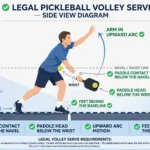
A legal padel serve must satisfy all six of these at once (FIP Rule 6):
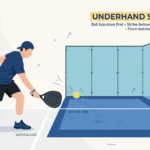
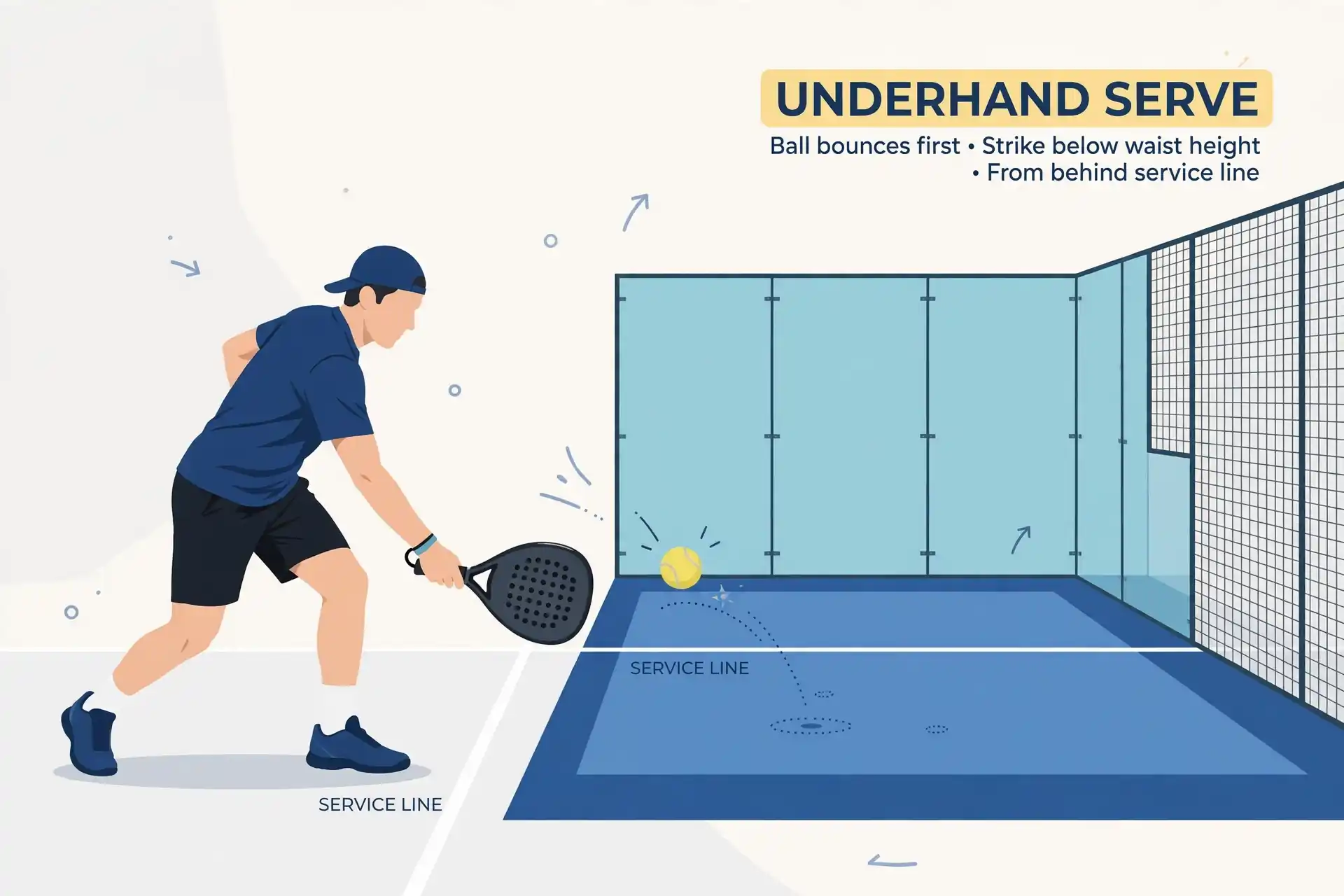
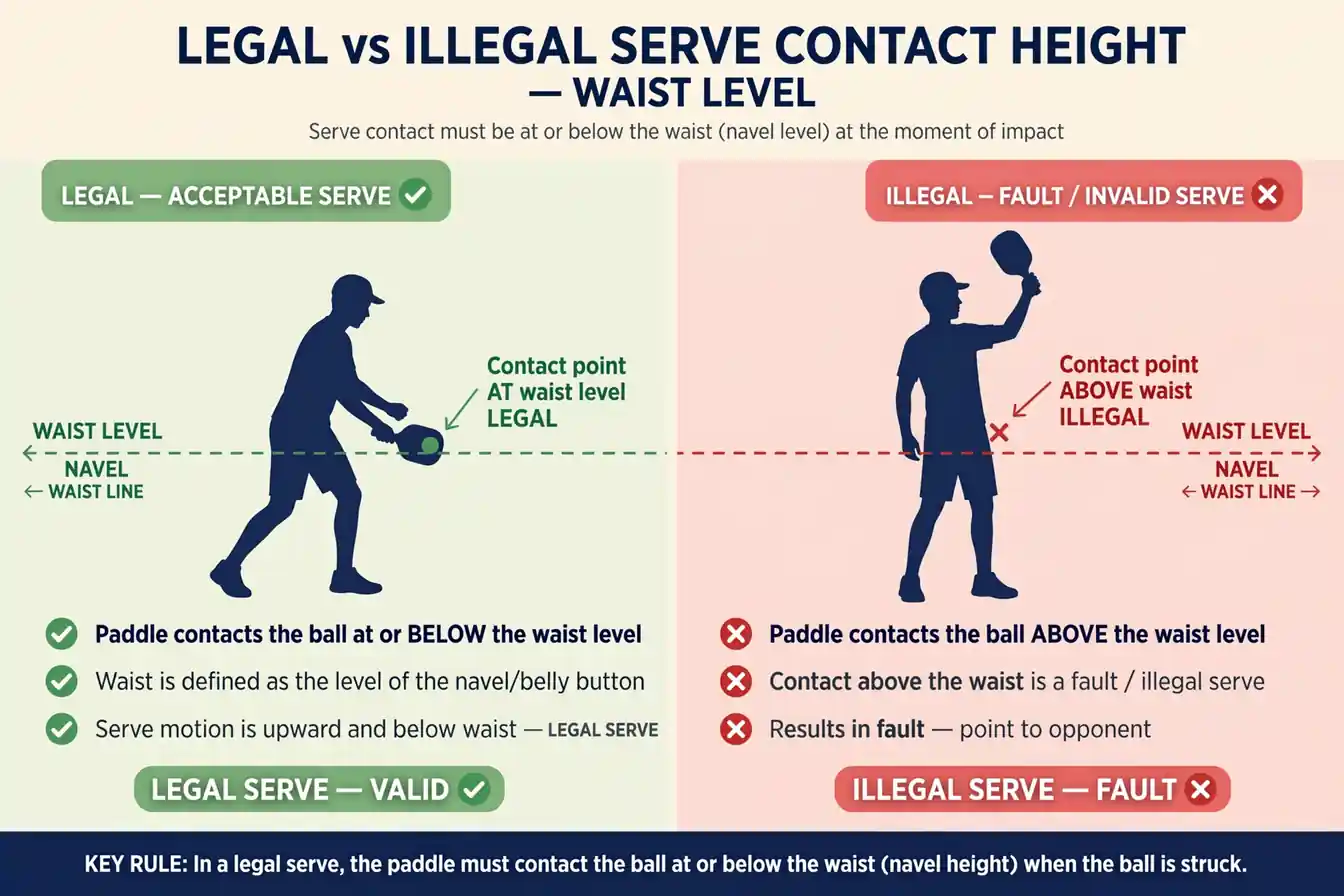
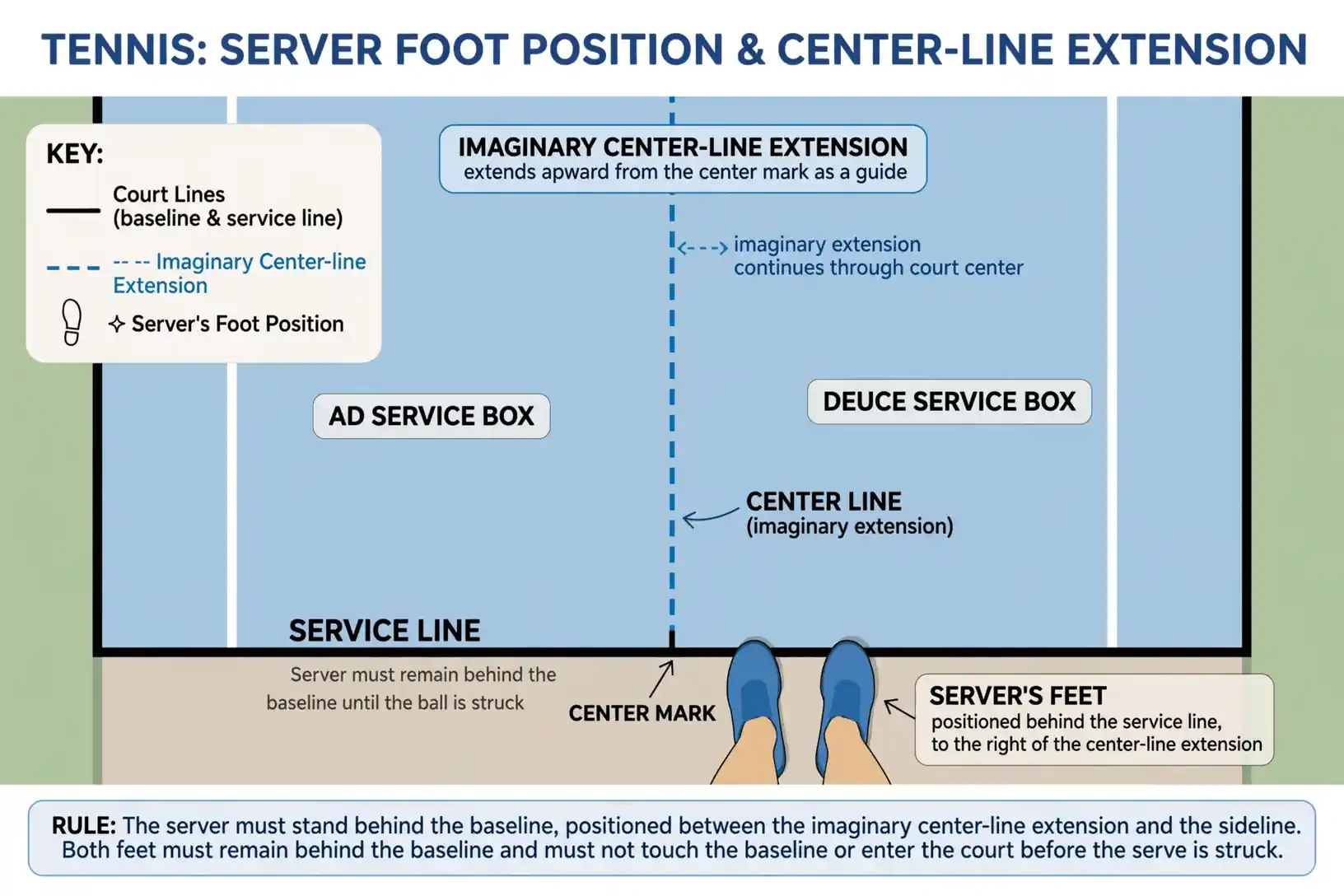
- Start behind the service line. When you begin the serve, one foot must be behind the service line, positioned between the imaginary extension of the center service line and the side wall. Your feet must stay there until the ball is struck.
- Bounce the ball first. Drop the ball and let it bounce on the ground inside your service area before you hit it. You may not toss it in the air and strike it on the volley.
- Keep it at or below waist height. The ball must be struck at or below your waist. This is the rule that kills the power serve — contact above the waist is a fault.
- Keep a foot on the ground. At least one foot must be in contact with the ground when you strike the ball. No jump serves.
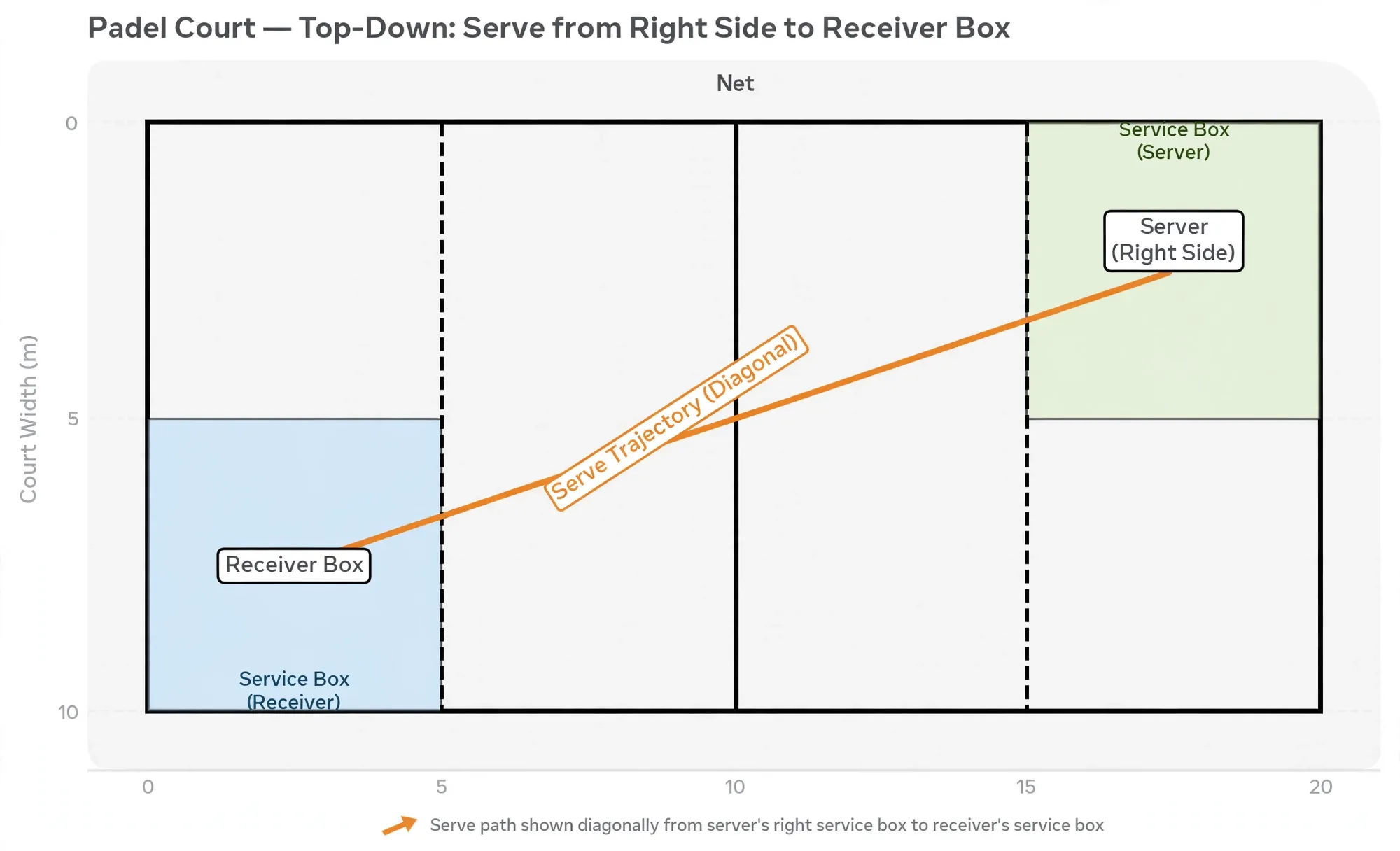
- Go diagonal, into the box. The serve must travel diagonally over the net and bounce inside the receiver’s service box. The box lines count as good. Serves alternate sides every point, starting from the right.
- Don’t touch the lines with your feet. Your feet may not touch the service line or the imaginary center line while serving.
Miss any one of these and it is a fault — you get a second serve. Miss twice in a row and it is a double fault: the point goes to the receivers.
The 2026 Imaginary-Line Clarification
New in the 2026 FIP rulebook: an imaginary line extends the service line toward the side walls, and the ball may not cross the service line — or its imaginary extension — before it is struck. In plain terms: you cannot bounce the ball far out wide past the court and reach for it; the bounce and the strike must happen inside the legal corridor. Most club players never thought about this, which is exactly why the FIP spelled it out.
Serve Faults: The Complete List
FIP Rule 7 lists exactly six ways a serve becomes a fault:
- Breaking any of the six requirements above — wrong stance, no bounce, above the waist, foot on the line, foot off the ground.
- Missing the ball entirely. Swing and a miss counts as a fault. (If you never attempt the hit — just re-bouncing — that is not a serve yet.)
- Landing outside the box. The ball bounces outside the receiver’s service box. Remember: the lines are good.
- Hitting yourself or your partner. The ball touches the server, the server’s partner, or anything they are wearing or carrying.
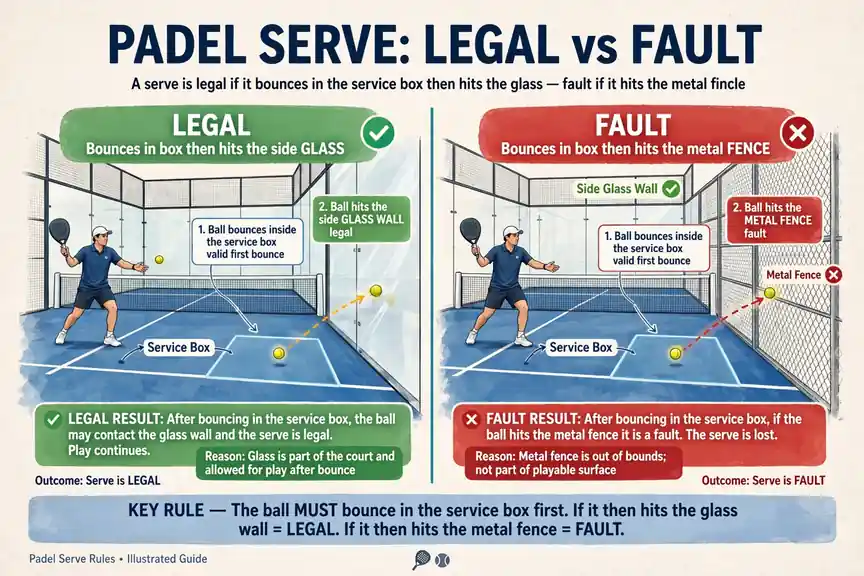
- The fence rule. The ball bounces correctly in the box but then touches the metallic fence before its second bounce. This is the famous one — glass is fine, fence is a fault.
- Out through the gates. The ball bounces in the box and flies straight out through the court’s access gates, on a court with no safety zone for out-of-court play.
Glass vs. Fence: The Rule Everyone Gets Wrong
After your serve bounces legally in the box:
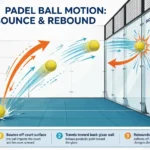
- Touches the side glass? Play continues — it is a good serve, and the receiver must play it.
- Touches the metal fence or mesh? Fault. Immediately.
Why the difference? Glass gives a true, predictable bounce; the metal mesh gives a dead, irregular one. The rulebook treats them differently everywhere, not just on the serve. Smart servers actually aim for the side glass on purpose — a serve that bounces and slides into the glass jams the receiver into an awkward, cramped return. That is 100% legal.
Net Cords on the Serve: “Net,” Not “Let”
Tennis players, listen up — padel words this slightly differently, though the outcome is familiar:
- Serve clips the net or posts and lands in the correct box (without touching the fence first) → it is called a “net” and the serve is replayed. On a first serve you get two serves again; on a second serve you replay just the second serve.
- Serve clips the net and lands outside the box (or hits the fence) → it is a fault, not a replay.
During a rally (not the serve), a net cord that drops in is simply play on — no replay.
Foot Faults, Simply
Your feet have three jobs on the serve: start behind the line, don’t touch the line, don’t touch the imaginary center line. The most common beginner foot fault is the front foot creeping onto the service line during the forward swing. Fix it by starting half a step further back — the serve’s power comes from placement, not from crowding the line. Note the common myth: the FIP requires only one foot behind the line at the start (not both), plus at least one foot on the ground at contact.
The Receiver’s Duties
The serve has rules for the other side too (FIP Rule 8):
- Let it bounce. The receiver must wait for the ball to bounce inside the box and hit it before the second bounce. Volleying the serve gives the point to the server.
- You can stand anywhere. The receiver — and everyone else — may stand in any part of their own side. Most receivers stand a step or two behind the service line.
- If the ball hits you before bouncing, the point goes to the server. Don’t try to dodge-catch a serve with your body.
- Receiving order is fixed. In the first game of each set, the receiving pair decides who receives first — and that player receives the first serve of every game until the set ends. Partners alternate across games, and the order cannot change mid-set.
- Be ready. The server should not serve until you are ready — but if you attempt the return, you cannot then claim you weren’t ready.
Why Does This Rule Exist?
The underhand, bounce-first serve exists for one reason: to make sure every point is a rally, not a free point for the server.
Padel was invented in 1969 by Enrique Corcuera in a walled garden court in Acapulco — a small 20×10m box where a tennis-style power serve would have been absurd and unplayable. His wife Viviana wrote the first rules, and the gentle serve was baked in from the start: with glass walls keeping everything in play, the sport’s whole identity is long, tactical rallies. A big serve would break that identity on the very first shot.
The waist-height limit and the no-volley return rule do the same job from the other direction: they stop the server from manufacturing cheap points and stop the receiver from killing the serve early. Every serve rule pushes toward the same outcome — four players, a rally, from the first ball.
What-If Scenarios
What if I bounce the ball outside my service area and step in to hit it? Fault. The bounce must happen within your service area, behind the service line.
What if my serve hits the side glass after bouncing in the box? Good serve — play on. Glass is fine; only the metal fence is a fault.
What if the serve hits the net, then the fence, then drops in the box? Fault. A “net” replay only applies if the ball avoids the metallic fence before its second bounce.
What if I catch my toss and re-bounce? Fine, as long as you never attempted to strike the ball. The serve only counts once you attempt the hit (FIP Rule 6.6).
What if the receiver is clearly not ready and I serve anyway? The serve is replayed — but only if the receiver genuinely made no attempt to return it.
What if we served from the wrong side and nobody noticed for three points? All points stand. Fix the sides as soon as it is discovered; a first-serve fault already committed still counts.
What if my serve bounces in the box and rolls out through the open gate? On a court without an authorized out-of-court safety zone, that is a fault. Where proper safety zones exist, out-of-court play rules apply.
Case Studies: The Serve in Real Matches
1. The serve that starts 65-minute finals — Riyadh P1 2026, men’s final. World No. 1s Arturo Coello and Agustín Tapia beat Alejandro Galán and Federico Chingotto 6-4, 6-2 in just 65 minutes at the Padel Rush Arena in February 2026 — their 32nd title together on the Premier Padel circuit. Watch any pro final and you will notice something: almost no free points on serve. Every point begins with the same controlled underhand delivery, and matches are decided by rallies, not aces. That is the serve rule working exactly as designed.
2. A debut decided by rallies, not serves — Riyadh P1 2026, women’s final. Ari Sánchez and Andrea Ustero — playing their first tournament together — came back to beat world No. 1s Gemma Triay and Delfi Brea 3-6, 6-1, 6-4 in 1 hour 56 minutes. Ustero became the youngest player ever to win a P1 event. Three sets, no serve-dominated shortcuts: the underhand-serve rule kept every game a contest of teamwork and tactics.
3. The rulebook keeps evolving — the 2026 imaginary line. The FIP’s January 2026 rulebook added the imaginary service-line extension because servers were exploiting the gray area wide of the court. It is a small clarification with a big message: even at the pro level, the serve is policed to stay a rally-starter, never a weapon.
FAQ
1. Can the padel serve be overhand? No. It must be underhand, bounced first, and struck at or below waist height.
2. How many serves do you get? Two, like tennis. Two consecutive faults is a double fault and the point is lost.
3. What happens if the serve hits the net and goes in? It is a “net” — the serve is replayed. On a first serve you get two serves again; on a second serve you replay just the second serve.
4. Can the serve touch the glass? Yes — after bouncing in the box, touching the side glass is fine. Touching the metal fence before the second bounce is a fault.
5. Can the receiver volley the serve? No. The serve must bounce first; volleying it gives the point to the server.
6. Where must the server stand? Behind the service line, between the imaginary center-line extension and the side wall, with at least one foot on the ground at contact.
7. What is a foot fault in padel? Touching the service line or the imaginary center line with your feet during the serve — or starting with no foot behind the line.
8. Can I re-bounce the ball before serving? Yes, as long as you have not attempted to strike it. The serve begins at the attempt.
Key Takeaways
- The padel serve is underhand, bounced first, at or below the waist, diagonal into the box — six requirements, all mandatory.
- Two serves per point; two faults in a row loses the point.
- After the bounce, glass is good, metal fence is a fault.
- Net cord landing in = replay (“net”); net cord landing out = fault.
- The receiver must let it bounce — no volleying the serve.
- New for 2026: the imaginary service-line extension — the ball cannot cross it before the strike.
- The whole design exists so that every point starts a rally.
Keep Reading
Keep Reading
- Playing Off the Glass Walls: Padel Wall Rules
- Padel Faults, Lets, and When the Ball Is Out
- How to Play Padel: Complete Beginner Guide