Intro
Same court, same net, same ball — so what actually changes between pickleball singles and doubles? Less than you would think, but the differences that exist (the score call, the serve rotation, the strange 0-0-2 start) confuse almost every beginner who tries both. This guide compares the two formats rule by rule, explains the strategy shift, and helps you choose where to start.
What Stays Exactly the Same
First, the reassuring part. Almost the entire rulebook is identical:
- Court and net: 20 × 44 feet, 36 inches at the sidelines, 34 at center — for both.
- The two-bounce rule: serve bounces, return bounces, then volleys — see [pickleball double bounce rule].
- The kitchen: 7 feet, no volleys from inside it, momentum counts — see [pickleball kitchen rule].
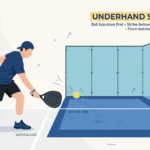
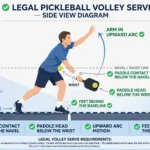
- Serving mechanics: underhand, below the waist, paddle below wrist, diagonal, one attempt — see [pickleball serve rules].
- Faults: the full list applies equally — see [pickleball faults].
- Scoring target: games to 11, win by 2; only the serving side scores (in traditional scoring — see [pickleball scoring]).
Doubles is the most common format in recreational play, but the rules were written format-neutral. Everything below is about the differences — and there are only a handful.
Difference 1: How You Call the Score
This is the difference you will notice first.
Doubles — three numbers. Before every serve, the server calls: serving team’s score, receiving team’s score, server number. “7–3–2” means: our team has 7, they have 3, and I am the second server. The third number exists because each team gets two servers per turn.
Singles — two numbers. Just server’s score, receiver’s score. “5–2” means: I have 5, you have 2. No third number, because there is only one server per side.
Beginners in doubles forget the third number constantly. Until it becomes habit, glance at your partner before serving and silently confirm: “Am I server 1 or 2?”
Difference 2: The Serve Rotation (and the 0-0-2 Mystery)
In singles, it is brutally simple: you serve until you lose a rally or fault. Then the serve passes immediately to your opponent (Rulebook §4.B.4). One server per side, no second chances.
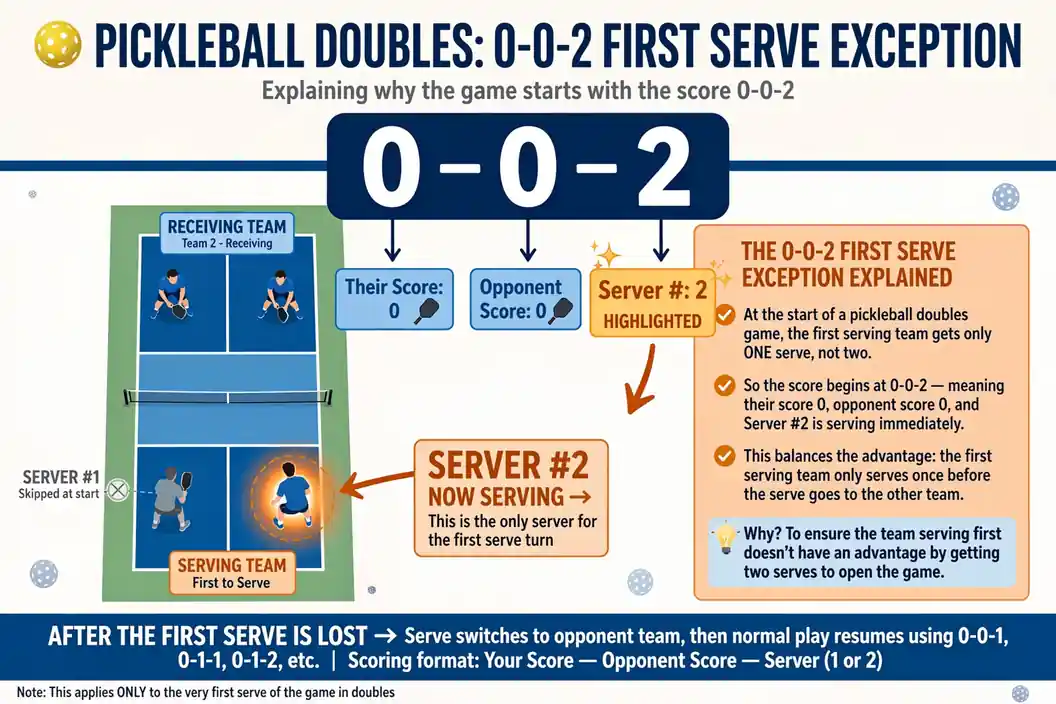
In doubles, each team normally gets two servers per turn: server 1 serves until their team faults, then server 2 serves from their correct side until the team faults again — only then does the serve pass to the other team (side-out).
The exception: at the very start of the game, the first serving team gets only one server. The game opens with the score called as “0–0–2” — zero to zero, second server. After that first rally is lost, the serve passes immediately to the other team, which then enjoys the normal two-server rotation.
Why start at 0–0–2? Pure fairness. Without the exception, the team serving first would get two servers before the opponents ever touch the ball as servers — a built-in head start. Starting as “server 2” burns the phantom first serve and keeps the opening even. It feels strange the first five times, then becomes automatic.
Difference 3: Where You Stand to Serve
Both formats share one elegant rule: serve from the right court when your score is even (0, 2, 4, 6, 8, 10), from the left when it is odd (1, 3, 5, 7, 9, 11).
- Singles: your own score decides. Win a point? Your score changed, so you switch sides for the next serve.
- Doubles: the serving team’s score decides, and the team switches sides after every rally they win. The receiving team holds its positions until it wins the serve back through a side-out.
This is why experienced players can reconstruct the entire game state from the score call alone — the score tells you who serves, from where, and (in doubles) which server number is live.
Difference 4: How the Game Actually Plays
The rules barely change, but the sport changes completely:
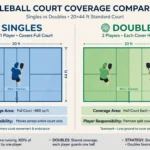
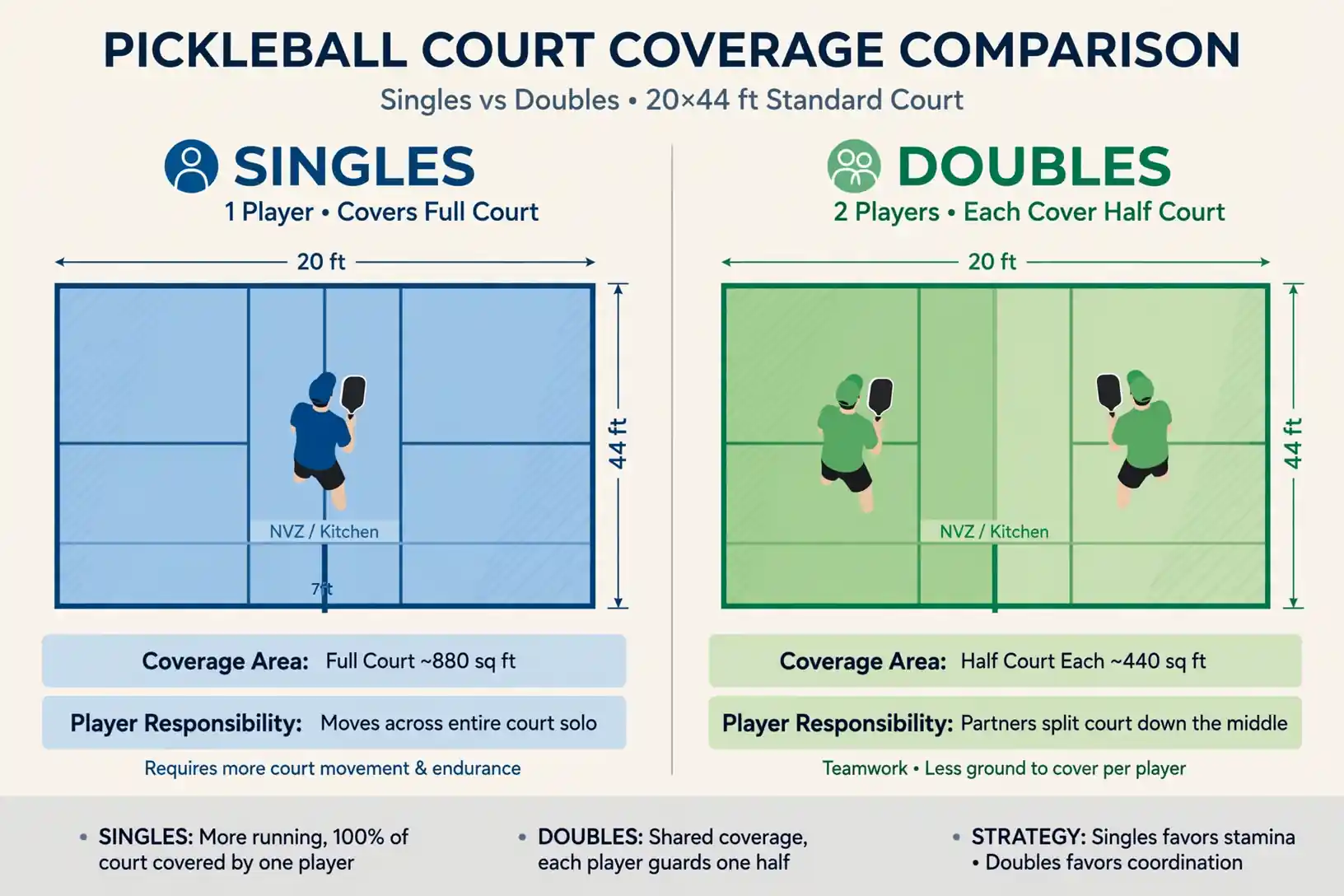
Singles is a sprint. One player covers the full 20 × 44 court. Points reward speed, deep groundstrokes, passing shots, and fitness. Rallies are shorter, errors come faster, and there is nowhere to hide — every weakness is exposed within minutes. It is the purer athletic test.

Doubles is a chess match. Half the court each, a partner covering your mistakes, and rallies built on patience: dink exchanges at the kitchen, the third-shot drop, coordinated poaching. Points last longer, strategy matters more than speed, and communication (“mine!”, “yours!”, “bounce!”) becomes a skill of its own.
Advanced doubles adds stacking — partners deliberately lining up on the same side (rather than the traditional left/right) to keep both forehands in the middle or to keep a stronger player on a preferred side. It is legal, common at higher levels, and the clearest sign that doubles is a partnership sport: you are not just covering half a court, you are engineering one.
Which Should Beginners Play First?
Doubles — and it is not close. Less court to cover, longer rallies, a partner covering your mistakes, built-in coaching (“let it bounce!”), and the social side that made pickleball explode. Most clubs organize around doubles, so you will find games faster.
Try singles once you can rally comfortably: it is the fastest way to expose holes in your footwork, conditioning, and shot selection. Many players use singles as training and doubles as their main event.
The Hidden Differences: Fitness, Gear, and Mindset
Beyond the rulebook, the formats demand different athletes:
Fitness. A competitive singles match is roughly twice the running of doubles — every ball is yours, every corner must be covered. Players who dominate doubles on guile alone often gasp their way through singles. If you want singles stamina, train it deliberately: it will not arrive by accident.
Paddle choice. Doubles rewards control paddles — soft touch for dinks, precision for drops. Singles rewards a bit more power and reach, because you must finish points from the back of the court. Beginners should not buy two paddles; just know that when you eventually specialize, the formats pull equipment in slightly different directions.
Mindset. Doubles is collaborative problem-solving: you and a partner adjusting together, covering for each other, communicating constantly. Singles is solitary accountability: every error is yours, every adjustment is yours. Players often discover which temperament they have only by trying both — many lifelong doubles players are surprised to find they love the lonely clarity of singles.
Time and format. Because singles rallies are shorter but more physical, singles events at tournaments often play best-of-3 to 11 just like doubles — but feel completely different on the body. In rec play, singles games are frequently played to 7 or first-to-11-winner-stays, simply because full games are exhausting.
Why Does This Rule Exist?

The two-format design exists because pickleball was built as a backyard game first. Doubles is the social core — four friends, one net, everyone involved. The first-server exception, the three-number call, the side-switching: all of it is machinery to keep doubles fair despite having twice as many servers.
Singles exists for the competitor in every group — the player who wants the result to depend on nobody else. The rules strip doubles down to its minimum (two numbers, one server, instant side-out) rather than inventing a new game. That restraint is deliberate: one sport, two expressions, zero relearning.
What-If Scenarios
In doubles, can the same player serve twice in a row as server 1 and 2? No — server 1 and server 2 are the two partners. After server 1’s team faults, the partner serves as server 2 from their correct side.
What if server 2 is standing on the wrong side when they take over? The serve must come from the side dictated by the team’s score (even = right, odd = left). Serving from the wrong side is a fault — check the score before serving.
Can I play doubles with only three players (cutthroat)? Not in the official rules — but rec groups do it all the time with house rules. Just agree on the rotation before starting.
In singles, do I still call the score? Yes — two numbers before every serve, same as doubles minus the server number.
Does the 0–0–2 exception apply in rally scoring? Rally-scoring formats (like MLP’s former system — see [pickleball rally scoring]) use different service structures entirely. The 0–0–2 exception belongs to traditional side-out scoring.
Can partners switch sides mid-rally? Yes — during the rally you may stand anywhere. The even/odd positioning only governs where the serve starts.
Case Studies: Real Matches, Real Rules
Doubles at its most dramatic. The 2024 Major League Pickleball finals came down to the Dallas Flash versus the New Jersey 5s. The 5s took the women’s matches; the Flash answered in mixed doubles. With the match tied, it went to a DreamBreaker — MLP’s singles-rotation tiebreaker — and the Dallas Flash emerged as champions. It is the perfect showcase of why doubles formats need tiebreaker machinery at all: team doubles is so evenly matched at the top that championships get decided by format innovations, not just rallies.

Singles under the harshest spotlight. At the PPA Vietnam event in April 2026, Hoang Nam Ly faced Christian Alshon in a singles quarterfinal. On match point at 11–10, Alshon’s return was called out by Nam Ly — on a Grandstand Court with no video replay available. The call stood; Nam Ly advanced. In singles there is no partner to confer with, no second server to steady you — one disputed call on match point, and the match is over. It is the format’s brutal beauty: everything, good and bad, is yours alone.
FAQ
Is doubles really more popular than singles? Yes — USA Pickleball notes doubles is the most common format, and nearly all social and league play is doubles.
Can beginners play singles? Absolutely, but expect a workout. Singles exposes fitness and footwork gaps within minutes — which is exactly why it is great training.
Do I need different equipment for singles vs doubles? No. Same paddle, same ball, same court.
What is “stacking” in doubles? Partners lining up on the same side of the court (instead of left/right) to keep preferred forehands in the middle. Legal at all levels.
Why three numbers in doubles scoring? Because each team has two servers — the third number tracks whether server 1 or 2 is serving.
If my doubles partner and I disagree on the score, what do we do? Stop and resolve it before the serve. In refereed play, any player may ask the referee to confirm the score, server, and positions.
Key Takeaways
- Rules are 95% identical — court, kitchen, two-bounce rule, serve mechanics, faults.
- Doubles: three-number call, two servers per team, 0–0–2 opening exception.
- Singles: two-number call, one server, lose a rally and the serve passes immediately.
- Even score = serve from the right; odd = from the left — in both formats.
- Beginners: start with doubles (social, forgiving, longer rallies); add singles for training.
- Doubles is chess; singles is a sprint. Same sport, two different games.
Keep Reading
Keep Reading