Intro
If you have played even one game of pickleball, you have heard someone shout “kitchen!” — and half the people shouting it do not know the actual rule. The kitchen is pickleball’s most misunderstood rule. Many beginners believe you can never step into it. That is wrong, and the mistake costs real points.
This guide explains the pickleball kitchen rule from every angle: where the zone is, what “volley” means, what is allowed, what is a fault, the tricky momentum rule, and why the rule exists at all. By the end, you will know more than most players at your local courts.
This article is for new players, and it pairs with our pickleball-rules beginner guide, our pickleball-serve-rules guide, and our guide to common pickleball-faults.
What the Kitchen Is: The Non-Volley Zone Explained
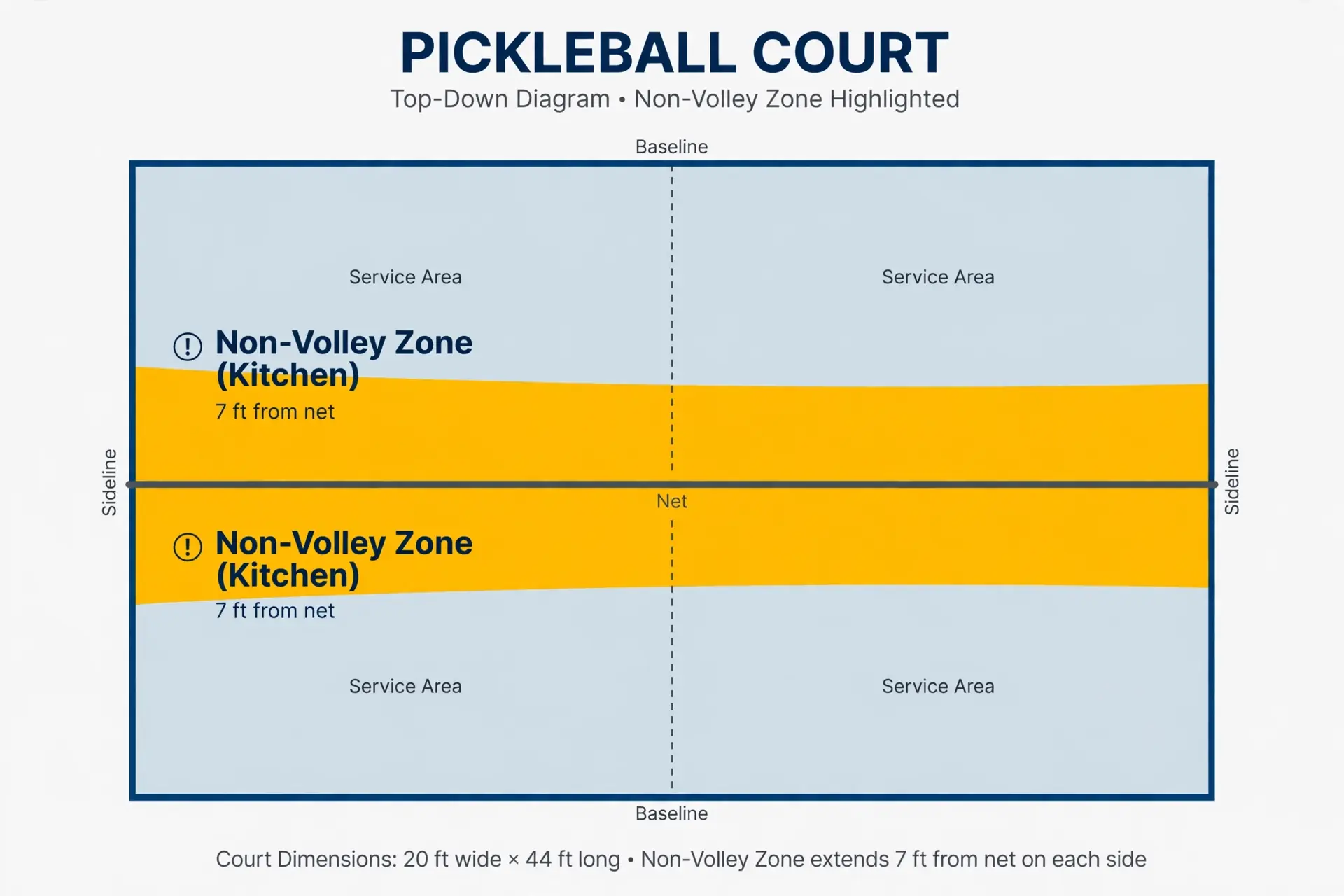
The “kitchen” is the nickname for the non-volley zone (NVZ) — the official name in the USA Pickleball rulebook. The rulebook never uses the word “kitchen,” but everyone on court does, and its meaning is not officially agreed on (more on that later).
Here is where it is and how big it is:
- The zone extends 7 feet from the net on each side.
- It runs the full 20-foot width of the court (the whole court is 20 feet wide and 44 feet long, per the official rulebook).
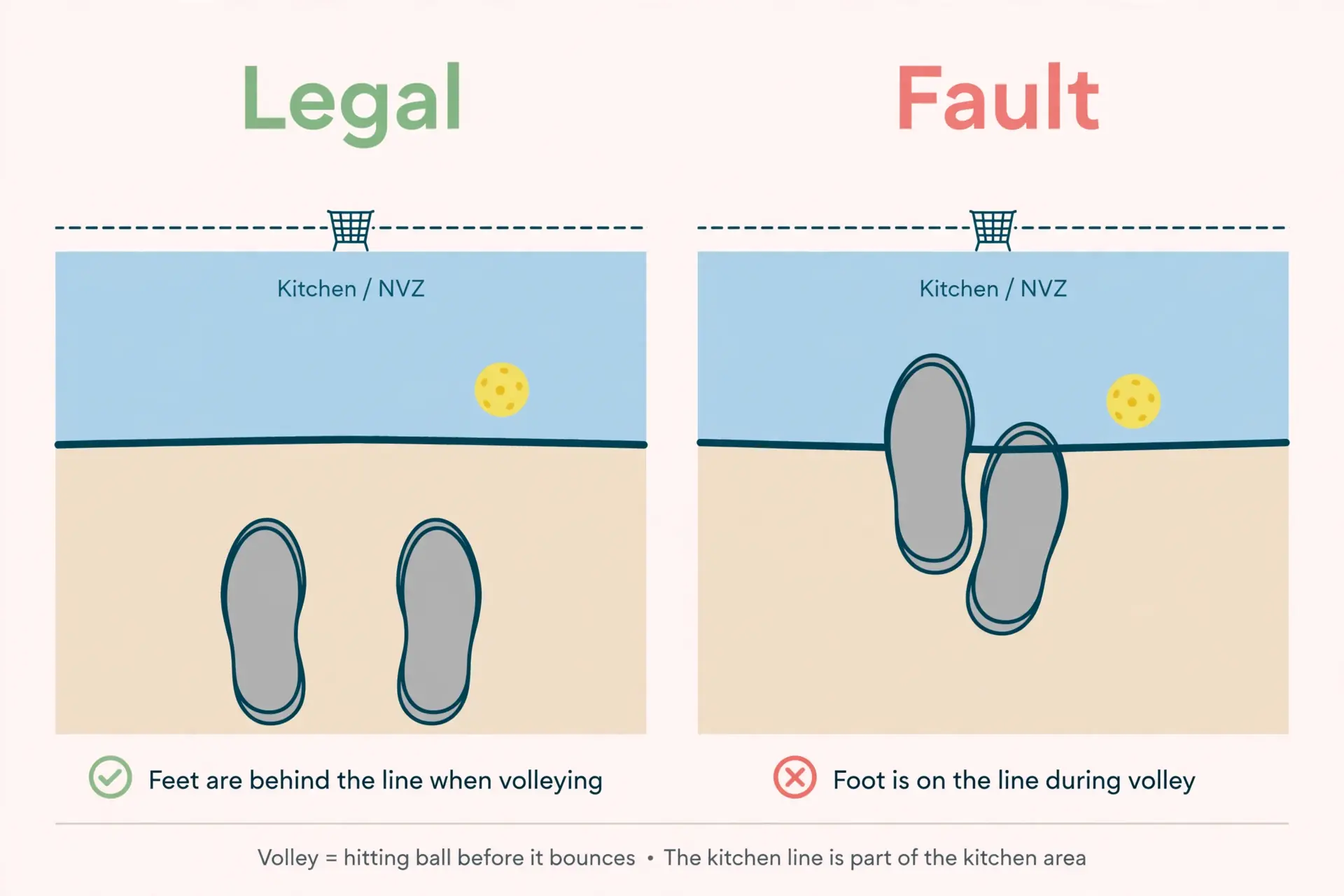
- The lines are part of the kitchen. If any part of your foot touches the kitchen line, you are in the kitchen. This is the one place in pickleball where touching a line is bad for you — everywhere else, a ball touching a line is in.
The rule itself is one sentence, and it is a volley rule, not a “stay out” rule:
> You may not volley the ball while you — or anything touching you — are in contact with the kitchen or its lines.
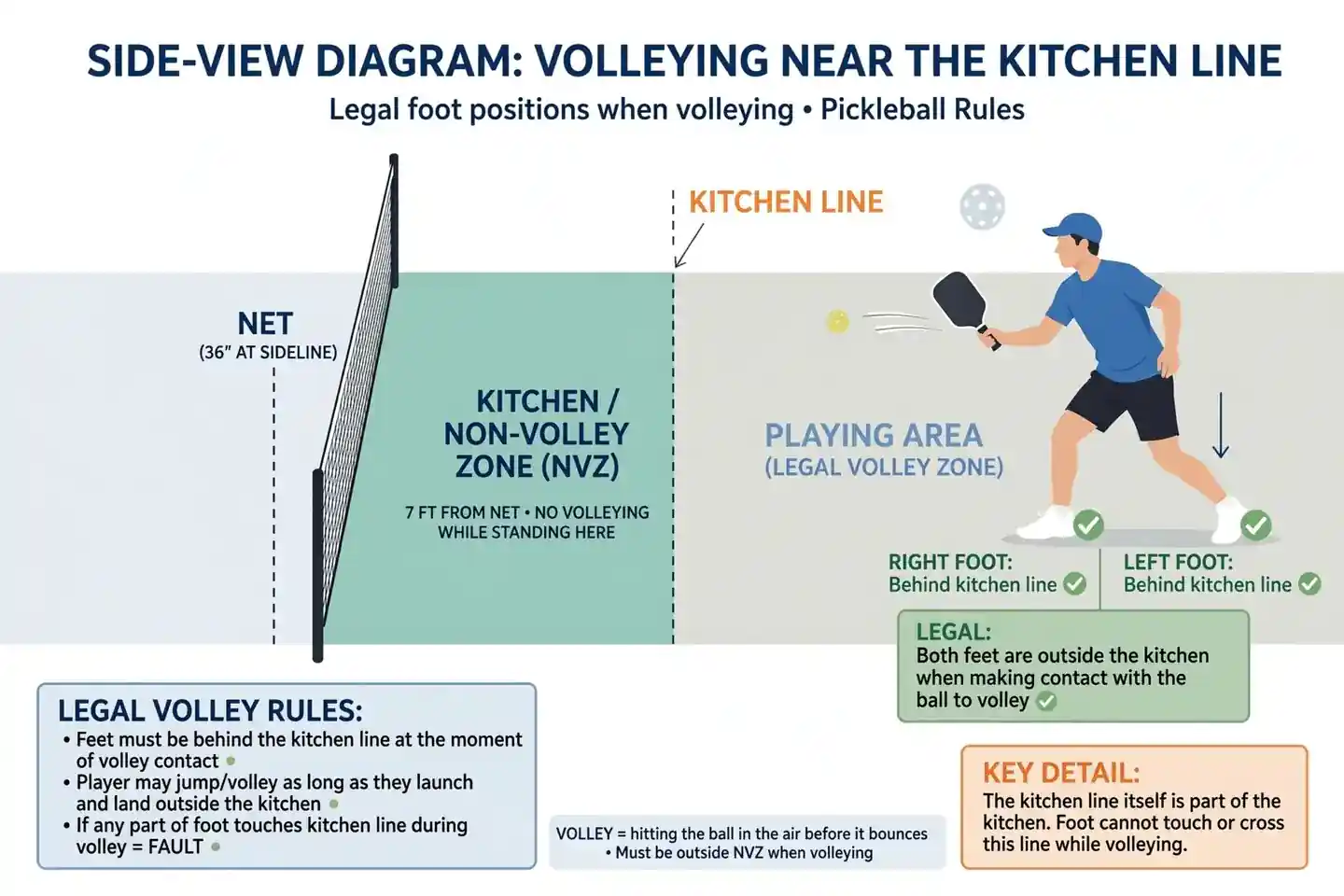
A volley means hitting the ball out of the air, before it has bounced. So the kitchen forbids one specific shot from one specific place. That is the whole thing. Everything below is just a variation of that sentence.
What is ALLOWED (this surprises most beginners)
- Standing in the kitchen. You can stand in it any time you like, for as long as you like, even when the ball is not near you.
- Walking through the kitchen between shots or between rallies.
- Hitting a ball that has already bounced while standing in the kitchen. This is completely legal and very common — it is how most dinks (soft short shots) are returned.
- Reaching your paddle over the kitchen to hit a volley, as long as you and your paddle never touch the zone or the line. What matters is where your feet and body touch, not where the air above the zone is.
- Going into the kitchen after a rally ends. Once the point is over, the zone means nothing.
What is NOT allowed: the kitchen faults
The 2026 USA Pickleball rulebook (Section 11.A) lists these faults. A fault means you lose the rally:
- Volleying while touching the kitchen (Rule 11.A.1). If you, your shoes, your paddle, your clothing, your hat, or even your partner (if they are touching you) are in contact with the zone while you volley — fault. Yes, a dropped paddle or a hat that falls into the kitchen during your volley is a fault.
- Momentum carrying you in after a volley (Rule 11.A.2). If you volley from outside the kitchen but your forward motion then carries you into it — a foot, a knee, a hand you put down to catch yourself — that is a fault. It does not matter if the ball is already dead. You must come to a full stop outside the zone.
- Volleying before both feet are back outside (Rule 11.A.3). If you were in the kitchen (legally, to play a bounced ball), you must get both feet back onto the playing surface completely outside the zone before you may volley again.
The serve exception
The kitchen appears in one more place: a serve must clear the kitchen and its line. A serve that lands in the non-volley zone or touches the kitchen line is short and a fault. The special line restriction applies to the serve only — during an ordinary rally, a ball may legally land in the kitchen.
Why Does This Rule Exist?
Pickleball was invented in 1965 on Bainbridge Island, Washington, by three dads — Joel Pritchard, Bill Bell, and Barney McCallum — who were building a backyard game for their families using a lowered badminton net, wooden paddles, and a plastic wiffle-style ball.
As the game took shape, the creators realized there was a problem: without any restriction, players would stand right at the net and smash every ball. Tall, athletic players would dominate, rallies would last two shots, and the game would be no fun for kids, grandparents, or anyone without a big reach. One popular history telling says the zone was added to stop a tall neighborhood kid from slamming the ball back across the net.
The solution was the non-volley zone: a 7-foot “no smashing from here” strip that forces the game to be played with soft shots, placement, and patience close to the net. It is the reason a 70-year-old with good hands can beat a 25-year-old with big power. The zone created pickleball’s most famous exchange — the slow, tense dink rally at the kitchen line, where position and patience beat raw strength.
And why is it called the “kitchen”? Nobody knows for sure. The most popular theory is that the term came from shuffleboard, which also has a section called the “kitchen” with special restrictions. The nickname stuck, and the sport that everyone calls it by a name its rulebook never uses tells you something about pickleball’s backyard spirit.
What-If Scenarios
What if my momentum carries me into the kitchen after a great volley? Fault — even if the ball was already dead and the point seemed over. Hit the volley and move back, not through.
What if I volley from outside, stop completely, then walk into the kitchen? Legal. Once your momentum has fully stopped outside the zone, you can walk in freely.
What if my partner is in the kitchen and I volley from outside while touching them? Fault. Anything in contact with the volleying player — including their partner — counts.
What if my hat or sunglasses fall into the kitchen while I volley? Fault. Anything you are wearing or carrying that touches the zone during the act of volleying is a fault.
What if I jump, hit a volley in the air, and land in the kitchen? Fault. This is the famous Erne risk — the jump-around-the-post shot is legal only if you land outside the zone.
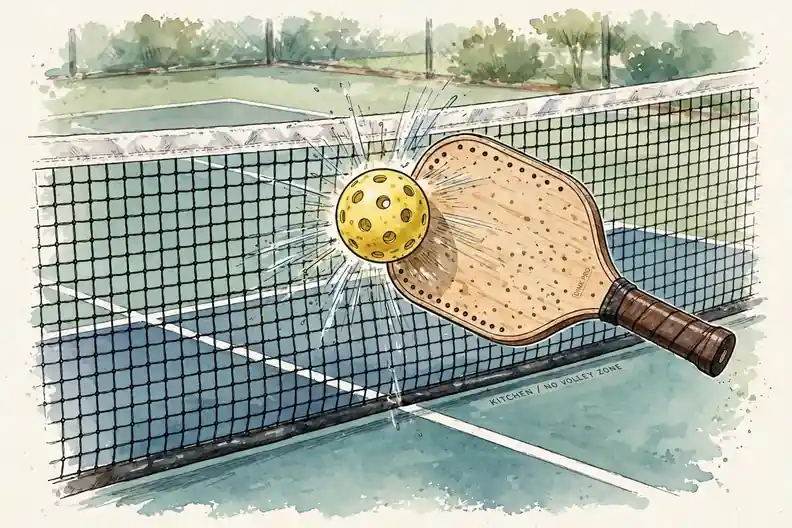
What if the ball bounces in the kitchen and I step in to hit it? Legal — as long as the ball bounced first. Just remember to get both feet back outside before your next volley.
What if I am standing in the kitchen and the ball comes to me before it bounces? Do not touch it. Either let it bounce (then you can play it), or get out and volley it. Volleying it from there is a fault.
What if my paddle crosses over the kitchen line but my feet do not? Legal. Only contact with the zone surface counts.
What about wheelchair players? The rulebook allows wheelchair players’ front (smaller) wheels to touch the non-volley zone during a volley.
Case Studies: The Rule in Real Matches
1. The overturned kitchen call that swung a PPA final — Select Medical Orange County Cup, 2026. The men’s doubles final came down to a fifth game between Gabe Tardio and Ben Johns (“The Counter Kings”) and Federico Staksrud and James Patriquin (“Fedquin”). “Fedquin” had won game four 11-4 to force the decider. At 3-1-2 in game five, with “Fedquin” serving, Tardio hit an Erne winner — but was called for a kitchen foot fault. On replay review, the call was overturned, correctly. Instead of “Fedquin” serving at 4-1-2, it was “The Counter Kings” serving at 1-3-1. The overturned call appeared to rattle Patriquin, and Tardio/Johns rolled to an 11-3 game-five win and the title. One kitchen-line call — reversed on replay — changed a championship.
2. Cameras are now watching the kitchen — PPA and MLP, 2026 season. With prize money rising and line-call disputes growing, the PPA Tour and Major League Pickleball announced a partnership with PlayReplay, an AI-powered line-calling company. Four cameras mounted on the net posts detect line calls, foot faults, and kitchen violations in real time — either announcing calls live or letting players challenge and watch animated replays. When the pros need robot cameras to judge the kitchen rule fairly, it tells you how fine the margins are — and how much the rule decides matches.
FAQ
1. Can I stand in the kitchen in pickleball? Yes. The rule only forbids volleying while touching the kitchen. Standing, walking, or playing a bounced ball from the kitchen is fully legal.
2. What exactly is a volley? Hitting the ball out of the air before it bounces. Once the ball has bounced, your shot is a groundstroke, not a volley, and the kitchen rule no longer applies to it.
3. Is touching the kitchen line a fault? If you are volleying, yes — the line is part of the zone. A toe on the line during a volley is a fault. For any other shot (a bounced ball), touching the line is fine.
4. What is the momentum rule? If your own forward motion from a volley carries you — or anything you wear or carry — into the kitchen, even after the ball is dead, it is a fault. You must stop completely outside the zone first.
5. Can I hit a ball from the kitchen if it bounced? Yes. Let the ball bounce, then play it from inside the kitchen. That is the normal, correct way to return most dinks.
6. Can a serve land in the kitchen? No. A serve that lands in the non-volley zone or touches the kitchen line is short and a fault. During rallies, though, balls may land in the kitchen freely.
7. Why is it called the kitchen? The official name is the non-volley zone. “Kitchen” is an unofficial nickname whose origin is debated — the leading theory is that it was borrowed from shuffleboard, which has a restricted area also called the kitchen.
8. Do I have to get both feet out before volleying again? Yes. After being in the kitchen, both feet must touch the playing surface completely outside the zone before your next volley, or it is a fault.
Key Takeaways
- The kitchen (non-volley zone) is the 7-foot strip on each side of the net, full court width, including the lines.
- The rule bans volleying (hitting before the bounce) while touching the zone — nothing else. Standing in it is legal.
- The momentum rule is the one that costs points: stop fully outside the zone after every volley.
- A serve must clear the kitchen and its line — the only time touching a line is bad for you.
- The zone exists because pickleball’s 1965 inventors wanted rallies, not smashes — it is what lets skill beat size.
- When in doubt at the line, give yourself one step of margin. The pros now need cameras to get these calls right.
Keep Reading
Keep Reading
- Pickleball Double-Bounce Rule Explained
- Pickleball Serve Rules: Complete Guide
- Common Pickleball Faults and How to Avoid Them