Intro
New players lose more points to this rule than any other. You serve, your opponent returns, you rush forward and smash it out of the air — and the point is gone before you understand why. The double-bounce rule (officially the two-bounce rule) is the one rule that makes pickleball play nothing like tennis, and once it clicks, the whole sport starts making sense.
This guide explains exactly what the rule requires, clears up the confusing name, shows why the rule exists, and reveals how professionals build their entire strategy around it. Ten minutes here will save you dozens of lost points.
What the Rule Actually Says
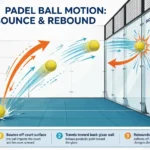
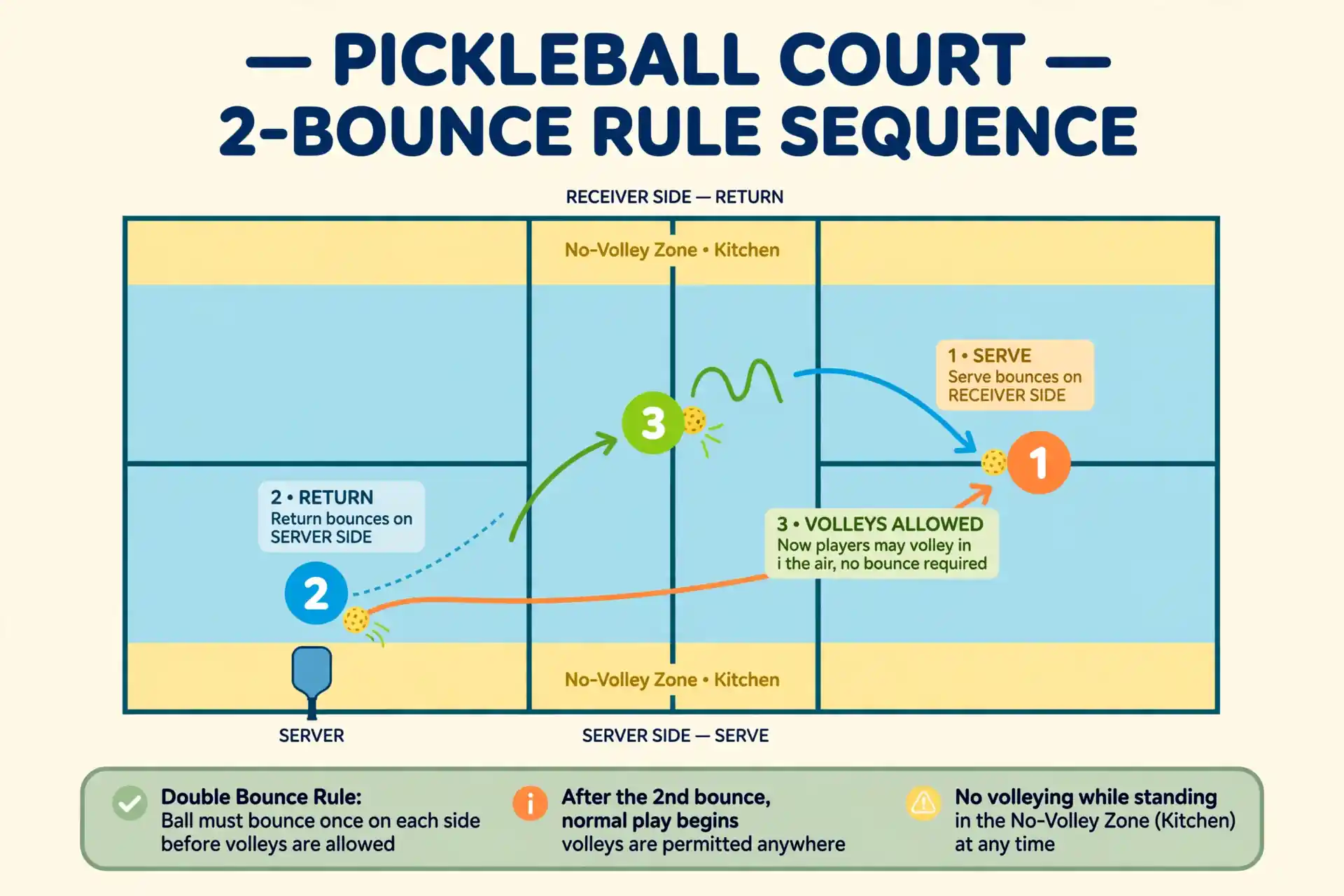
USA Pickleball’s rulebook keeps it to one idea, enforced as Fault Rule 7.A: at the start of every rally, the ball must bounce once on each side of the net before anyone is allowed to volley (hit the ball out of the air).
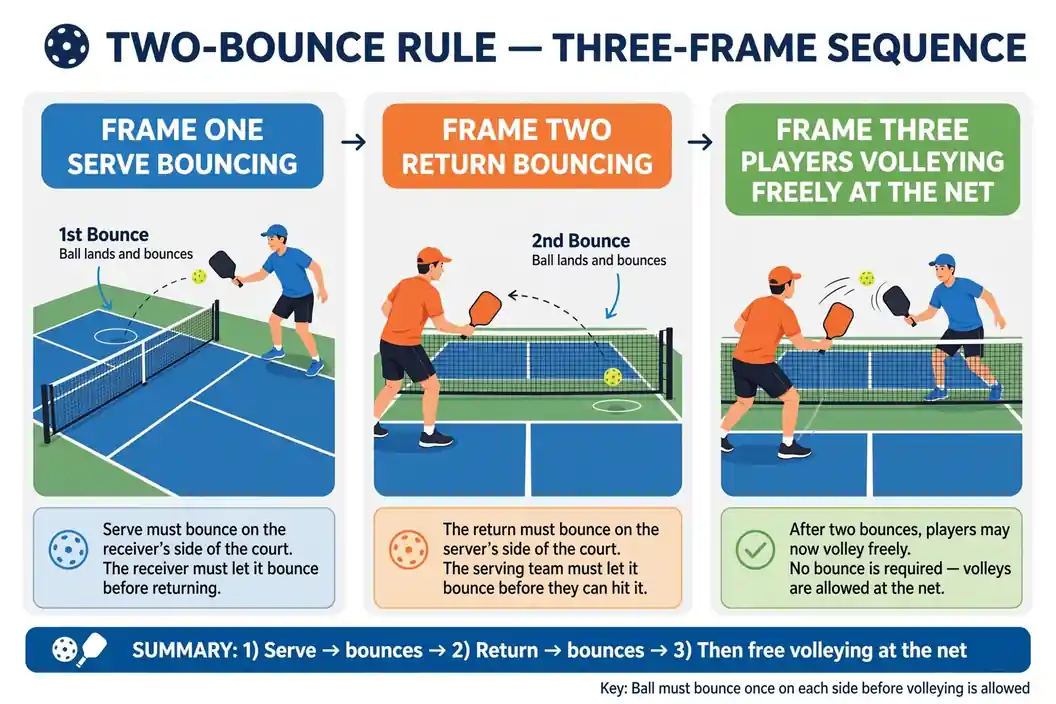
It works in three steps:
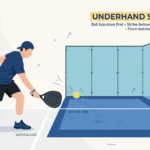
- The serve must bounce on the receiving side before the returner hits it.
- The return of serve must bounce on the serving side before the server’s team hits it.
- After those two bounces, both teams may volley freely or keep hitting groundstrokes — your choice.
The rhythm to memorize: serve, bounce — return, bounce — then play. It applies identically in singles and doubles, in rec games and pro finals. There are no exceptions.
The Name Confusion (Read This Once)
Here is where most beginners get tangled, and most online guides make it worse. There are two different things with almost the same name:
- The two-bounce rule (what players call the “double-bounce rule”): the serve and the return must each bounce once before volleys are allowed. This is the rule in this article.
- A double bounce: the ball bouncing twice on the same side before you return it. That is a completely separate fault (Rule 7.E) — if the ball bounces twice on your side, you lose the rally, full stop.
So when someone yells “double bounce!” on court, check which one they mean. Nine times out of ten they mean the two-bounce rule — you volleyed too early.
Why Does This Rule Exist?
The rulebook states the purpose plainly: it “eliminates the serve and volley advantage and extends rallies.” Translate that into court reality.
Without this rule, the serving team would serve and sprint straight to the net, then smash the return out of the air before it lands. The returner would barely get a swing. Points would end in three shots, the serve would be a weapon instead of a starting signal, and the player who serves first would win most games — exactly like big-serve tennis, where the returner is a spectator.
The founders of pickleball wanted the opposite: a game where ordinary people trade shots for a while. By forcing two bounces, the rule hands the receiving team a fair start. The server cannot attack the return in the air. The returner gets time to reach a good position. Rallies get a chance to develop — and that is the whole character of the sport.
Notice what the rule does not do: it does not slow the ball, shrink the court, or weaken anyone’s smash. It just inserts two mandatory bounces at the start. Everything after that is full-speed pickleball.
How the Rule Shapes Pro Strategy
Professionals do not just obey the two-bounce rule — they weaponize it. Watch any pro doubles final and you will see the same choreography, dictated entirely by those two bounces:
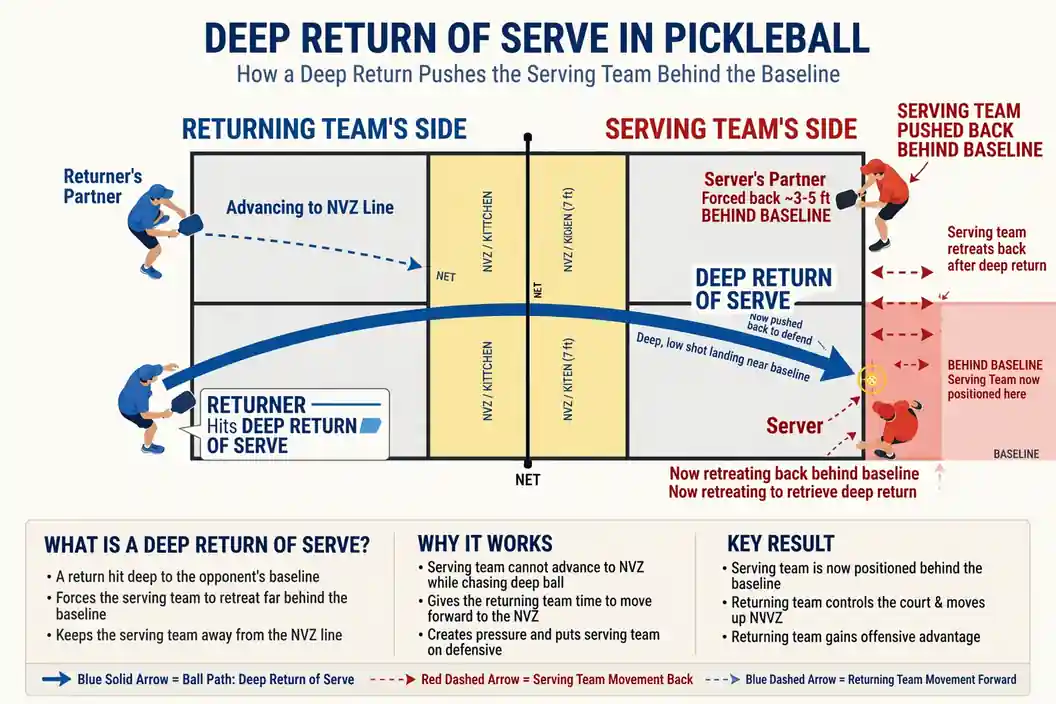
The return goes deep — always. Because the serving team must let the return bounce, the returner hits it as deep as possible, pinning both servers behind the baseline. The deeper the return, the longer the servers need to reach the net. At the pro level, a short return is practically a gift.
The returners rush the net. While the serving team is stuck waiting for the bounce, the receiving team sprints to the kitchen line. By the time the third shot is hit, the returners are already in the best position on the court. The two-bounce rule is the reason the receiving team — not the serving team — usually holds the early advantage in a rally.
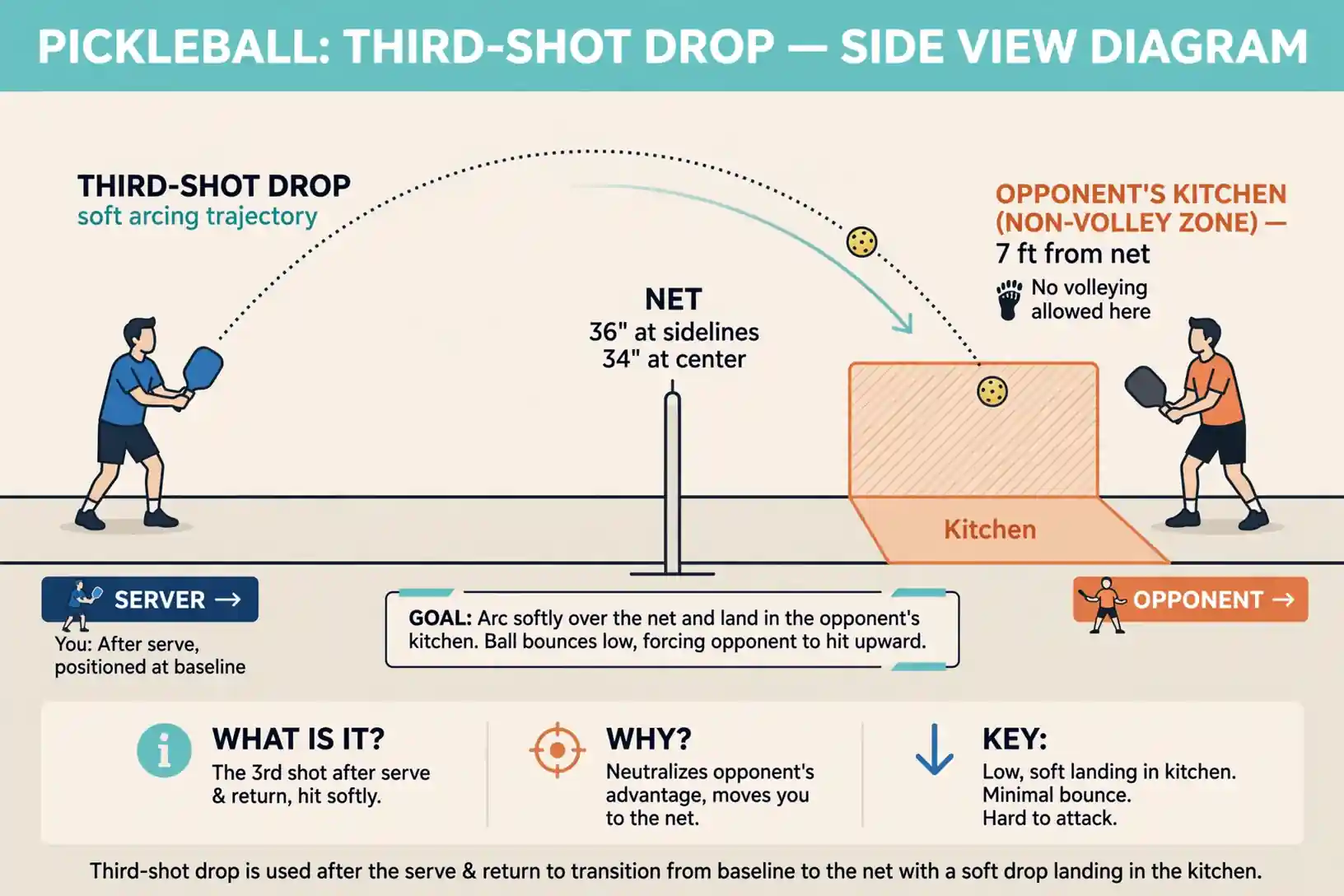
The third-shot drop was invented for this moment. The serving team’s third shot is the hardest in pickleball: they are back at the baseline, the opponents are at the net, and they must hit something soft enough to survive. The answer the pros found is the third-shot drop — a gentle arc that lands in the opponent’s kitchen, buying time to move forward. Without the two-bounce rule, the third shot would just be a volley at the net, and the drop would never have needed inventing. Full breakdown: [how to play pickleball].
So the rule does not just prevent something. It creates pickleball’s signature shot.
Common Mistakes Beginners Make
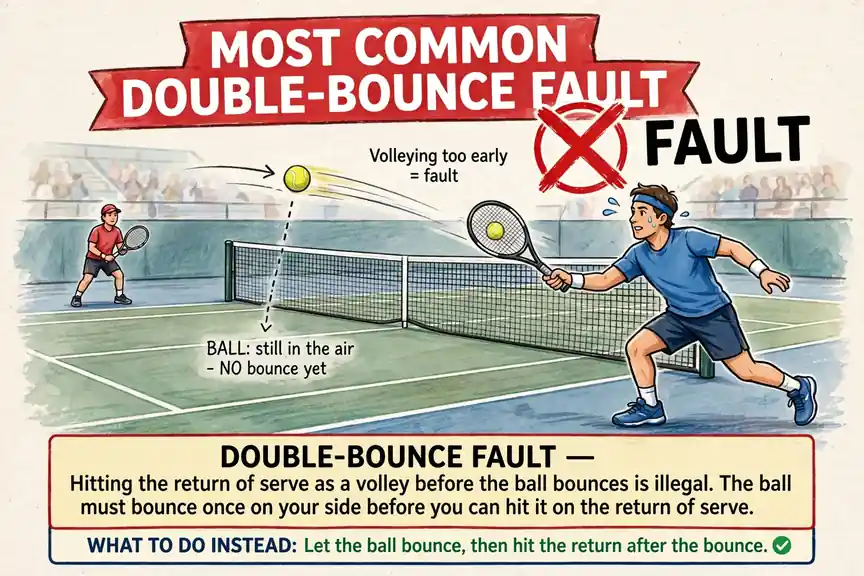
- Volleying the return. The classic. You serve, your opponent returns, and your tennis instincts scream “attack!” You volley it — fault. Let it bounce first, every time.
- Charging the net on your own serve. Same instinct, same fault. Stay back until the return bounces.
- Forgetting it applies to your partner too. In doubles, if your partner volleys the return before it bounces, your team loses the rally. Call “bounce!” for each other until it becomes habit.
- Thinking the rule lasts the whole rally. It only governs the first two shots. After the return bounces on the serving side, volleys are legal for everyone (outside the kitchen, of course — see [pickleball kitchen rule]).
- Mixing it up with the kitchen rule. These are separate rules. The two-bounce rule is about when you can volley; the kitchen rule is about where you can volley. A shot can violate both, one, or neither.
Making It Automatic: 3 Drills
Knowing the rule and obeying it at full speed are different skills. These three drills burn the rhythm into muscle memory:
1. The freeze drill. Rally with a partner with one constraint: after every serve and every return, both players must count “one” out loud when the required bounce happens. It feels silly for five minutes, then the rhythm becomes unconscious. Do it for one full game.
2. The deep-return game. Play points where the only thing you score is return depth: you win the point if your return lands within three feet of the baseline. This teaches the real lesson of the two-bounce rule — the return is not an attack, it is a positioning move.
3. The third-shot ladder. Start rallies as the serving team and play only third-shot drops — no drives allowed. Count how many drops land in the kitchen. When you can hit 7 out of 10, the rule has taught you its favorite shot.
What-If Scenarios
The serve bounces, I return it, and the ball never bounces on the server’s side because they volley it? Fault on the serving team — Rule 7.A. The return must bounce before being struck.
What if the serve itself is volleyed by the receiver? Same fault, on the receiving team. The serve must bounce first.
The ball bounces twice on my side before I hit it? That is the other double bounce (Rule 7.E) — fault, rally over. One bounce per side is required; two bounces on one side ends it.
Does the rule apply on a let serve (netted but lands legally)? The let is replayed, and the two-bounce sequence restarts with the new serve.
After the two bounces, can I volley from anywhere? Anywhere except inside the kitchen (non-volley zone). The kitchen rule takes over where the two-bounce rule leaves off.
In wheelchair pickleball, is it different? Yes — wheelchair players are allowed two bounces instead of one before returning (the two-bounce rule still requires the serve and return to bounce; the extra bounce allowance is for mobility).
Case Studies: Real Matches, Real Rules
The no-call that decided a match. At a 2026 PPA Tour event, qualifier Lenhard stood at his third match point against world No. 1 Ben Johns. Johns hit a volley that looked very close to bouncing twice before Lenhard reached it — the exact “double bounce” (two bounces, one side) this article distinguishes from the two-bounce rule. No fault was called. Lenhard returned the ball, won the rally, and won the match. “I clearly got my paddle under the ball,” Lenhard said afterward. “The ref didn’t call it, so the point went on.” Johns was visibly frustrated, but the result stood. Lesson: at full speed, even pro referees cannot always judge a bounce — which is why rec players should never argue one. If nobody is sure, play on.
The shot the rule created. Watch the third shot of any pro doubles rally and you are watching the two-bounce rule’s legacy. Because the serving team must let the return bounce, they begin every rally pinned at the baseline while the returners own the net. The pros’ answer — the soft, arcing third-shot drop into the kitchen — exists only because volleying the return is illegal. It is the most practiced shot in professional pickleball, and it is a direct child of this rule. Next time you drill your drops, remember: you are training for a problem the rulebook created on purpose.
FAQ
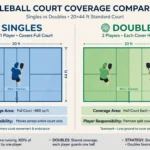
Does the double-bounce rule apply in singles too? Yes — identical in singles and doubles, rec and pro.
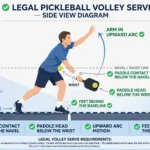
Can I volley the third shot? Yes, as long as the serve bounced and the return bounced. The third shot is the first one anyone may volley.
What if the return lands out — does the bounce still matter? No. If the return is out, the rally is already over; the serving team wins the point (in side-out scoring — see [pickleball scoring]).
Why do people call it the “double-bounce rule” if the official name is “two-bounce rule”? Habit. Players shortened it years ago, and the nickname stuck — even though it causes the confusion with an actual double bounce explained above.
Do I have to let the ball bounce if it is clearly flying out? No — and you should not. Let it fly, call “out,” and win the rally. The rule only matters for balls you intend to play.
Is there any format where this rule does not apply? No. It applies in every sanctioned format, including rally-scoring exhibitions (see [pickleball rally scoring]).
Key Takeaways
- The official name is the two-bounce rule: serve bounces, return bounces, then volleys are legal.
- A “double bounce” (two bounces on one side) is a different fault — do not mix them up.
- The rule kills the serve-and-volley advantage and forces longer rallies — that is its entire purpose.
- Pros build strategy around it: deep returns, rushing the net as returners, and the third-shot drop.
- The two most common beginner faults: volleying the serve, and volleying the return.
- When in doubt on a bounce call in rec play, play on — even pro referees miss them at full speed.
Keep Reading
- Pickleball Rules for Beginners
- Pickleball Scoring Explained
- The Kitchen Rule in Pickleball: Non-Volley Zone Explained
Keep Reading