Intro
If you have ever watched tennis, you already know most of padel scoring: the same 15–30–40–game points, the same sets, the same best-of-three matches. The confusing part is 40–40, because padel has three ways to finish a game from deuce: classic advantage, the golden point, and — new since January 2026 — the Star Point.
This guide is for complete beginners and tennis players trying padel for the first time. It follows the official Rules of Padel from the International Padel Federation (FIP), 2026 edition.
How padel scoring works, step by step
Points: love, 15, 30, 40, game
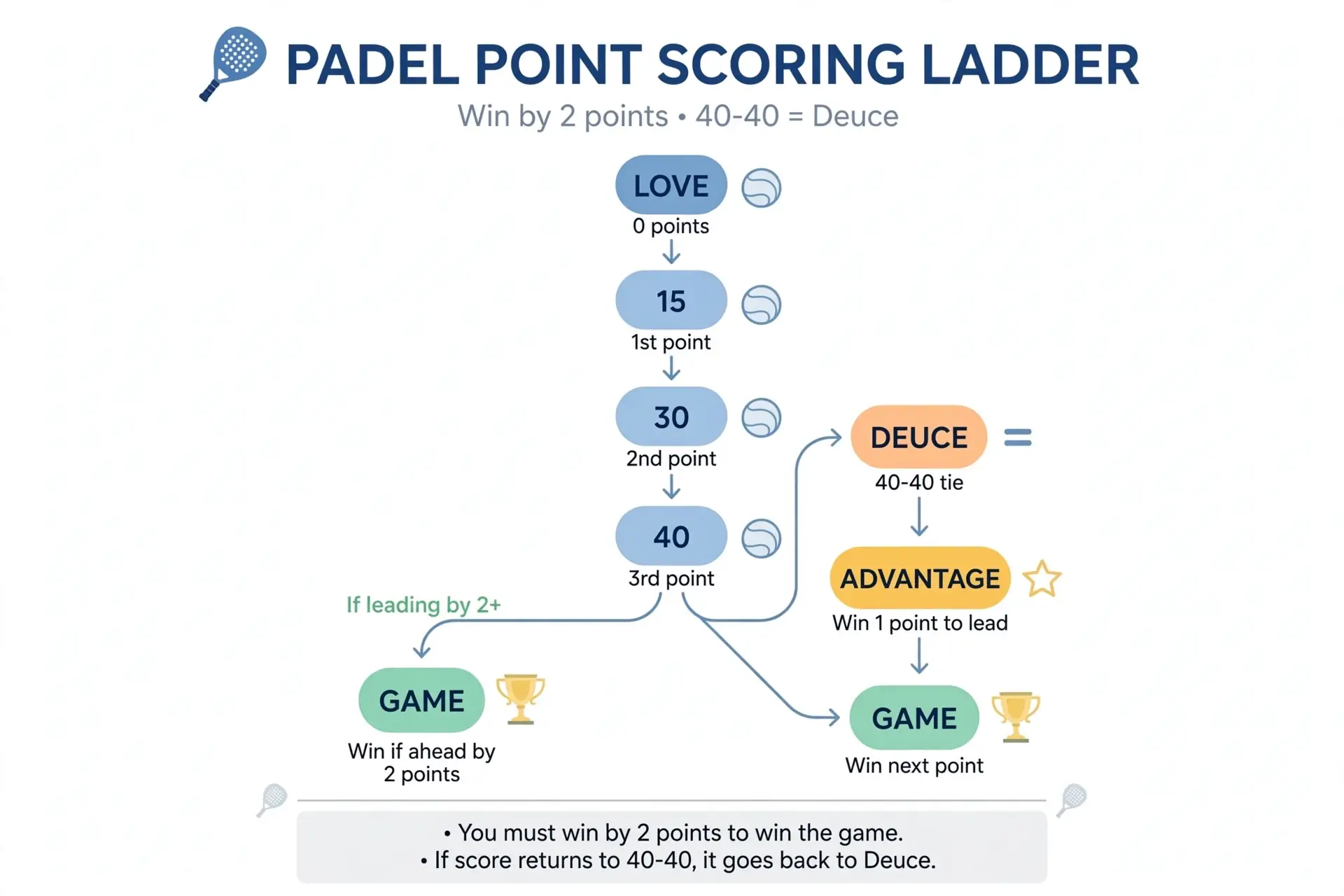
Every rally (an exchange of shots that starts with a serve and ends when someone wins it) gives the winner one point. Points have special names:
| Points won | Score called | |—|—| | 0 | Love | | 1 | 15 | | 2 | 30 | | 3 | 40 | | 4 (with a 2-point lead) | Game |
So if your pair wins the first rally, the score is 15–0. Win the next two and it is 40–0. Win one more and you win the game.
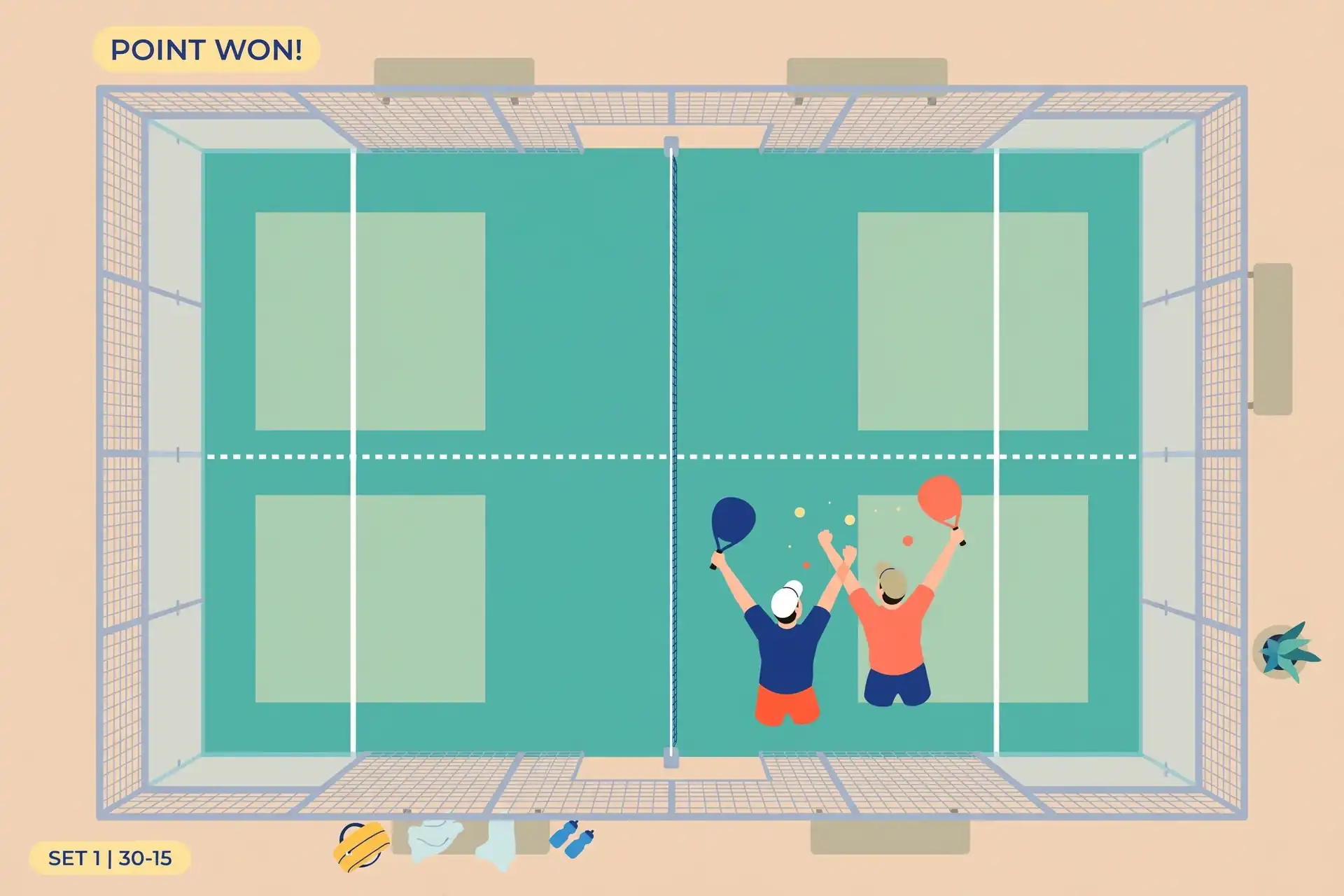
One habit to learn early: the serving pair’s score is always called first. If the servers have won two rallies and the receivers have won one, the score is “30–15,” not “15–30.” It sounds backwards at first, but every padel player does it this way.
Winning a game
To win a game, you need four points and a lead of at least two. That means:
- 40–0, 40–15, or 40–30: win the next rally and the game is yours.
- 40–40 (called deuce): the normal “win by two” path is replaced by one of three special formats — explained in the next section.
A quick example
Imagine you are serving. You win the first two rallies (30–0), lose the next one (30–15), then win the next two. The score goes 30–0 → 30–15 → 40–15 → game. Four points won, and you led by two at the end. Simple.
What happens at 40–40: three formats, one decision
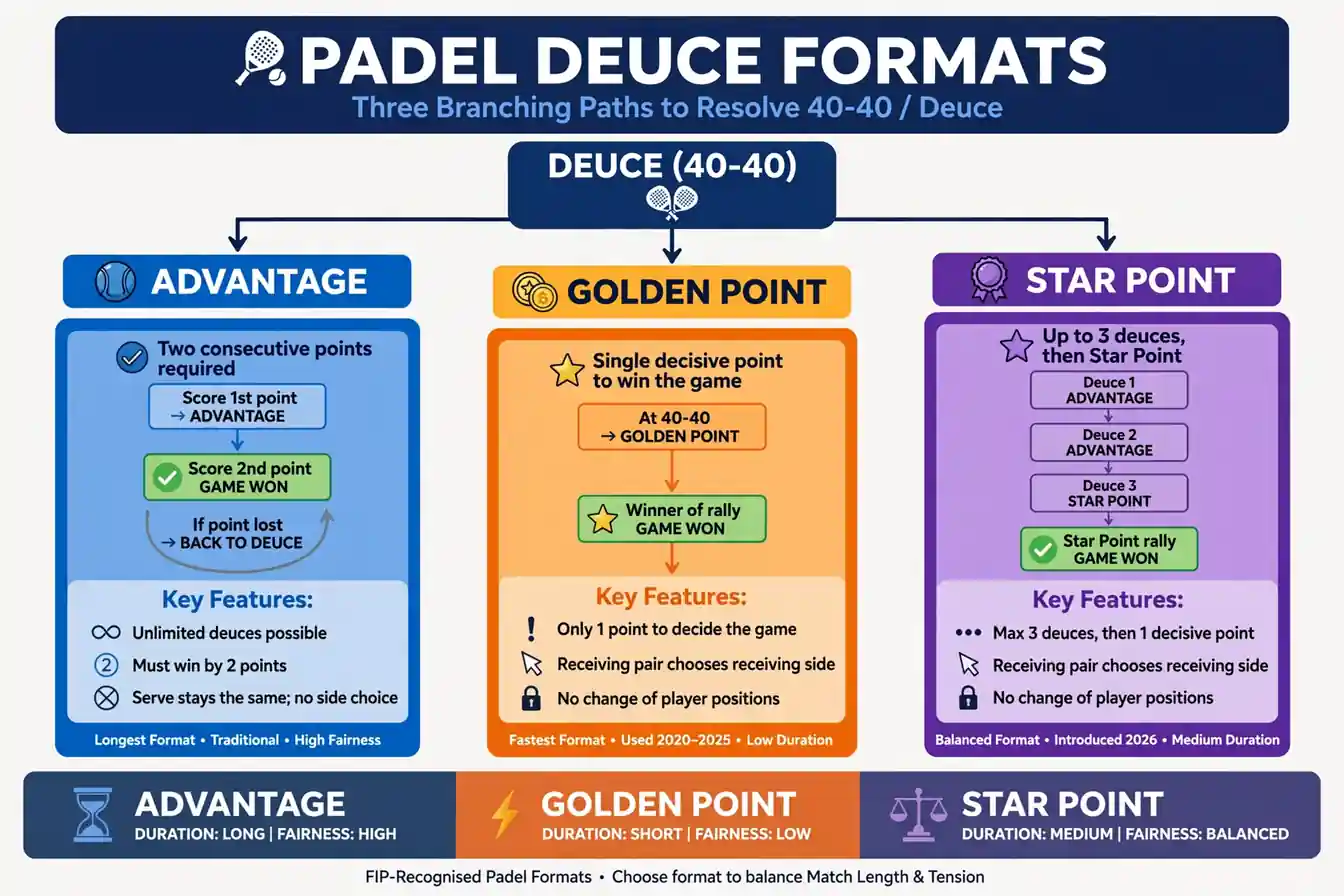
When both pairs reach 40–40, the score is deuce. The FIP’s official 2026 rulebook recognises three legal ways to finish the game from here. Your tournament or club picks one — so agree on it before the first serve.
Format 1: Advantage (the classic)
The traditional way. Win the rally at deuce and you get advantage. Win the next rally too and you take the game. Lose it and the score goes back to deuce. A game can, in theory, swing back and forth many times. This is still the default in many club matches and social games.
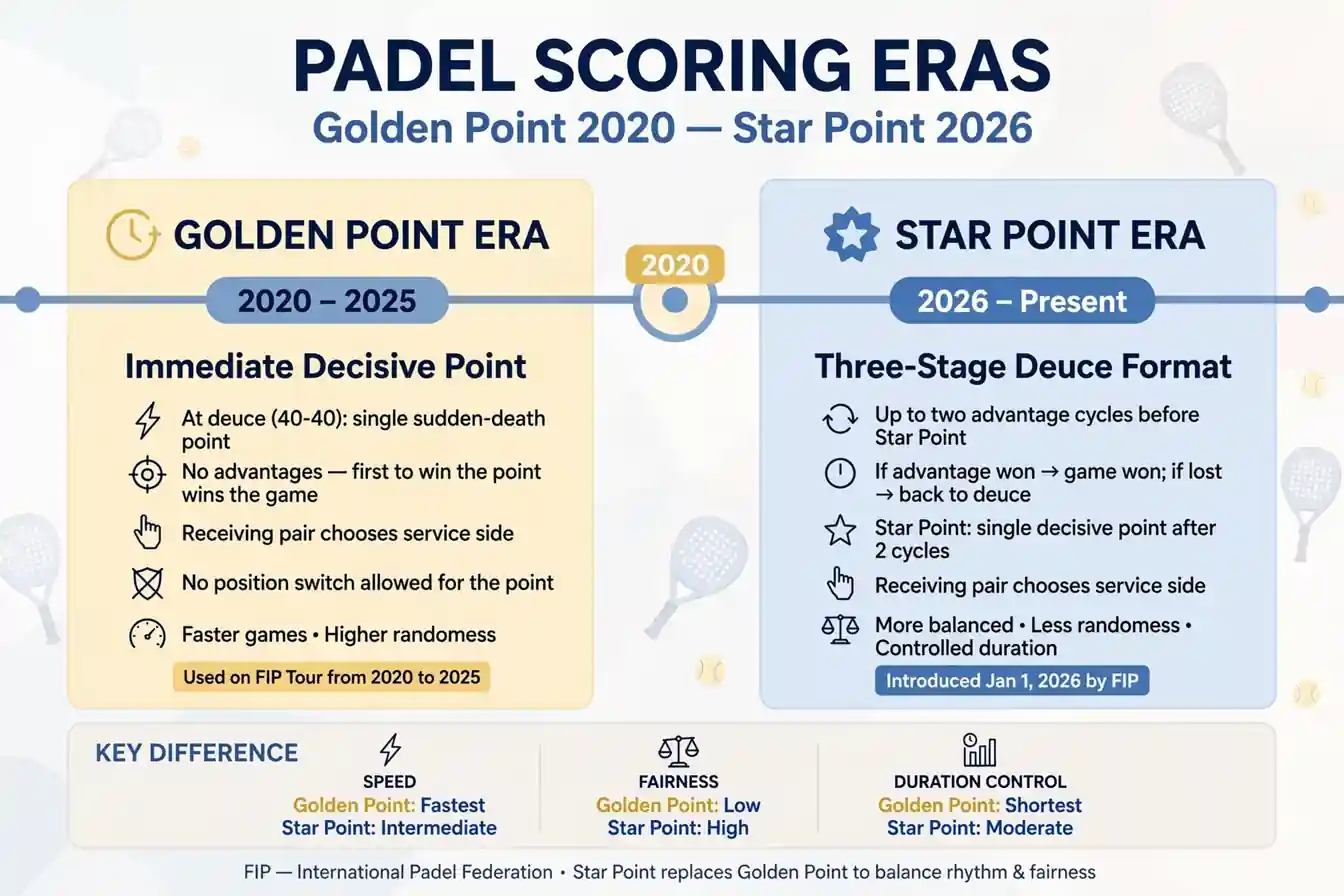
Format 2: The golden point (no-ad scoring)
The golden point — punto de oro — is sudden death at 40–40: no advantage, one rally decides the game. The official rule says the receiving pair chooses the side (right or left), the receivers cannot change positions for the deciding point, and in mixed doubles the receiver must be the same sex as the server.
The golden point ruled professional padel from 2020 to 2025, and it is still the format most clubs and social leagues use — fast, and every deuce feels electric.
Format 3: The Star Point (new for 2026)
From 1 January 2026, the FIP has used the Star Point on all its professional circuits (Premier Padel, CUPRA FIP Tour, FIP Promises, FIP Beyond). It is a compromise between advantage and the golden point:
- Deuce 1 → Advantage 1, then Deuce 2 → Advantage 2: normal advantage play — win two rallies in a row and the game is yours.
- Deuce 3 → Star Point: if the game still is not decided, one sudden-death point decides it. The receiving pair chooses the side, players cannot switch positions, and mixed doubles keeps the same-sex rule.
Two chances to win it the old-fashioned way, then one final winner-takes-all rally.
So which one will YOU play?
- Social/club padel: usually the golden point (fastest, most common).
- Local tournaments: check the rules sheet — it could be any of the three.
- Professional padel (2026 onwards): the Star Point.
If you are unsure, ask your opponent before you start. It takes ten seconds and avoids arguments at the worst possible moment.
Games, sets, and matches
Sets: first to 6, win by 2
Games add up into sets: first to 6 games with a 2-game lead. At 5–5, play continues — win two in a row for 7–5, or reach 6–6 and play a tiebreak.
The tiebreak: first to 7, win by 2
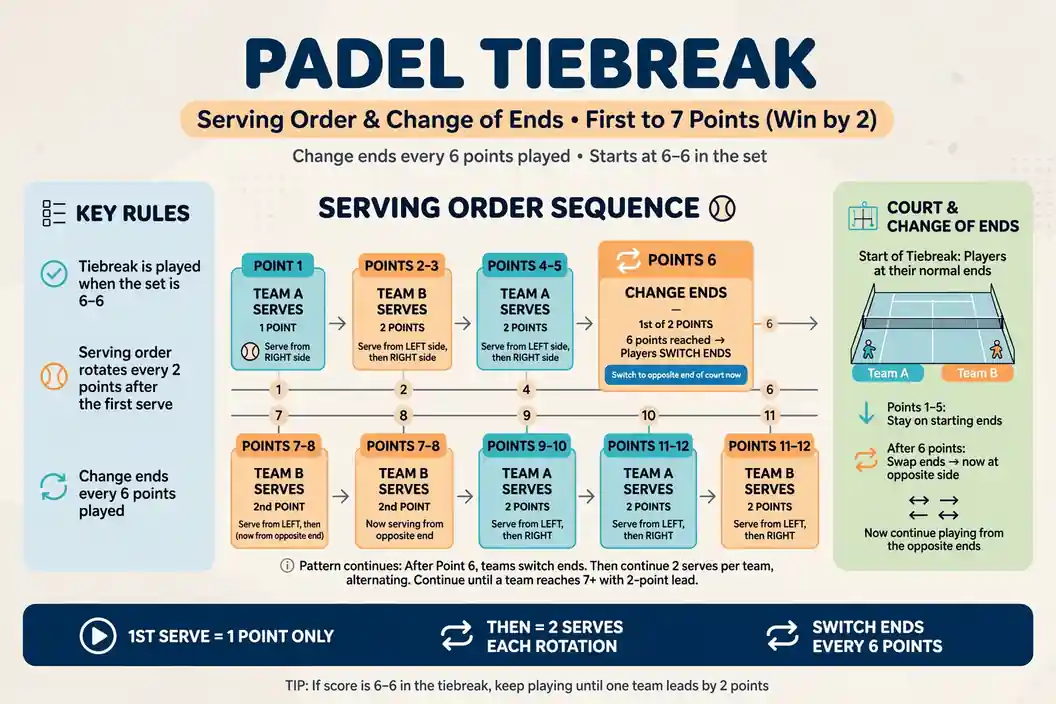
In a tiebreak, points are counted simply: 1, 2, 3, and so on (no more 15–30–40). The first pair to 7 points with a 2-point lead wins the tiebreak — and the set 7–6. If it reaches 6–6 in the tiebreak, play continues until someone leads by two.
Serving in a tiebreak goes 1–2–2: the player whose turn it is serves one point from the right, then players alternate two serves each, starting from the left. Players change ends every 6 points (and after every odd game in a normal set).
The match: best of 3 sets
A standard padel match is the best of three sets — the first pair to win two sets wins the match. Some social formats agree in advance to replace a deciding third set with a super tiebreak to 10 points (still win by 2), just to keep the session on schedule.
For more on how points are actually won and lost, see our padel rules beginner guide and our walkthrough of padel doubles rules.
Why does this rule exist?
Why tennis scoring at all?
Padel borrowed its entire scoring system from tennis — no accident. The FIP’s Rule 1 is written in tennis language because padel grew up inside tennis clubs and wanted to feel instantly familiar to millions of players. The quirky 15–30–40 counting (often traced to a clock face in medieval France) came along as part of the package.
Why the golden point? (2020)
In February 2020 the World Padel Tour introduced the golden point at the Marbella Masters. Its director-general, Mario Hernando, said the goal was to add tension and make padel more exciting to watch, live and on television — long advantage games made match lengths unpredictable. The idea came from doubles tennis, where the ATP already used no-ad scoring. It worked, but critics said one rally deciding a whole game felt too random and punished the serving pair.
Why the Star Point? (2026)
The Star Point is the FIP’s answer to that criticism: keep two rounds of classic advantage drama, then cap the game with a single deciding point so matches stay on schedule. It preserves the rhythm of advantage play while guaranteeing no game drags on forever — a compromise between tradition and television.
What-if scenarios
What if we reach 40–40 and never agreed on a format? Stop and agree before the next point. In a friendly game, the golden point is the usual default. In a tournament, the organiser’s rules decide.
What if the receivers want to swap sides for the golden point? They can choose which side to receive from, but the FIP rules say the receiving pair cannot change positions for the deciding point. Pick the side — the player standing there receives.
What if it is mixed doubles? On a golden point or Star Point, the receiver must be the same sex as the server.
What if the tiebreak reaches 6–6? Keep playing. There is no cap — someone must lead by two points, even if it goes to 12–10 or beyond.
What if the set reaches 5–5? Play on. At 7–5 the set ends; at 6–6 you play a tiebreak.
What if we agreed to a super tiebreak instead of a third set? Then at one set all, a single tiebreak to 10 points (win by 2) replaces the full third set.
What if the server serves from the wrong side in the tiebreak? Correct it as soon as it is discovered. Points already played still count.
What if the score is called wrong? Fix the call and continue — but points already played stand, even if the mistake is only noticed later.
Case studies: the rules in real matches
1. The first golden point in pro history — Marbella Masters, 2020
When the World Padel Tour opened its 2020 season at the Marbella Masters, every game that reached deuce ended with a golden point — the first in pro padel history, played in the pre-qualifying rounds on 29 February 2020. Players who had spent their careers grinding through advantage games suddenly faced winner-takes-all rallies from day one.
2. A tiebreak for the ages — Valencia P1 final, June 2026
The men’s final of the Valencia P1 in June 2026 — played under the new Star Point-era rules — showed how dramatic padel scoring gets. Arturo Coello and Agustín Tapia beat Alejandro Galán and Federico Chingotto 7–6, 1–6, 7–6. In the third-set tiebreak, Galán and Chingotto led 5–1 — then Coello and Tapia won six straight points to steal the title, their 23rd consecutive final as a pair.
3. The longest match in Premier Padel history — Italy Major semifinal, June 2026
Also in June 2026, the women’s semifinal of the Italy Major in Rome between Ariana Sánchez and Andrea Ustero and Bea González and Paula Josemaría lasted 4 hours and 12 minutes — the longest match in Premier Padel history. Even with the faster Star Point deuce format in force, the combination of games, sets and tiebreaks can still produce an epic — proof that scoring formats shape matches but never fully tame them.
FAQ
Is padel scoring exactly the same as tennis scoring? Almost. Points, games, sets and tiebreaks work the same way. The differences are the deuce formats: tennis mostly uses classic advantage, while padel officially recognises advantage, the golden point, and (from 2026) the Star Point.
What is the golden point in padel? A sudden-death rule used at 40–40 instead of advantage play. One rally decides the game. The receiving pair chooses which side to receive from, and the winner of that single point wins the game.
Is the golden point still used in professional padel in 2026? No — from January 2026 the pro circuits (Premier Padel, CUPRA FIP Tour and others) use the Star Point instead. The golden point is still very common in club and social padel.
What is the Star Point? The FIP’s 2026 deuce format: up to two advantage cycles are played, and if the game still is not decided, a single sudden-death Star Point decides it. The receivers choose the side and cannot swap positions.
Who decides which side to receive on a golden point? The receiving pair. This is the only point in padel where the returners — not the normal rotation — choose the side.
How does a padel tiebreak work? First to 7 points, win by 2. The first server serves one point from the right, then players alternate serving two points each. Change ends every 6 points.
How long does a padel match last? A best-of-three match typically takes 60 to 90 minutes at club level; the golden point shortens matches by roughly 10 to 15 minutes versus full advantage scoring.
Do you always have to win by two points in padel? In games played with advantage scoring: yes, two in a row from deuce. In sets: yes, two games (except via tiebreak at 6–6). In tiebreaks: yes, two points. The golden point and Star Point are the exceptions — one rally decides the game.
Key takeaways
- Padel scoring is tennis scoring: points go love – 15 – 30 – 40 – game, and the server’s score is called first.
- At 40–40 (deuce), three formats exist: advantage (win two in a row), the golden point (one sudden-death rally, 2020–2025 pro era, still common socially), and the Star Point (two advantage cycles, then one deciding point — pro standard from 2026).
- On a golden point or Star Point, the receiving pair chooses the side, cannot swap positions, and in mixed doubles the receiver must match the server’s sex.
- Sets go to 6 games (win by 2); at 6–6 a tiebreak to 7 (win by 2) decides it; matches are best of 3 sets.
- Agree your deuce format before the first serve — it is the single most useful scoring habit in padel.
Want to go deeper? Read our padel serve rules, how playing off the glass walls works, and the most common beginner mistakes to avoid.
Keep Reading
Keep Reading
- Padel Serve Rules: Underhand, Bounce First, Diagonal
- Padel Doubles Format, Tie-Breaks and Match Format
- Playing Off the Glass Walls: Padel Wall Rules
- Padel Doubles Positioning + Common Beginner Mistakes