Intro
Pickleball scoring confuses almost every beginner — not because it is complicated, but because it is different from every other racket sport. In tennis or badminton, whoever wins the rally scores a point. In pickleball, winning the rally is only half the story: it also matters who served. This guide explains the whole system in plain language — side-out scoring, the three-number score call, server rotation, and the newer rally scoring format — with real finishes from pro matches so you can see exactly how games end.
The One Rule That Explains Everything
Traditional pickleball scoring runs on a single idea: only the serving team can score a point.
- Win a rally while your team is serving → you score a point.
- Win a rally while your team is receiving → you score nothing. Instead, you earn the serve.
That second line explains the strangest thing on a pickleball court: a score that sits at 8–3 for what feels like forever. The receiving team can win rally after rally and the scoreboard will not move — until they finally take the serve and start scoring. Under the official rules, the serve is something you earn, not something you take in turns.
This makes the serve a valuable asset. A team on a hot serving streak can run up the score quickly; a team that keeps giving the serve back can play brilliantly for ten minutes and add zero points. Holding your serve matters far more in pickleball than in most sports.
How to Call the Score: Three Numbers in Doubles, Two in Singles
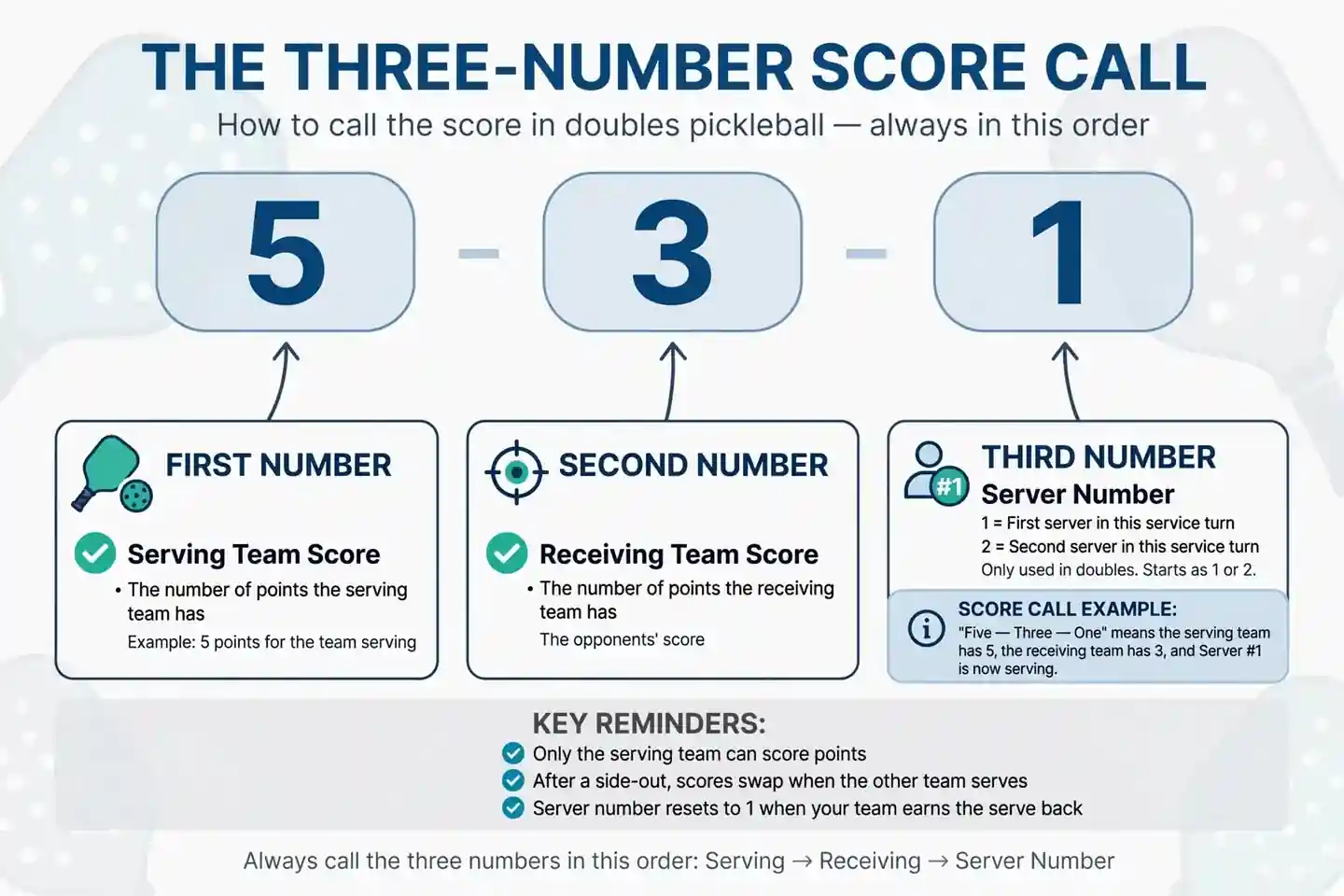
Before every serve, the server must call the score out loud. This is not just polite — under USA Pickleball rules, serving before the score is called is a fault. The call gives both teams one shared reference point and prevents most arguments.
Doubles: three numbers, in this exact order: the serving team’s score, the receiving team’s score, then the server number. “6–3–2” means: we have 6, they have 3, and I am the second server. That third number is the one beginners forget — and the most useful one, because it tells everyone how many faults remain before the serve changes hands.
Singles: two numbers. The server’s score, then the receiver’s score: “5–3” means the server leads; “0–4” means the server trails. No server number — one server per side.
Build this habit now: say all three numbers clearly on every serve, even in casual games. Skipped or mumbled calls cause most score disputes.
The 0-0-2 Start
Every doubles game begins at “0–0–2,” never “0–0–1.” It feels like a mistake the first time you hear it — it is actually a built-in handicap.
The team that serves first gets only one server instead of two. If that opening server loses the rally, it is an immediate side-out. The opening server is treated as the “second server” — hence the 2 — so the first side-out comes quickly. Without this rule, serving first would be too strong an advantage. After that opening side-out, both teams get two servers per turn for the rest of the game.
Server Rotation: Who Serves, From Where, and When It Changes
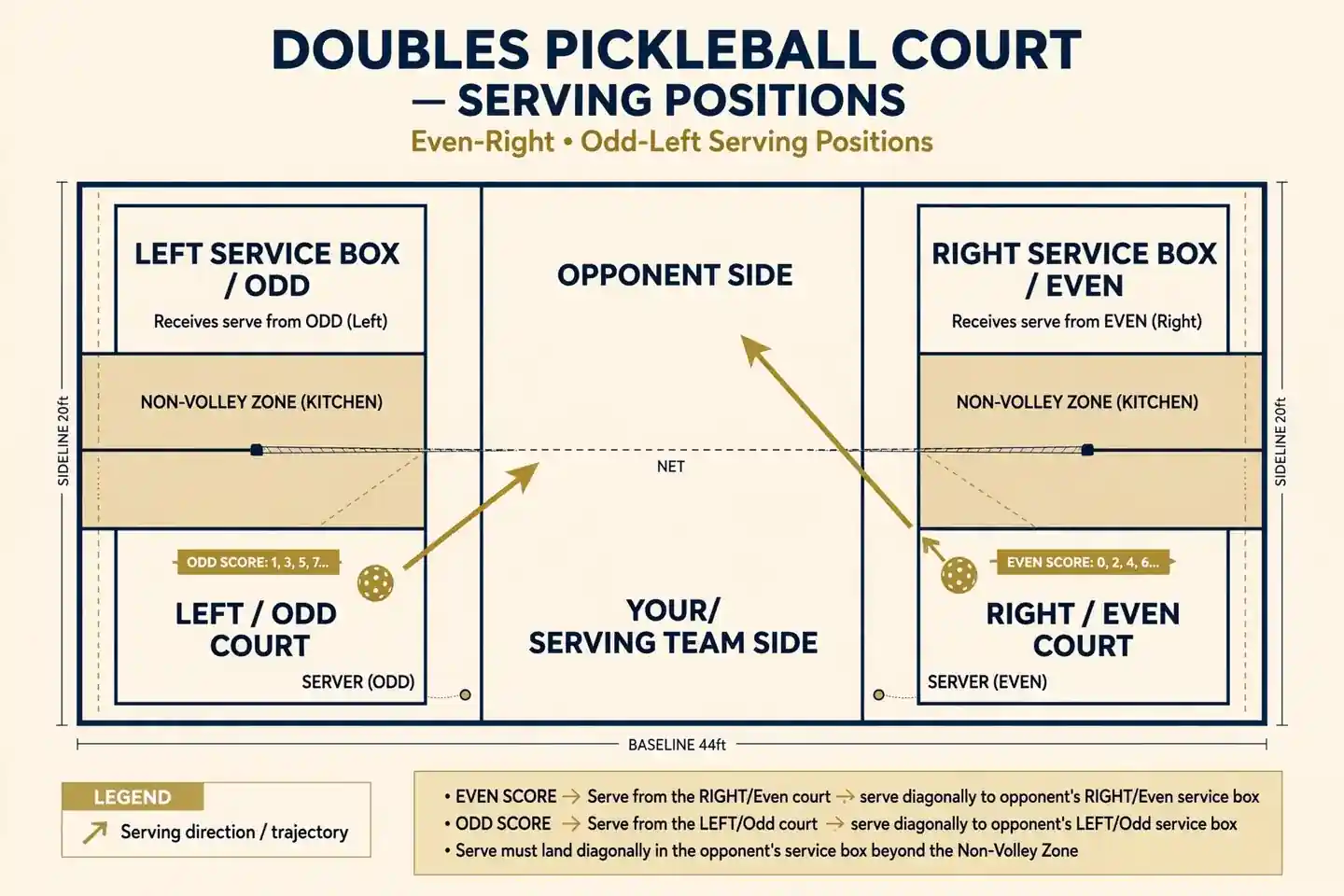
Serve rotation and the score are linked — and the link tells you where to stand: even score (0, 2, 4…) = serve from the right court; odd score (1, 3, 5…) = serve from the left. This applies to singles and doubles alike.
The full doubles sequence:
- After the 0–0–2 start, the first side-out gives the other team the serve, beginning with their player in the right court as server 1.
- Win the rally on your serve → score a point, partners switch sides, and the same server serves again. (At 0 you score to 1 — odd — so the server moves left.)
- Lose the rally on your serve → nobody scores. The serve passes to your partner (server 2), who serves from wherever they stand. No switching on this exchange.
- Lose the rally on server 2 → side-out. The opponents start with the player in their right court as server 1 and call their score first.
In singles, one fault hands the serve over immediately — no second server. Think of each team’s serving turn as an inning with two outs: each fault is an out, and two outs means side-out.
How a Game Ends: 11 Points, Win by 2
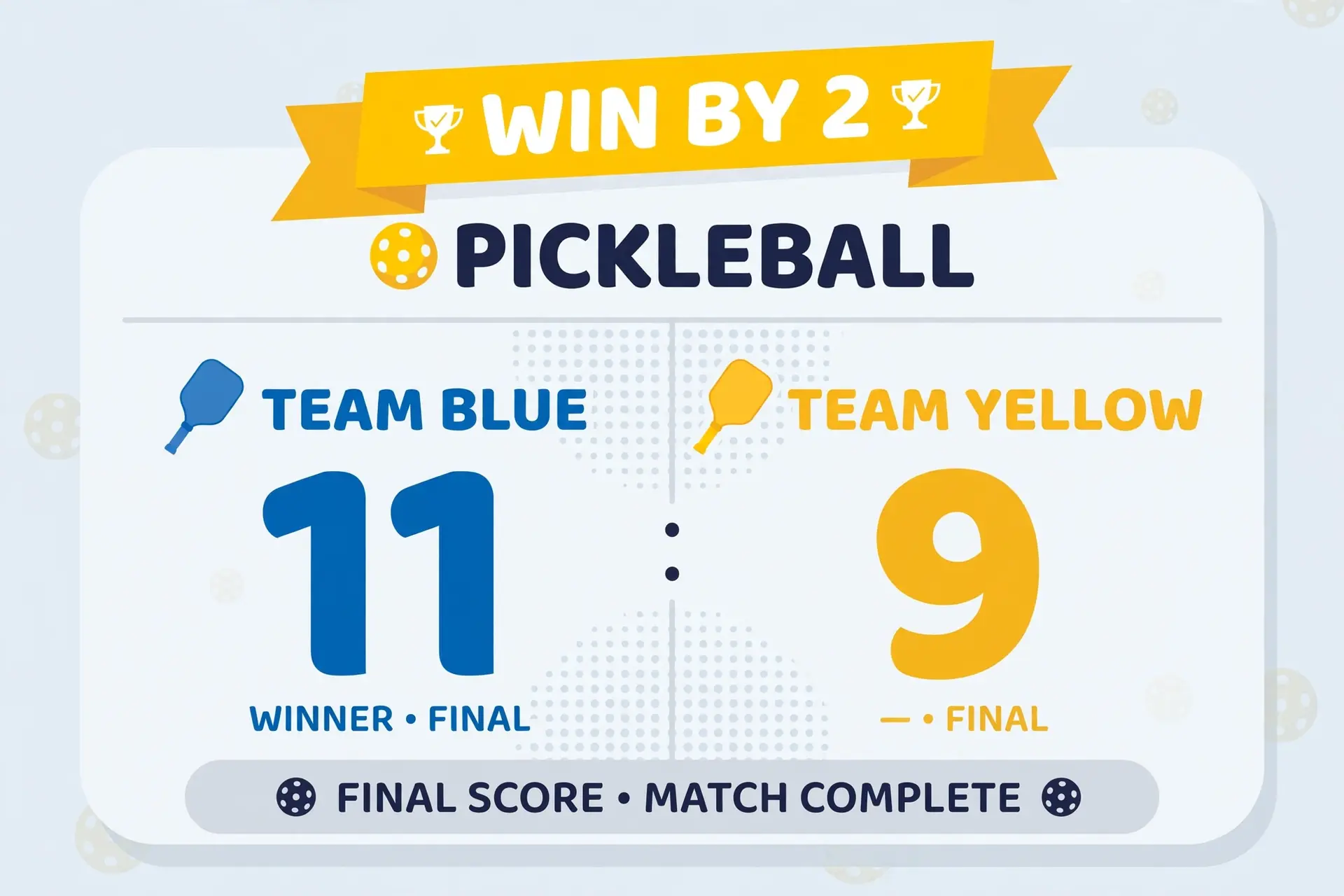
The standard game goes to 11 points, and the winner must lead by at least 2. 11–9 ends the game; 11–10 does not — play continues until someone opens a two-point gap, so a tight game can finish 12–10, 14–12, or longer. There is no cap.
Win-by-two applies at every target score. Rec games are almost always to 11, but tournaments often raise the target — later rounds to 15, finals to 21 — always win by 2. Confirm the target with your opponents before the first serve; expecting 11 and discovering at 10–9 that you are playing to 15 is an avoidable frustration.
Rally Scoring: Where Every Rally Counts
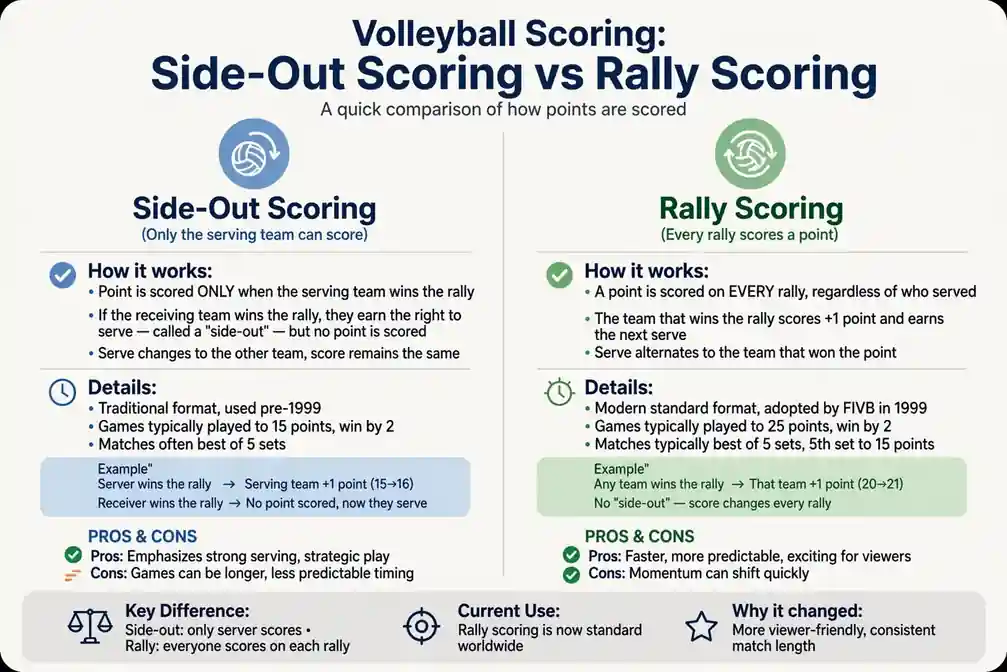
Everything above is side-out scoring — the official standard for most recreational play and USA Pickleball-sanctioned events. But there is a second system: rally scoring, where the winner of every rally scores a point, no matter who served.
The difference is stark. In side-out scoring, the receiving team can win rallies for free — no points change hands, only the serve. In rally scoring, there are no free rallies: every rally moves the scoreboard. Games usually target 15 or 21 (win by 2), and matches finish faster and more predictably — which is why leagues and broadcasters like it.
Major League Pickleball (MLP) put rally scoring on television. When MLP introduced it in 2023, games went to 21 (win by 2) with a twist: at 20 points a team was “frozen” and could only score its winning point while serving. MLP has since moved its main doubles games back toward traditional side-out scoring, keeping rally scoring in the “DreamBreaker” — a singles tiebreaker to 21 where each team’s four players rotate in for four points at a time.
In 2025, USA Pickleball provisionally recognised rally scoring as an optional format for specific tournament play — doubles rally scoring for round-robin and team formats, singles for double-elimination. It remains optional, chosen per event by the tournament director. The practical lesson: always check which scoring system your event uses before warming up. It changes how every rally feels.
Why Does This Rule Exist?
Side-out scoring came with the original game. When Joel Pritchard, Bill Bell, and Barney McCallum invented pickleball in 1965, serve-based scoring was simply the racket-sport tradition they all knew — badminton worked exactly this way (only the serving side scored, in games to 15) until its world federation switched to rally scoring in 2006 to shorten matches for television. Pickleball kept the classic style.
The classic system protects what the founders cared about most: long rallies for ordinary players. Because only the serving team scores, every board point is earned twice — once by winning the serve, once by holding it. That slows scoring down, gives beginners more rallies per game, and keeps comebacks alive: in side-out scoring, a team down 8–3 can win six straight rallies, take the serve, and reel off five unanswered points to steal the game. In rally scoring, a 20–16 lead is nearly over. Momentum swings are the entertainment — and side-out scoring manufactures them.
One honest note: unlike the kitchen, which has a documented design purpose, there is no recorded “eureka moment” for the founders’ choice of side-out scoring. The likeliest explanation — that it was the scoring tradition they knew — is supported by the era, not by a founding document. We say that plainly rather than inventing a story.
What-If Scenarios
The server calls the wrong score? Stop play before the serve and correct it. If nobody notices and the serve is struck, the rally usually stands in rec games — which is why the call is required before every serve.
The server serves before calling the score? That is a fault under the official rules. The call is part of the serve’s legal requirements.
The wrong player serves? In a refereed match, a fault once discovered. In rec play, replay from the point of the error if caught quickly. The even/odd rule is your built-in error check: even score serving from the left means something is wrong.
The score reaches 10–10? Keep playing. No cap in traditional scoring — the game continues until someone leads by two.
My team keeps winning rallies but the score never moves? You are winning as the receiving team. You are earning the serve, not points. Once the serve comes to you, those rallies start moving the scoreboard.
Only 20 minutes for a game? Agree a shorter target before starting — many groups play to 7 or 9, or rally scoring to 11. Everyone must agree before the first serve.
Case Studies: Real Finishes That Show How Scoring Works
The 24–22 championship game. The decisive game of the 2023 MLP Finals in Dallas — Orlando Squeeze versus the DC Pickleball Team — was played under rally scoring to 21, win by 2. It did not stop at 21. Neither team could open the two-point gap, and the game stretched to 24–22 before DC closed it out, sweeping the match 3–0 for the championship. It shows why win-by-two exists: at 22–22, the game is not about reaching a number — it is about being two points better when it matters.
The two-and-a-half-hour classic. In a 2025 PPA Tour final in Las Vegas, Ben Johns and Gabe Tardio faced Christian Alshon and Andrei Daescu before a national ESPN audience. Under side-out scoring, the match ran 12–10, 9–11, 11–7, 4–11, 12–10 — five games, two hours and twenty-eight minutes, at the time the longest match in PPA Tour history. Two of the five games stretched past 11 because of win-by-two. Side-out scoring does not just change who scores — it stretches decisive games and builds the tension that holds an audience for nearly two and a half hours.
The dreambreaker comeback. The 2023 DUPR Collegiate National Championship final — University of Virginia versus University of North Carolina — came down to a DreamBreaker: the rally-scoring singles tiebreaker to 21, with each team’s four players rotating in for four points each. UNC raced to 20–16 and stood on championship point. Twice UVA defended it, clawed back to earn a championship point of their own, and stunned UNC 23–21. Under rally scoring there are no free rallies to regroup in — every comeback point hurt.

FAQ
Why three numbers for the score? In doubles each team has two servers. The third number (1 or 2) says which partner is serving and how many faults remain before a side-out.
Why does the game start at 0–0–2? The first serving team gets only one server before the first side-out. The opening server counts as the “second server” to offset the advantage of serving first.
Can the score go past 11? Yes. With win-by-two there is no cap — 12–10, 13–11, 17–15, and beyond.
Do tournaments always play to 11? No. Early rounds are often to 11, later rounds to 15, finals to 21 — always win by 2. Confirm before your match.
What is the difference between side-out and rally scoring? Side-out: only the serving team scores. Rally: the winner of every rally scores, regardless of who served. Rally games are usually to 15 or 21.
Is rally scoring official? Side-out remains the official standard for USA Pickleball-sanctioned events. In 2025, USA Pickleball provisionally recognised rally scoring as an optional format for certain tournament types. MLP uses it in the DreamBreaker.
I lost track of the score — what now? Ask. And use the even/odd rule (even score = serve from the right, odd = from the left) to reconstruct who should be serving from the score alone.
Key Takeaways
- Only the serving team scores. Win rallies as the receiver and you earn the serve — not points.
- Call the score before every serve: three numbers in doubles, two in singles.
- Every doubles game starts at 0–0–2 — the first serving team gets just one server.
- Even score = serve from the right; odd score = serve from the left.
- Standard games go to 11, win by 2. Tournaments may use 15 or 21 — confirm first.
- In rally scoring, every rally scores a point no matter who served. Check your event’s format.
Keep Reading
Keep Reading
- The Kitchen Rule in Pickleball: Non-Volley Zone Explained
- Rally Scoring vs Traditional Scoring in Pickleball
- Pickleball Doubles Positioning and Strategy Basics
- Common Pickleball Beginner Mistakes + Choosing Your First Paddle