Intro
About to play pickleball for the first time? You do not need a 90-page rulebook. A small set of official rules covers almost everything you will meet on the court: how to serve, what the kitchen is, why the ball must bounce twice, and how scoring works. This guide explains each one in simple words, with real examples from pro matches so you can see the rules working in real life. Give it ten minutes, and you will be ready for your first game.
The Court: What You Are Standing On
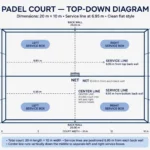
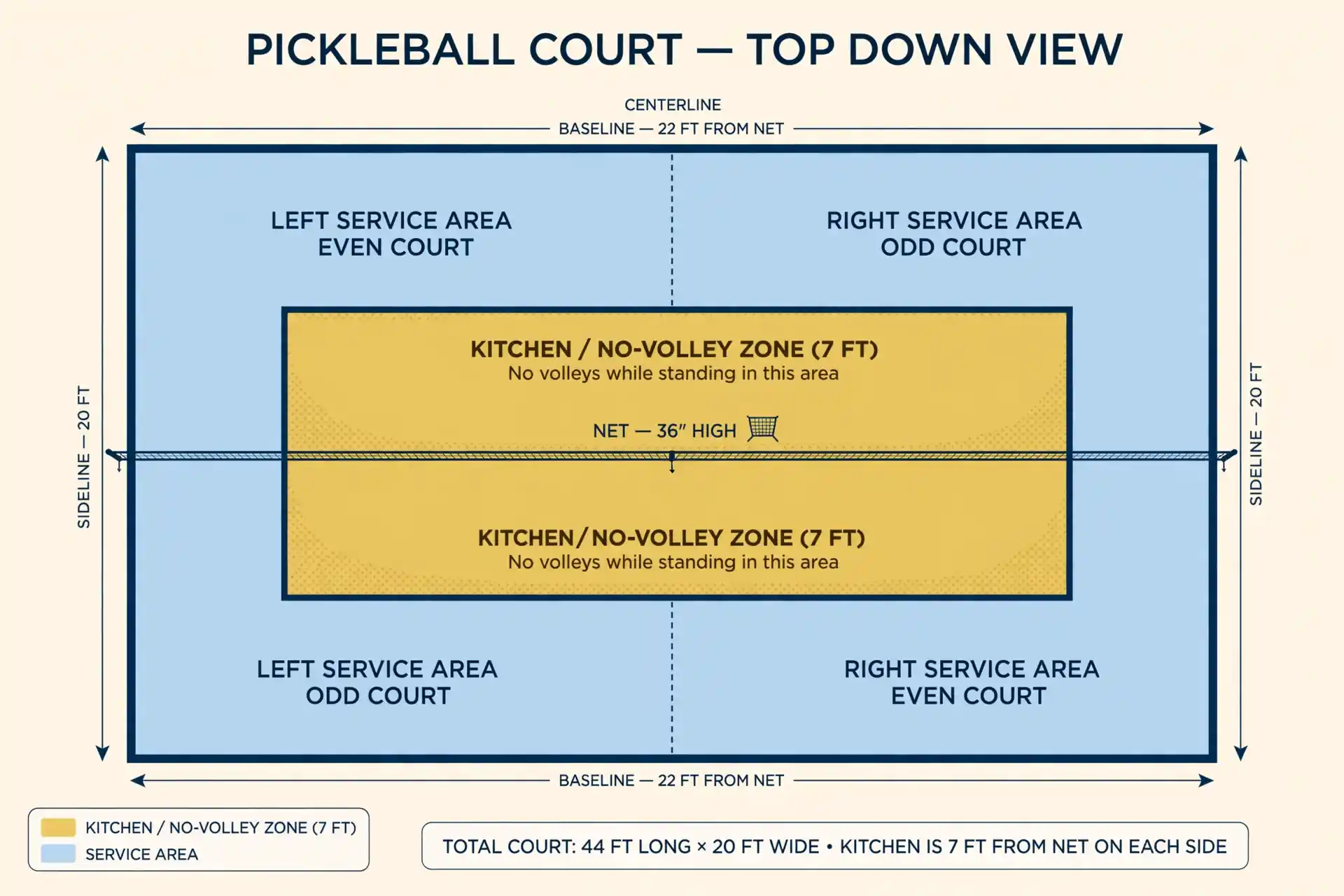
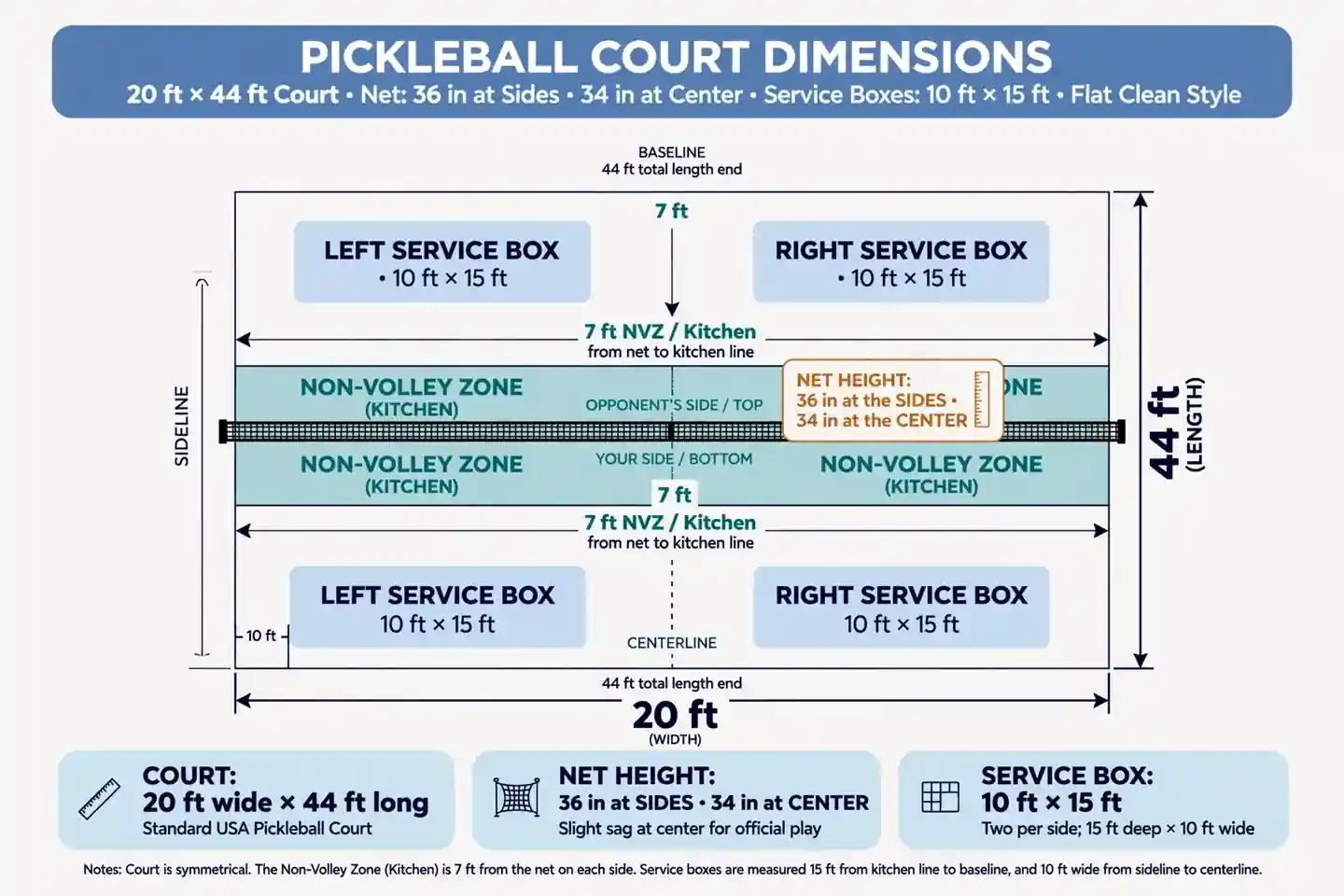
A regulation court is 20 feet wide and 44 feet long (6.10 m by 13.41 m) — and it is exactly the same size for singles and doubles. Unlike tennis, nothing changes when fewer players are on the court.
The net stands 36 inches (0.91 m) high at the sidelines and dips to 34 inches (0.86 m) at the center. Court lines are 2 inches wide, and a ball touching any line is “in” — with one famous exception covered in the serve section.
Know these zones by name:
- Baselines — the back lines, 22 feet from the net. Every serve starts behind one.
- Service boxes — behind the kitchen on each side, split by a centerline into left and right boxes, each 10 feet wide and 15 feet deep.
- The kitchen — officially the “non-volley zone,” a 7-foot strip on each side of the net running the full width of the court. Pickleball’s most famous rule lives here.
The Serve: Every Rule in One Place
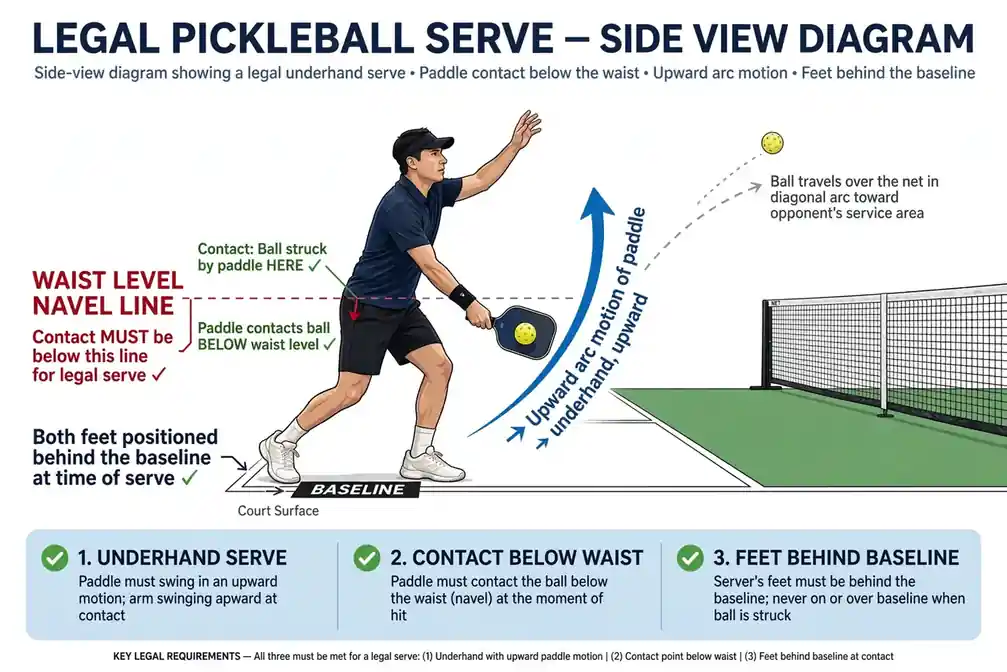
Beginners break serving rules more than any others. Here is the complete official checklist:
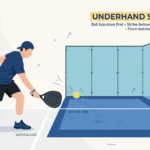
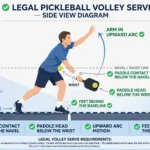
- Underhand motion. Your arm must move in an upward arc when the paddle strikes the ball.
- Contact below the waist. The paddle must strike the ball at or below waist level, with the paddle head not above the highest part of your wrist.
- Diagonal and legal. The serve travels into the opposite service box and must clear the kitchen completely — a serve landing on the kitchen line is a fault.
- Feet behind the baseline. At least one foot must be behind the baseline at contact, and your feet may not touch the court or cross the imaginary extensions of the sideline and centerline.
- One attempt. Exactly one serve attempt per turn — unless a “let” happens (the ball clips the net and still lands legally), which is replayed with no penalty.
- No added spin. You may not put spin on the ball with your hand during the release.
There is a second legal option: the drop serve. Drop the ball and hit it after it bounces — and the underhand-arc, below-waist, and paddle-below-wrist requirements do not apply. Since the 2025 rule update, you may also let the ball roll off your paddle face (gravity only) to start a drop serve. Both serve types stayed legal in the 2025 USA Pickleball rulebook; deliberately spinning the ball on release stays banned.
One more 2025 update: if the server calls the score and you are not ready, you can now say “stop” or “wait” out loud, and the server must hold. No more confusion about hand signals.
The Two-Bounce (Double-Bounce) Rule
This rule is unique to pickleball, and it is why rallies last longer than in most racket sports:
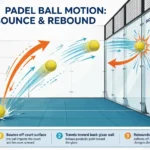
- The serve must bounce on the receiving side before the returner hits it.
- The return must bounce on the serving side before the server hits it.
- After those two bounces, either team may volley or let it bounce — your choice.
Remember the rhythm: serve, bounce. Return, bounce. Then play. USA Pickleball’s rulebook states the purpose plainly: the rule “eliminates the serve and volley advantage and extends rallies.” Without it, the serving team could rush the net and smash the return — and most points would end in three shots. Deep dive: [pickleball double bounce rule].
The Kitchen (Non-Volley Zone)
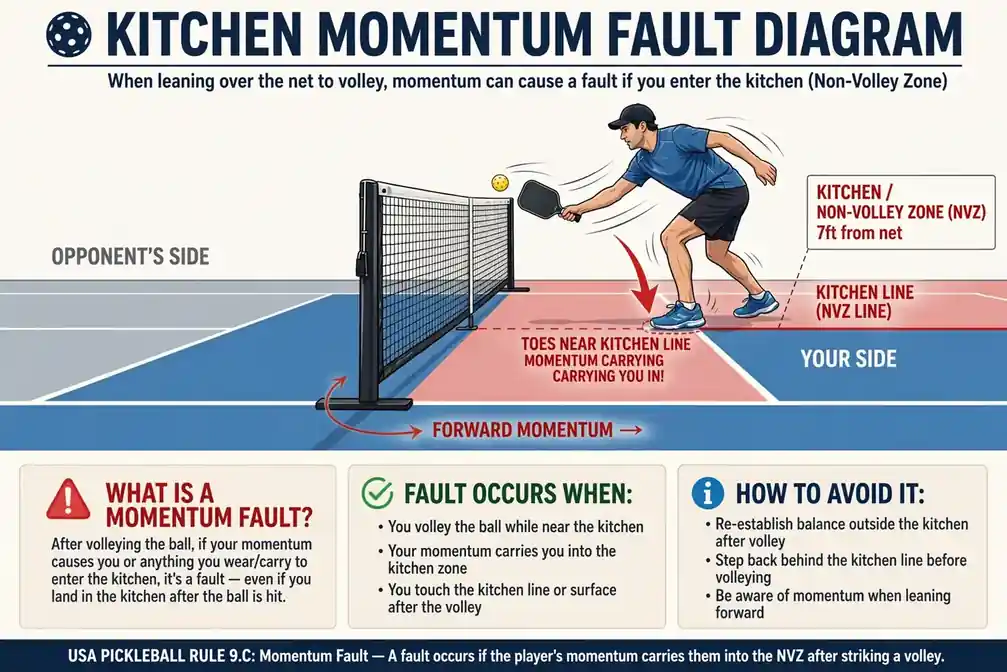
The kitchen is the 7-foot zone on each side of the net. The rule sounds simple but has sharp edges:
- No volleying while standing in the kitchen — a volley means hitting the ball before it bounces.
- The kitchen line counts as the kitchen. Touching it while volleying is a fault.
- Momentum counts. If your momentum carries you into the kitchen after a volley — even after the ball is dead — it is a fault.
- Anything you wear or carry counts. If your hat or a sticker falls off your paddle into the kitchen during a volley, that is a fault. (A pro learned this the hard way — see the case studies.)
- Touching your partner counts. Crash into your partner while they volley and step in the kitchen, and Rule 9.C treats you as one player — fault.
- You may stand in the kitchen anytime you are not volleying. Walk through it, stand in it, hit balls that have already bounced. The rule is only about volleys.
This is why pickleball looks nothing like tennis at the net: you cannot camp on the net and smash everything. You must win points with soft shots (“dinks”), placement, and patience. Full breakdown: [pickleball kitchen rule].
Scoring: The 30-Second Version
Traditional pickleball scoring has one big idea: only the serving team can score a point. Win a rally while serving and you score. Win a rally while receiving and you earn the serve back — but no point. Games are normally played to 11 points, win by 2 (tournaments sometimes use 15 or 21, always win by 2).
In doubles, the server calls three numbers before each serve — “6–3–2” means: our score 6, their score 3, second server. Singles uses two numbers: server’s score, then receiver’s score. Every doubles game starts at “0–0–2” because the first serving team gets only one server before the first side-out. Full guide: [pickleball scoring].
Faults: What Ends a Rally
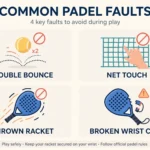
A fault stops play instantly — there are no do-overs. A fault by the receiving team gives the serving team a point; a fault by the serving team loses the serve.
- Serve lands outside the correct box (including on the kitchen line).
- Ball hits the net and does not cross over.
- Ball is volleyed before the two required bounces.
- Ball lands out of bounds (lines are “in,” except the kitchen line on a serve).
- Ball bounces twice before being returned.
- Volley hit from inside the kitchen, or momentum carries you in.
- Player, clothing, or paddle touches the net or net post while the ball is live.
- Live ball strikes a player or anything they wear or carry.
- Ball hits a permanent object (fence, post, ceiling) before landing on the court.
- Any service rule broken (foot fault, above-waist contact, and so on).
Singles vs Doubles: What’s Actually Different
The court and most rules are identical. What changes is the serve and the score:
- Doubles is the best format for beginners — less court to cover, longer rallies, and a partner covering your mistakes.
- Singles is more physical, and one fault hands the serve straight to your opponent.
- In doubles, the first serving team gets only one server before the first side-out (the 0–0–2 start); after that, both partners serve in turn until two faults cause a side-out.
- In both formats, even score = serve from the right, odd score = serve from the left. This built-in check tells you exactly where to stand.
Why Does This Rule Exist?
Pickleball was invented in the summer of 1965 on Bainbridge Island, Washington, by Joel Pritchard, Bill Bell, and Barney McCallum — three friends entertaining their bored kids with a badminton net, ping-pong paddles, and a plastic ball. Nearly every rule exists to protect one thing: a game where ordinary people can have long, fun rallies.
The kitchen exists because of what happened without it. In early games, players rushed the net and smashed every ball out of the air — a contest of height and speed, not the family game the founders wanted. So they marked a 7-foot no-volley strip on each side of the net. USA Pickleball’s rulebook still gives the reason: the rule prevents “players from executing smashes from a position within the zone.” No camping on the net, no free smashes.
The double-bounce rule exists for the same reason — it kills the serve-and-volley advantage in the first three shots, so the receiving team gets a fair start and rallies can develop.
Side-out scoring keeps every point precious: you must first earn the serve, then hold it, to move your score forward. That is why a team trailing 8–3 can still come back — the scoreboard only moves when the serving team wins rallies.

One honest footnote: nobody knows exactly why the non-volley zone is called “the kitchen.” The most repeated theory traces it to shuffleboard, which has its own restricted area called the kitchen — but the link is not documented. It remains one of the sport’s charming unsolved mysteries.
What-If Scenarios
Serve clips the net and lands in the right box? That is a “let” — replay the serve, no penalty.
Serve lands exactly on the kitchen line? Fault. On a serve, the kitchen line is “out.”
My toe touches the kitchen line while I volley? Fault. The line is part of the zone.
I volley safely, then my momentum tips me into the kitchen a second later? Still a fault — even if the ball is already dead. The momentum rule has no time limit.
My partner and I collide during a volley and they step in the kitchen? Fault under Rule 9.C. Players touching during a volley are treated as one person.
I am not ready when the server calls the score? Since 2025, call out “stop” or “wait.” The server must wait.
Case Studies: Real Matches, Real Rules
The sticker that cost a point. In spring 2025, during a mixed doubles match at a PPA Tour event in Sacramento, James Ignatowich won a rally at the net with a clean volley — then lost the point anyway. The small certification sticker on his paddle had fallen off mid-swing and dropped into the kitchen. Under Rule 9.B, anything a player is wearing or carrying that touches the non-volley zone during a volley is a fault. He won the point on the court and lost it on the score sheet. Lesson: the kitchen punishes what touches the zone, not just your feet.
The “two become one” fault. At an MLP event in Dallas, Andrei Daescu got over-eager at the kitchen line during a mixed doubles match with Anna Bright. As Bright volleyed, Daescu crashed into her and his foot landed on the kitchen line. Referee Courtney Johnson called the fault immediately — Rule 9.C treats two players who touch during a volley as a single player. It is the rule most recreational players have never heard of, until it happens to them.
The match point nobody called. In a 2026 PPA Tour match, qualifier Lenhard stood at his third match point against world No. 1 Ben Johns. Johns hit a volley that looked very close to bouncing twice before Lenhard reached it. No fault was called. Lenhard returned the ball, Johns lost the rally — and the match. Johns was visibly frustrated, but the referee’s silence stood, and so did the result. Lesson for beginners: without a referee, players call faults on themselves. If nobody is sure, play continues.
FAQ
How long does a beginner game take? A recreational game to 11 points usually takes 15 to 30 minutes.
Can I step into the kitchen at all? Yes. Enter it, stand in it, hit balls that have bounced. You just cannot volley while you or anything touching you is in the zone.
Do I get a second serve if the first is a fault? No. One attempt per server — unless it was a let (netted but landed legally), which is replayed.
Is pickleball easier than tennis? Most beginners say yes: the court is less than a third the size of a tennis court and the ball is slower. The strategy still takes years to master.
Can the ball hit the net post and stay in play? If a live ball hits the net post and lands in, play continues — it is legal, as a challenged ruling in a 2026 PPA final confirmed.
Should beginners start with singles or doubles? Doubles. Less court to cover, longer rallies, and a partner covering your mistakes while you learn.
Key Takeaways
- Serve underhand, below the waist, diagonally — one attempt, one foot behind the baseline.
- Let the serve bounce and the return bounce before anyone volleys.
- Never volley from inside the 7-foot kitchen — and keep your momentum, clothing, and partner out of it too.
- Only the serving team scores; games go to 11, win by 2.
- A fault ends the rally instantly — no replays.
- In rec play, call faults on yourself. That one habit will make you welcome on any court in the world.
Keep Reading
- Pickleball Scoring Explained
- The Kitchen Rule in Pickleball: Non-Volley Zone Explained
- Pickleball Double-Bounce Rule Explained
- Pickleball Serve Rules: Complete Guide
- How to Play Pickleball: Complete Beginner Guide