Intro
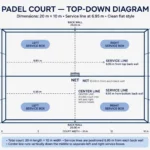
Every padel court in the world is the same box: 20 meters long, 10 meters wide, wrapped in glass and fence, split by a low net. But inside that simple rectangle hides a set of precise measurements — service lines, wall heights, mesh sizes, ceiling clearances — that decide how the game actually plays.
This guide gives you every official padel court dimension from the FIP rulebook (2026 edition), plus the ball and racket specs, explained in plain language with the “why” behind the numbers. It pairs with our padel-rules beginner guide and our padel-wall-rules deep dive.
A warning first: several ranking guides get these numbers wrong — one popular site places the service line “3 meters from the net” (it’s 6.95m), another reverses the net heights. Every figure below is from the official FIP rulebook.
The Big Number: 20m × 10m
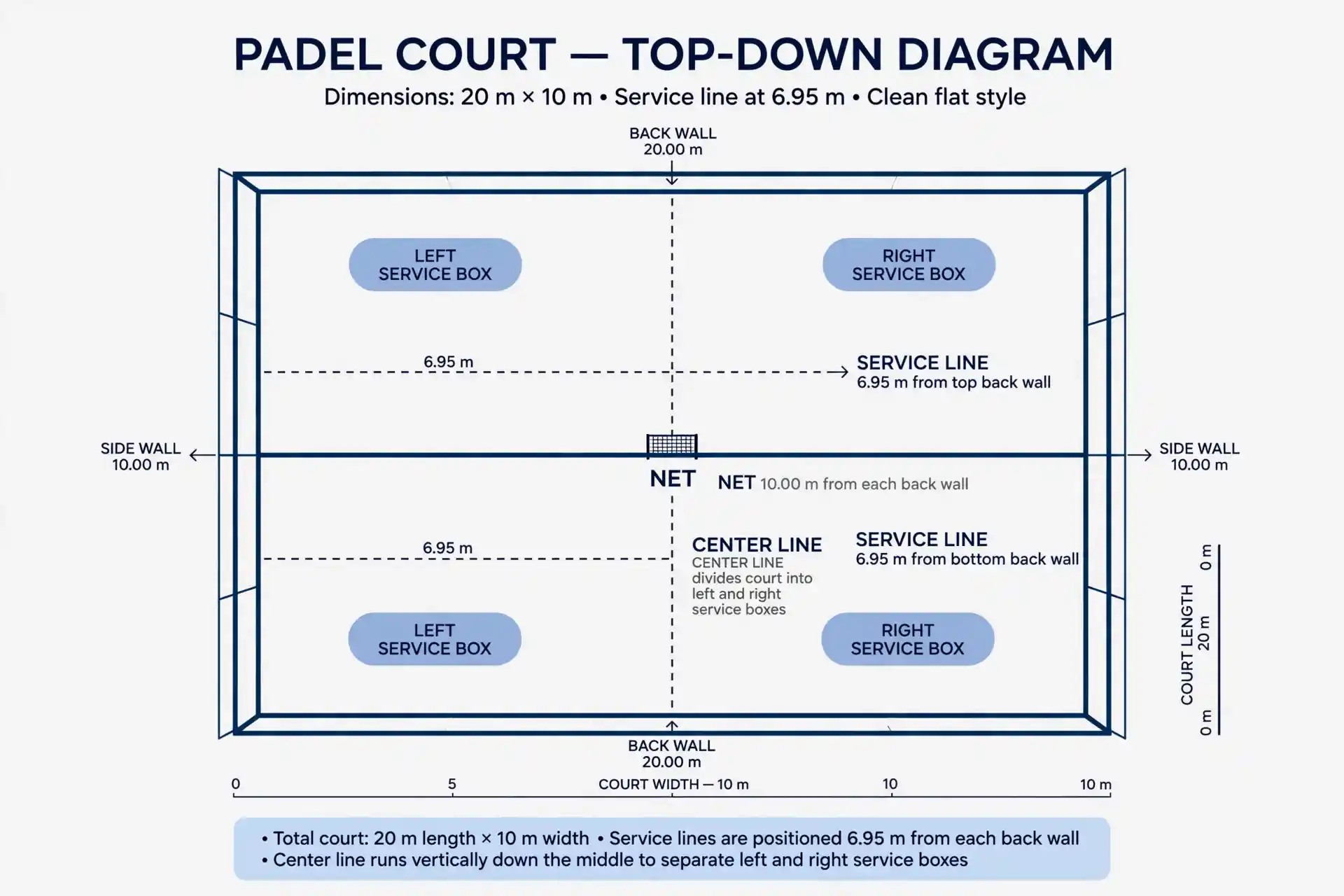
- The court is a rectangle 20 meters long by 10 meters wide, measured inside, with a 0.5% tolerance.
- The net divides it into two 10m × 10m halves.
- Total playing area: 200 m² — about a quarter the size of a tennis court, which is why padel rallies feel so fast and close.
The Net: 0.88m at Center, 0.92m at the Ends
- Net length: 10 meters (spans the full width).
- Height: 0.88m at the center, rising to 0.92m at the ends (posts max 1.05m).
- A white strip 5–6.3cm caps the net; the mesh must be tight enough that a ball can’t pass through.
- For comparison: a tennis net is 0.914m at center — padel’s is a touch lower, which suits the underhand game.
Service Lines and Boxes
- Service lines run parallel to the net, 6.95 meters from it on each side.
- The center service line divides the net-to-service-line area into two boxes and extends at least 20cm past the service line.
- Each service box is therefore 5 meters wide × 3.05 meters deep (10m court − 6.95m = 3.05m to the back wall).
- All lines are 5cm wide, preferably white or black for contrast.
Walls and Fence: 3m of Wall + 1m of Fence
End walls (behind each baseline): 4 meters total — 3 meters of wall (glass or solid, smooth and uniform for a true bounce) topped by 1 meter of metal mesh fence.
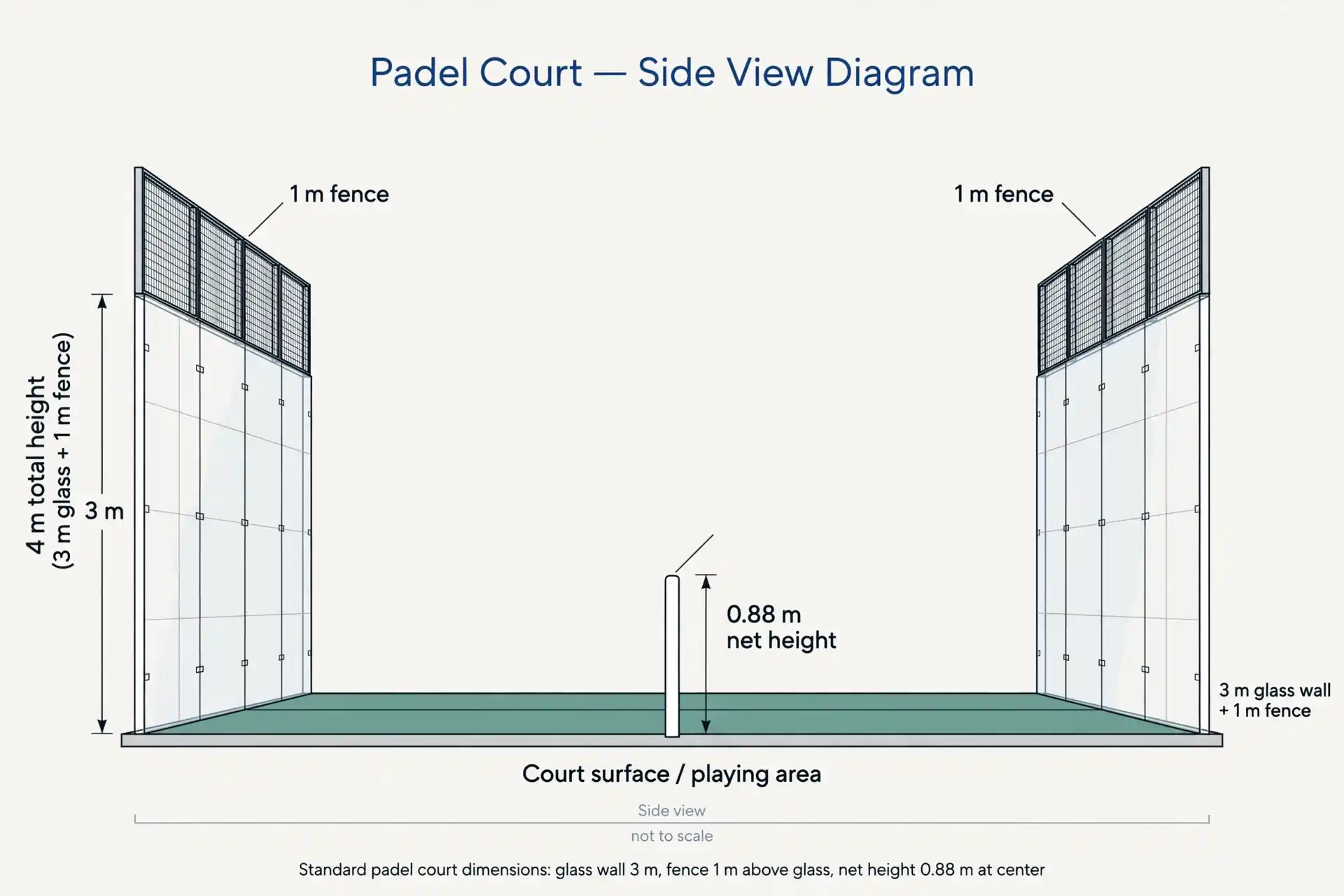
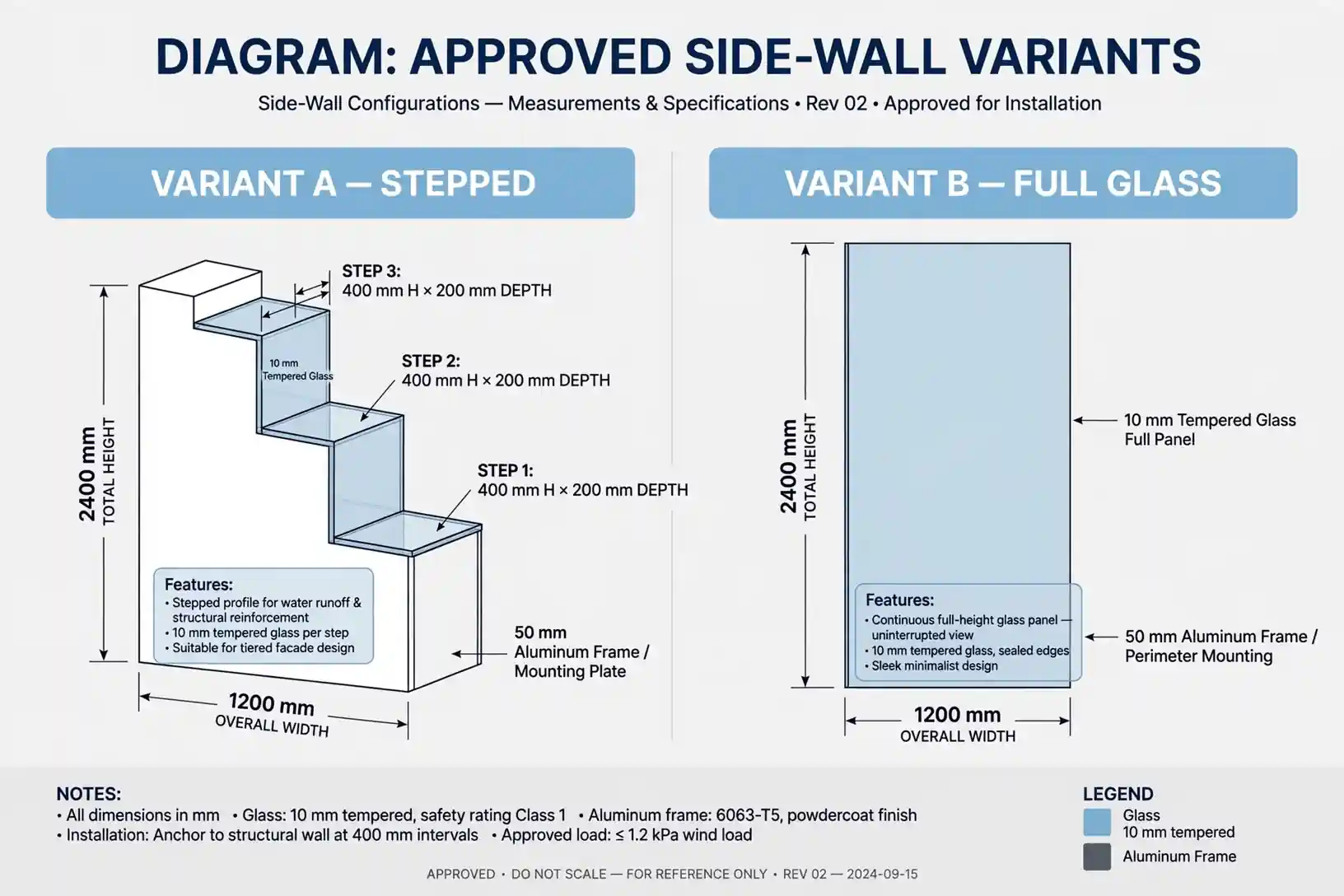
Side walls — two approved designs:
- Variant 1 (stepped): a 3m-high × 2m-long step, then a 2m-high × 2m-long step at each end, with mesh filling the middle up to 3m and the ends up to 4m.
- Variant 2 (full glass/panoramic): a 3m-high × 4m-long wall panel at each end with no step, mesh completing the enclosure to 4m.
The mesh itself: diamond or square weave, holes 5–7.08cm diagonally, wire 2–3mm thick — tight enough for a fair bounce, open enough to see through.
Ceilings, Light, and Surface
- Minimum ceiling height: 6 meters everywhere above the court, with nothing hanging into that space. For new builds, the FIP suggests 8 meters — high lobs are a core tactic and low roofs ruin them.
- Floodlights must sit at least 6m above the surface (8m suggested for new builds) and never intrude into play.
- Surface: cement, synthetic material, or artificial grass — anything giving a regular bounce. Permitted colors: green, blue, or terracotta, clearly different from the wall color. Must be level within 3mm over 3 meters.
- Orientation: outdoor courts should ideally run north–south so neither pair stares into the sun.
Gates and the Safety Zone
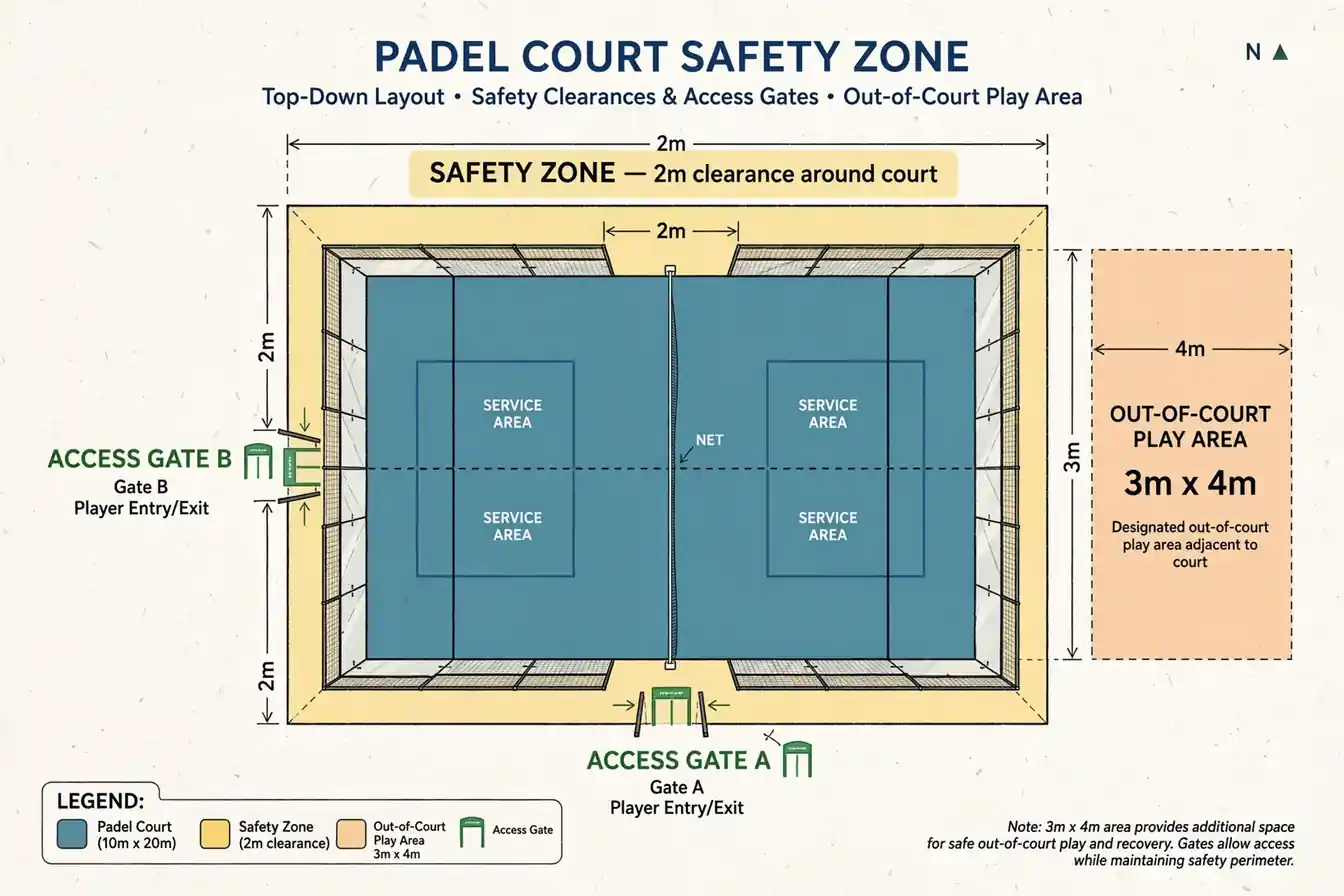
- Access gates sit on the sides, symmetric about the center. One opening per side: 1.05×2.0m to 2.20×2.20m; two per side: 0.72×2.00m to 1.10×2.20m.
- Out-of-court safety zone (for the spectacular chases through the gates): minimum 3 meters wide × 4 meters long × 3 meters high on each side (4m wide recommended), with two access points and zero obstacles. The 2026 rulebook raised the minimum from 2m to 3m.
- Gate frames and posts must be padded (2cm+ cushioning) where players might collide with them.
The Ball and Racket Specs
Ball (FIP-approved):
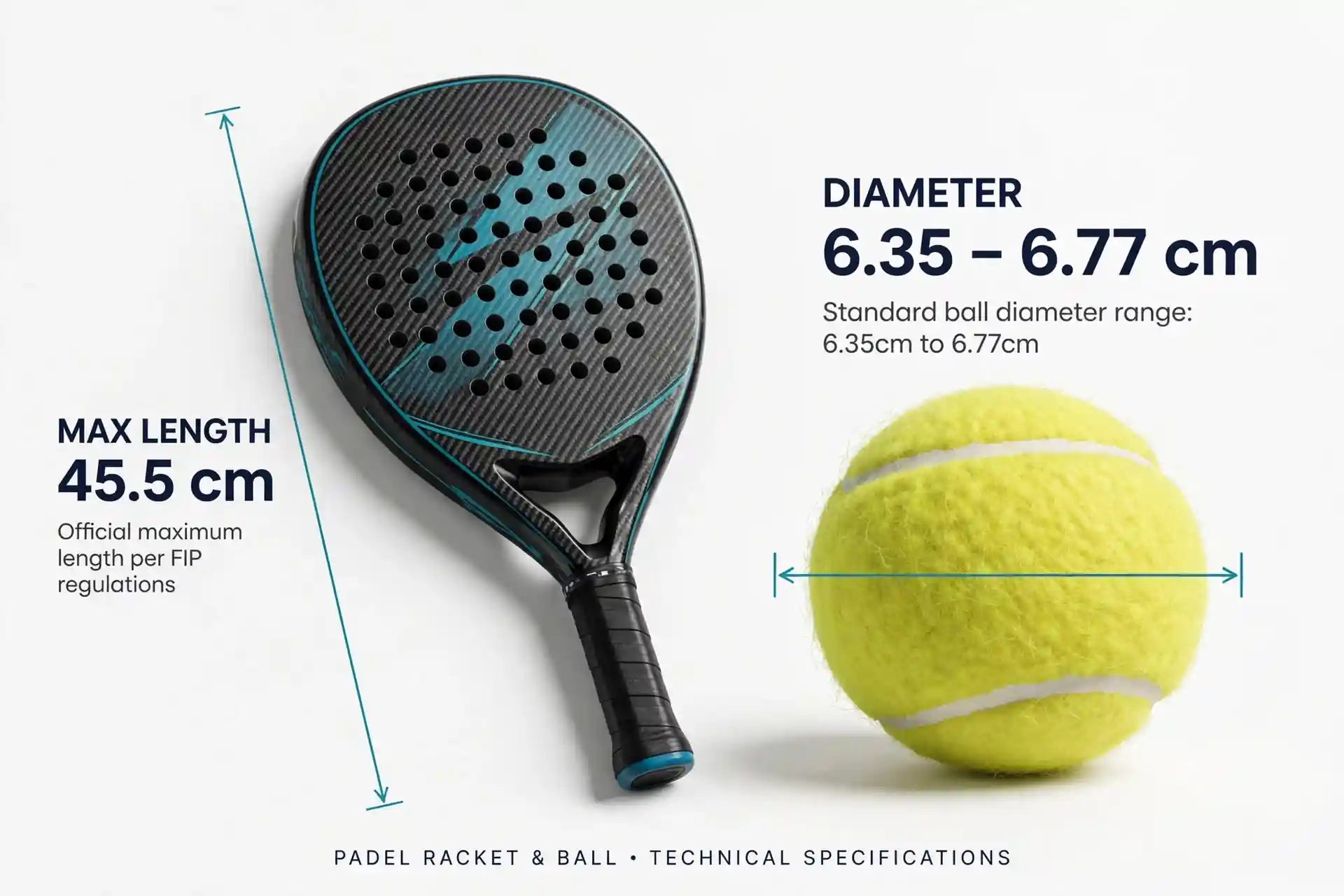
- Diameter 6.35–6.77cm, weight 56.0–59.4g
- Bounce 135–145cm when dropped from 2.54m onto a hard surface
- Pressure 4.6–5.2 kg per 2.54 cm² — slightly less lively than a tennis ball, which keeps rallies going
- Color: white, yellow, or any color with clear contrast against the surface (color restriction lifted in 2026)
Racket:
- Maximum 45.5cm long, 26cm wide, 38mm thick
- Solid, stringless face with holes 9–13mm in diameter
- Wrist cord mandatory, max 35cm — break it mid-point and you lose the point
How the Dimensions Shape the Way Padel Plays
Numbers on a page don’t tell you why the game feels the way it does. The dimensions are the gameplay:
- The 10-meter width is exactly wide enough for two players to cover side by side — which is why padel is a doubles sport and why the “elastic band” positioning works. Any wider and pairs couldn’t cover the middle; any narrower and serves would be unreturnable.
- The 6.95m service lines make the underhand serve fair: the box is deep enough (3.05m) that a gentle serve still has to travel, but shallow enough that the receiver can attack a weak one.
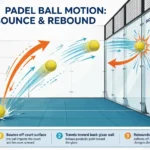
- The 3-meter walls are the perfect rebound height — low enough that defensive lobs off the glass stay readable, high enough that smashes can be aimed at them for winners.
- The 0.88m net sits in the attacking sweet spot: low enough for confident volleys, high enough that flat drives need real control.
- The 6-meter ceiling minimum exists because the lob is padel’s great tactical weapon — a lower roof would delete an entire dimension of strategy.
Change any one number and you’d change the sport. That’s why the FIP guards them so carefully.
Why These Dimensions?
The 20×10m box exists because of a garden. Enrique Corcuera’s 1969 Acapulco court had to fit a small plot — and the compact size turned out to be genius: four players cover it comfortably, rallies stay alive, and the walls are always within reach.
The 3-meter walls were the original garden walls, kept because they produce the ideal rebound height. The 0.88m net is low enough for attacking volleys but high enough to demand control. The 6.95m service lines create boxes deep enough for the underhand serve to be fair but shallow enough to attack. Every number traces back to one design goal: long rallies between four players in a small, fair arena.
What-If Scenarios
What if a court is slightly off — say 19.8m long? The 0.5% tolerance allows tiny deviations (10cm on length). Beyond that, it’s not regulation — fine for social play, not for sanctioned competition.
What if the ceiling is only 5 meters? Playable socially, but high lobs — a core padel tactic — become impossible. Don’t book it for serious games.
What if there’s no safety zone outside the gates? Then out-of-court play is not authorized: a ball bouncing in and flying out through the gates on the serve is a fault, and chasing balls outside isn’t legal.
What if the walls are brick instead of glass? Allowed — the FIP permits any material with a uniform, smooth, hard surface and true bounce. Glass is just the modern standard.
What if the court runs east–west outdoors? Legal but unpleasant — one pair will face the sun. The N–S orientation is a recommendation, not a rule.
What if the glass panels are tinted or have big adverts? Allowed within limits — the FIP permits one logo per wall, sized and colored so it doesn’t interfere with players’ vision. Anything that disrupts play must go.
What if it rains on an outdoor court? Play continues unless the surface becomes dangerous — then the umpire suspends the match, and the restart follows the suspension rules (no warm-up under 5 minutes, 1 minute for 5–20, 3 minutes beyond that).
Case Studies: Dimensions in the Real World
1. The arena standard — Padel Rush Arena, Riyadh 2026. The Riyadh Season P1 (February 2026) was staged in a purpose-built arena to full FIP specs — 20×10m courts, 8m+ clearances, full safety zones — hosting the world’s best pairs including the finals’ 65-minute men’s masterclass. When 35 million players need identical conditions worldwide, the dimension table is what makes it possible.
2. The construction boom. The FIP’s World Padel Report 2025 counted 77,300 courts worldwide, with 14,355 built in 2025 alone — every one of them following the dimension rules in this article. The 20×10m box is now one of the most replicated sports structures on earth.
3. The 2026 safety upgrade. The FIP raised the out-of-court safety zone minimum from 2m to 3m for 2026 because professional athleticism had outgrown the old space. Court dimensions aren’t frozen history — they evolve with the sport.
FAQ
1. How big is a padel court? 20 meters long × 10 meters wide (interior), 200 m² total — about a quarter of a tennis court.
2. How high is a padel net? 0.88m at the center, 0.92m at the ends.
3. How far is the service line from the net? 6.95 meters. (Beware guides that say 3 meters — that’s roughly the distance from the service line to the back wall.)
4. How tall are the walls? 3 meters of wall (glass or solid) plus 1 meter of metal fence = 4 meters total at the ends.
5. What’s the minimum ceiling height? 6 meters; 8 meters is recommended for new builds so lobs stay playable.
6. How big is a service box? 5m wide × 3.05m deep.
7. What are padel balls like? 6.35–6.77cm diameter, 56–59.4g — similar to tennis balls but slightly less pressurized for longer rallies.
8. What’s the maximum racket size? 45.5cm long, 26cm wide, 38mm thick, with a mandatory wrist cord.
9. Can courts have different wall materials? Yes — glass, brick, or any solid material is allowed as long as the surface is uniform, smooth, hard, and gives a true bounce. Glass is simply the modern standard.
10. How much space does a court need in total? The playing box is 20×10m, but allow at least 0.5m clearance on each side (11×21m minimum footprint) — plus the 3×4m safety zones if out-of-court play is offered.
Key Takeaways
- 20m × 10m interior, 200 m² — the universal box.
- Net 0.88m center / 0.92m ends; service lines 6.95m from the net; service boxes 5m × 3.05m.
- Ends: 3m wall + 1m fence; two approved side-wall designs.
- Ceiling 6m minimum (8m recommended); safety zone 3m × 4m × 3m per side.
- Ball 6.35–6.77cm; racket max 45.5cm; wrist cord mandatory.
- Every dimension serves the same goal: four players, long rallies, one fair arena.
Keep Reading
- Padel Rules for Beginners
- Playing Off the Glass Walls: Padel Wall Rules
- Padel Serve Rules: Underhand, Bounce First, Diagonal
Keep Reading